Have you ever had an erotic dream about your friend’s spouse? If you did, would you tell them?
This is the set up of “Marble,” a dark comedy by Irish playwright Marina Carr, having its Chicago premiere at the Copernicus Center in Jefferson Park and produced by the Gift Theatre.

The action starts when Ben (John Gawlik) hears from his friend Art (Paul D’Addario) that he has had an erotic dream about Ben’s wife. In the dream, Ben’s wife, Catherine (Brittany Burch), has golden spun hair and commits the deed in a room made of marble. When Ben tells Catherine about the dream, she reveals she had the same dream.
The overarching theme of the production: Marriage kind of sucks. We meet two upper middle class urban couples who are all clearly unhappy with the monotonous nature of their lives. But they have a cavalier acceptance of their mundane existence that brings an offbeat feel to the show while also making the stakes (marriage, infidelity, death) feel unusually low.
Even when characters contemplate suicide, or envision their own soon-coming natural deaths, it comes across as plainly as doing dishes or any other unenjoyable yet necessary household chore.
But this show still works, for two reasons. One is the acting, by a cast entirely composed of Gift ensemble members that breathe life into charters that would otherwise feel flat. The other is the direction of Kay Martinovich, who clearly understood what Carr wanted to get across with this script. Even though it was written about 20 years ago, the story feels fresh in Martinovich’s hands.
Ultimately, the play is about women — specifically, middle class housewives. It explores the roles women are expected to play domestically, and how their married lives become reduced to a perpetual cycle of caretaking and housekeeping. Inevitably, their individualism is so swallowed up that they disappear into a shell of sadness that no else seems to see.
Martinovich crystalizes these ideas with her staging. Characters who are not in scenes often remain on stage. They are ghosts wallowing in the shadows of the impending doom that will eventually come to the realization that they have all stopped living life many years ago. The fact that this production earns so many audible laughs is both a testament to Carr and stark social commentary on the roles of women and the ease in which audiences will recognize their plight.
At one point, Ben tells Catherine, “women who can’t ovulate should die offstage,” which earns a room resounding gasp followed by chuckles.
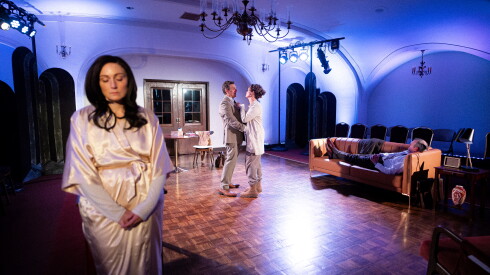
Burch is excellent as Catherine. Her monologues are poetic in language but sharp in wit and emotion. Her downward spiral is haunting. The repeated dreams of Art eventually push her over the edge, but over time, it’s revealed that she had always been teetering.
Cyd Blakewell is equally as impressive as Art’s wife, Anne, a housewife who lives on three glasses of wine per day. Once the dreams start, she recognizes something is off with Art but simply asks him to keep her oblivious. As an actor, Blackwell has a keen gift that emerges throughout her performances. She can convey more feelings with her facial expressions than most of us can with words.
The play asks existential questions about dreams and reality. The characters, particularly Catherine and Anne, are so flippant with their own morality – to them, death is always around the corner, and with a life so unfulfilling, why care? The rub here is that if they don’t care, how can the audience?
At times, this sort of fatalism makes it hard to invest in the stakes of the characters, whose marriages are ripped apart by these fantasies. The comedic nature of the script, paired with a casual approach to impending doom, makes it a little difficult to react to the inevitable final scenes, yet again, the fine acting makes it work.
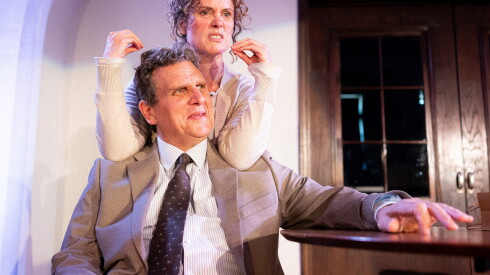
What the production does well is spur reflection. Catherine dreaming about Art, and not being able to have him, is all too relatable. For me, I watched her dreams about Art, and her discussions about the road-not-taken, and all the could-have-beens, and thought about my own “art.” In my case, it’s the unfinished screenplay on my laptop. Here, the characters’ dreams infiltrate their realities, and in the end, make some of them wonder whether their actual lives were even worth living.
In the end, the play itself is like a marriage that goes off the rails. The crash is tragic, but as a spectator, you can’t take your eyes off it.