One of Rodgers and Hammerstein’s most memorable creations was the 1945 Broadway musical “Carousel.” The tragic, violence-tinged love story between a Maine millworker named Julie and the flawed carousel barker Billy Bigelow ends on a redemptive, upbeat note.
Almost forgotten is that the beloved musical was based on “Liliom,” a once well-known 1909 play by Hungarian playwright Ferenc Molnár. And it is Molnár’s darker, more complex tale that forms the basis of an intense ballet of the same name by the now 87-year-old American choreographer John Neumeier.
The Joffrey Ballet opened its 2026-27 season Thursday evening with the Chicago premiere of this nearly two-and-a-half hour work, which debuted in 2011 at the Hamburg Ballet. Neumeier, a Milwaukee native, served as director and chief choreographer of the German company from 1973 to 2024.
This audacious, highly imaginative adaptation shifts the setting to an American amusement park called Playland, setting the action against the bleak, sociopolitical backdrop of the 1930s Great Depression. In one ensemble scene, desperate unemployed men scuffle over a few job postings, scrambling over homeless figures sprawled on the ground.
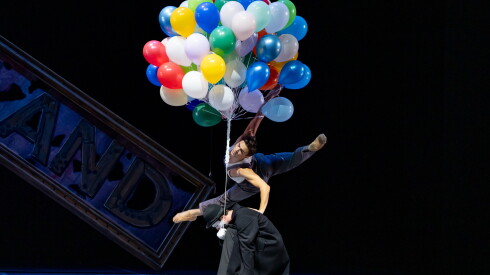
This version retains the name, Liliom, for the cocky, attention-grabbing carousel barker. Inescapably drawn to him is Julie, who in this version is a modest cafe waitress. Theirs is a troubled relationship with Liliom even hitting her in a fit of anger. Fired from his job and desperate for money, he commits a very public suicide after a botched robbery attempt and must face a kind of posthumous trial in what the ballet’s synopsis calls the “beyond.”
The ballet opens and closes 16 years after Liliom’s death with Playland closed and dilapidated. After serving time in purgatory, the barker is given a chance to redeem himself. He brings a star from heaven to his son, Louis, born after his death, but he fails in his mission to connect and lashes out at the teenager after being rejected.
Neumeier uses an overall dance vocabulary rooted solidly in ballet but draws here on Broadway show choreography and social dances, leaning into the theatrical expressionism inherent in Ferenc’s original play. This is especially true in his surreal depiction of a kind of trial in the afterlife with a gatekeeper (Dylan Gutierrez) and six red-suited devils, all moving in weirdly jerky, iterative ways.
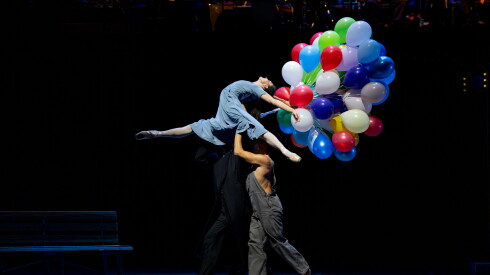
“Liliom” is also expressionist in the enthralling, often unsettling scenes that Neumeier interweaves into the main story. Carnival figures such as the Sad Clown (poignantly realized by Jackson Miles) constantly reappear, as do Chinese jugglers, with reminders of the larger world around the realm of Playland.
The ballet opens daringly in complete silence as the mysterious Balloon Man (Evan Boersma), holding a bunch of several dozen balloons in one hand, gradually makes his way across the stage with very long, outstretched strides as he sets about bringing Liliom momentarily back to earth.
The constant, unexpected juxtapositions in the ballet are echoed and extended in Michel Legrand’s wonderfully vibrant score that unexpectedly sets the Frank Sinatra panache of Rob Parton’s Jazztech Big Band against the Lyric Opera Orchestra, capably led Thursday evening by Nicholas Koo. (Read more here about the music and how it is performed.)
Before his death in 2019, Legrand has wrote more than 200 television and film scores, so it’s not surprising that the music here has a definite cinematic flair with tinges of Aaron Copland and Leonard Bernstein.
If there is a downside to “Liliom,” the story can sometimes be difficult to follow even with the synopsis, and some of the emotional depth gets lost at times amid the work’s sheer narrative and theatrical complexity.
That said, the performances are uniformly superlative. José Pablo Castro Cuevas vividly embodies first the swagger and braggadocio of Liliom and later his pain, anger and shame. He is ideally matched with the ever-reliable Joffrey star, Victoria Jaiani, who manages to convey both Julie’s modesty and her attraction to the barker.
Marie (Natali Taht), a friend of Julie, and Wolf (Jonathan Dole), a hapless bellman, are kind of side characters in this story. But their duet is a joy, with the couple’s fresh, wholesome love expressed in simple movements like jogging arm in arm.
Providing a sharp contrast is another more suggestive duet early on between Liliom and his past lover, Mrs. Muscat, who owns the carousel where he was employed. Amanda Assucena aptly captures her scheming ways as she tries to lure him back, the two posturing and preening, with him flipping her over his back and onto his lap.
Overall, every Joffrey dancer smartly executes the unusual technical demands of Neumeier’s ballet movement, while conveying the essence of their characters often through simple telling gestures.