While critical opinion might be mixed on Klaus Mäkelä, who will become the full-fledged artistic director of the Chicago Symphony Orchestra next fall, the Chicago audience has completely embraced the 30-year-old Finnish conductor with his fresh-faced flair.
That became very clear Thursday evening, when the CSO’s music director designate returned for his first-ever three-week run with the ensemble and received an ardent round of cheers before one note had even sounded.
After more than a decade of steadfast artistic leadership from Riccardo Muti, one of the incontrovertibly great conductors of his generation, the CSO took a radically new direction in 2024 and put its faith in a young talent it hopes will become the next great conductor.
Like the orchestras in San Francisco and New York, who have also recently appointed music directors, the CSO is resetting its direction and trying to appeal to new audiences.
Reinforcing this notion of a renewal was the CSO’s announcement earlier Thursday of a rebranding, complete with a streamlined new red logo and modified names like relabeling the ensemble’s building complex as Chicago Symphony Center.
But more important than names and looks is the music itself, and Mäkelä and the CSO stumbled a bit out of the gate Thursday during Jean Sibelius’ compact Symphony No. 7 in C major, Op. 105, with characteristic Nordic reserve and an episodic structure. While there were some striking individual moments in this performance, it just never cohered into a compelling whole.
But any deficiencies in that performance were quickly forgotten once the evening’s main attraction got underway — Shostakovich’s towering Symphony No. 4 in C minor, Op. 43, which ran about an hour and required an augmented orchestra including nine French horns and eight percussionists.
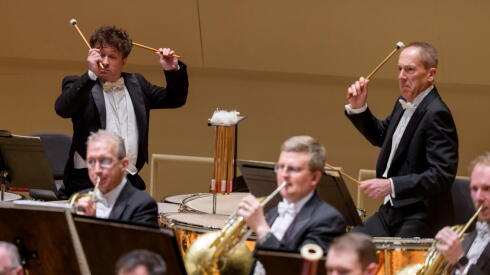
Unlike the in-your-face musical evocation of artillery discharges and goose-stepping soldiers in some of the composer’s symphonies, this symphony is suffused with palpable pain — both Shostakovich’s own and that of his country living under Stalin’s brutal, repressive regime.
He finished the score in May 1936 just a few months after he had been denounced in a Pravda article infamously titled “Muddle Instead of Music.” He wisely filed away the symphony, which could have gotten him banned or worse, and it was not premiered until a less tense time in 1961.
The mood can be angry, manic, discordant or mournful, sometimes in quick succession or almost all at once. There is a sense of organized chaos, with one musical phrase interrupting, cutting off or crashing into another. The woodwinds and brass exchanging musical slap shots. The clarinets voicing a quirky, unsettling ditty. The strings delivering strange, punctuating pizzicato bursts.
Unusual sounds abound, like the unexpected appearance of castanets and weird, ghostly passages from the usually celestial celeste near the haunting conclusion of the third movement, and others where it wasn’t clear how exactly they are being produced.
To pull off this symphony requires a performance that is raw, edgy and intense, and that is exactly what Mäkelä and the CSO delivered. He arguably could have leaned even more into those qualities, but this was an emotionally devastating (in the best sense of the word) take by any measure.
And back to that notion of “organized chaos,” the maestro negotiated the hairpin turns and sudden lurches with pinpoint command and never let the throughline become lost or the emotional intensity droop. Yet, at the same time, he brought forth the music’s innately unsettled, off-kilter and sometimes almost out-of-control feel.
This work allows absolutely every instrument in the orchestra to have moments in the spotlight, and these musicians made the most of them. Examples include principal trombonist Timothy Higgins’ fine playing in the third movement and a searching first-movement solo from the CSO’s always-wonderful English hornist Scott Hostetler.
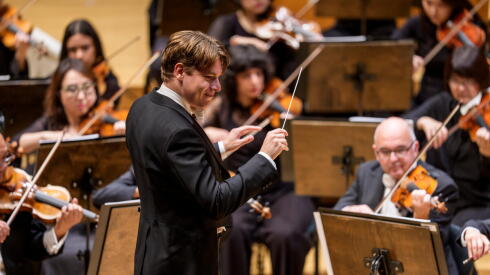
We’re starting to get a better understanding of the kinds of repertoire that appeals to Mäkelä, especially his enthusiasm for less frequently heard music by famous composers, like the choice of Symphony No. 4. It is hardly unknown but had not been played by the CSO for nearly two decades.
An even clearer example of this penchant will come Oct. 8-10 when Mäkelä and the ensemble present rare performances of William Walton’s 1931 oratorio, “Belshazzar’s Feast,” which nearly fell out of the repertory in the 1970s.
Mäkelä was clearly the musicians’ choice as their new music director, and it’s exciting to watch the rapport between them deepen, to see him mature and develop before our eyes and to find out how this musical marriage ultimately plays out.