Jack Johnson, who in 1908 became the first Black man to win boxing’s heavyweight championship, is buried at Graceland Cemetery in Uptown. In a place known for elaborate shrines to the city’s most famous, his grave went for six decades without any individual marker at all, only a single tombstone for his family’s plot reading, simply, “Johnson.” Following the 2005 release of Ken Burns’ documentary about him, “Unforgivable Blackness,” a small flat stone was placed to single him out and note his historic achievement.
The modesty of his burial site doesn’t reflect the man’s personality. Johnson was full of swagger and fond of fast cars and furs. His biggest victories against white champions, when finally allowed, were followed by violent riots. There’s something about the bareness of the sport of boxing that made its champion an emblem of raw physical superiority, and therefore made the ring an arena in which racial identity felt raw and significant.
The tension between the ambition of excellence and fear of the consequences surrounding African-American accomplishment becomes the core theme of Marco Ramirez’s play “The Royale,” inspired by Johnson’s ascent to the boxing crown and receiving an elegant, beautifully acted revival at Writers Theatre under the direction of Definition Theatre’s founder Tyrone Phillips.
“The Royale” was first produced in 2013, revised for its Chicago debut in 2015, and went on to well-received productions off-Broadway and on regional stages for years.
The play’s popularity stems from its core theatrical conceit, which works exceptionally well here. The fights are represented without physical contact, with stomping and clapping to represent the blows (the movement direction is from Rasell Holt). The rhythmic percussion — without the help of any instruments — extends to other scenes as well, providing a stylized sensibility that fits with its highly condensed, focused storytelling.
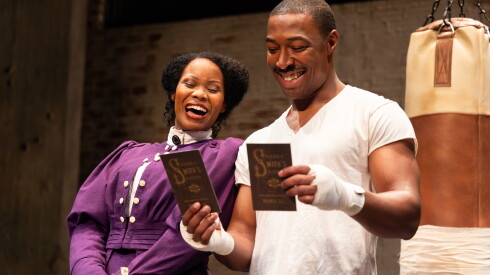
This is a bio-play that homes in on its theme without concern for everything it leaves out or fictionalizes for efficiency. Everything here is minimal, as boxing matches tend to be. Lauren M. Nichols’ set is little more than wood planks, a brick background and a punching bag or microphone. The boxing scenes barely require any clothing, although costume designer Gregory Graham provides period-specific garb elsewhere that tells quite a bit about differences in characters’ class status, or at least their aspirations to it.
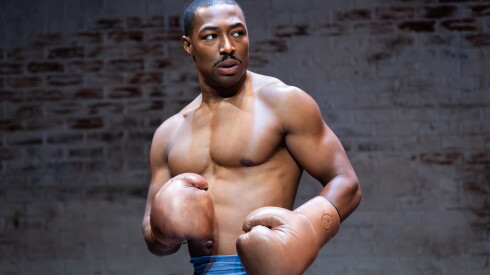
During the matches, Jason Lynch’s lighting plays a significant role, emphasizing how alone a boxer is, no matter how much the endeavor may represent something bigger.
The five-person cast here is excellent. La’Tevin Alexander plays Johnson’s stand-in, here named Jay Jackson, not just with plenty of physical power but with a strong sense of destiny. He’s particularly able to make us curious why his character refuses to talk about his past, and then to dig deeper when he is finally forced to, upon the arrival of his sister Nina. Nina is the cautious one, and in AnJi White’s performance at first hesitant and then eager to voice everything bad that could happen if Jay were to win the “Fight of the Century,” and certainly not just to Jay himself.
The supporting characters here tend to be functional but each actor has their moments. James Vincent Meredith delivers a soulful, easygoing-yet-wise take on Jay’s coach; Ajax Dontavius brings an important likability to the younger rival-turned-sparring partner Fish; and Scott Aiello plays the white promoter Max without resorting to stereotype, even when he tries to explain dynamics that Jay is always fully aware of.
Could the production be even more atmospheric, more musical, more choreographic? Probably. But I think Phillips here is looking to emphasize the contemplative nature of Ramirez’s play, which continues to reflect so much on society.
Completed not long after President Obama’s re-election in 2012, it’s hard not to see the play as at least partly inspired by the success and response to the election of the country’s first Black president.
We’ve even seen the very consequences play out in the years following “The Royale” when it started making its theatrical rounds. Obama’s election led to the ascent of a man — ironically enough once a boxing promoter — so very willing to fuel white resentment.
“The Royale” reduces plenty of complexity into a svelte 85 minutes, and the play and production land with heavyweight force when delivering a climactic coup de théâtre that manifests the psychic fight behind the physical one.