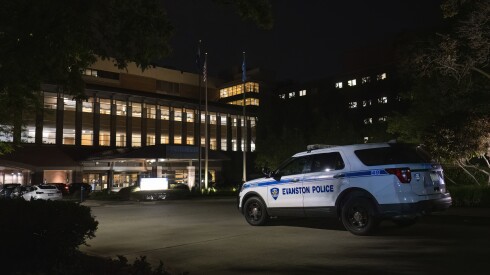
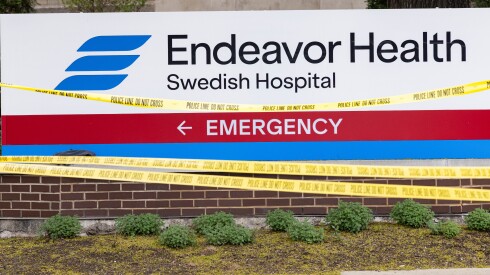
The emergence of a gun at Endeavor Health Swedish Hospital on Saturday in a shooting that killed a Chicago police officer and left another gravely wounded exposes the potential security fail points when a detainee arrives for treatment.
The shooting was the second at an Endeavor Health hospital in the Chicago area in less than a year. Last summer, a man who had been taken to Evanston Hospital for a psychiatric evaluation reached for a gun in his backpack after he became agitated, striking a security guard trying to restrain him, according to prosecutors. Criminal charges against the man are still pending.
In last week’s incident, prosecutors accuse Alphanso Talley, 26, of using the same 10mm handgun from a dollar store robbery that morning to kill Chicago police officer John Bartholomew, 38, and wound his partner in a shattering scene in what was supposed to be a safe and protected environment at Swedish Hospital.
Talley was arrested after the alleged robbery and claimed he had swallowed drugs, prompting the hospital trip, prosecutors have said. Between the arrest and the shooting inside a CT scan room a few hours later, the gun surfaced. Prosecutors say Talley allegedly “reached under a blanket and pulled out a 10mm semi-automatic handgun,” causing the fatal security break in a chain that is meant to protect law enforcement, hospital staff and patients.
Chicago Police Department policy lays out at least two searches in this scenario: after Talley’s initial arrest and before Talley was transported to the hospital. Officers — not the ones who were shot — searched Talley after his arrest and found stolen cash in his pockets but no gun, according to prosecutors, who claimed Talley “had been concealing [the gun] from the moment he was arrested.”
It remains unclear if anyone, either Chicago officers or hospital security, patted down Talley again once he was at the hospital.
CPD policy allows officers to conduct a strip search, meaning an arrestee removes some or all of their clothing, in cases involving a firearm or drugs and when there is “reasonable belief” they are concealing a firearm or drugs. It’s unclear what type of search officers conducted after Talley’s initial arrest. A Chicago police spokesperson declined an interview request, saying the “entire incident” is under investigation.
Endeavor Health, which owns Swedish Hospital, previously said that Talley “was wanded upon arrival” as part of the hospital’s safety protocols.
Endeavor Health and Swedish Hospital declined an interview request to talk about the shooting. In a statement, the hospital did not address how a gun got into its facility, but said it shared in the grief and concern for everyone impacted, particularly for the loss of Chicago police officer John Bartholomew.
“We are conducting a comprehensive review of what we can do both internally and in partnership with law enforcement to advance our ongoing commitment to keeping our patients and team members safe, which is always our top priority,” read the statement shared with the Sun-Times.
Security experts say a wand used correctly should have picked up the gun, even if it was concealed on the body.
“I think the question is, ‘was the [wand] device used properly? Was it turned on?’ This all goes back to training and all that. There’s a protocol for how to search people,” said Bill Marcisz, a former hospital security executive and current president and chief consultant for Strategic Security Management Consulting.
The Illinois Department of Public Health said this week it was reviewing the shooting as the state’s hospital licensing agency.
The Illinois Health and Hospital Association did not comment on last week’s shooting, but said an increase in violence highlighted by staff reports has led hospitals to hire additional security, train staff on de-escalation techniques and work on internal safety policies, said Paris Ervin, the association’s spokesperson.
The alleged shooter at Evanston Hospital last June arrived at the hospital via ambulance after the Evanston police crisis team had been dispatched to respond to a call about a man in distress. The police crisis team does not have authority to search any individuals, according to the communications manager for the City of Evanston. It was unclear if the man, Christian Haywood, was patted down or screened for weapons before or when he arrived at the hospital without police escort.
‘It would be preferable … that someone has eyes on them at all times’
There are several areas of high security risk involving a patient who is detained by law enforcement, experts say. Officers should always notify the hospital before arriving, and both the officers and hospital staff should understand each agency’s policies, Marcisz said.
Jennifer Taylor, a professor at Drexel University who researches first responder health and safety, said the handoff of a patient — from law enforcement or medical staff — is the area most ripe for policy intervention because that is when errors can occur. There has been a reluctance to enact policies that allow first responders to restrain individuals because it could be done improperly or end up hurting someone, Taylor said. But when dealing with someone suspected of being violent, it’s important to have the person undergo a full pat down.
“We need to have policies where the individual who’s responsible for escorting the patient can say, ‘Look, I want to take a moment and timeout, and before we take this person and hand them off to people in the emergency department,’” Taylor said, “let’s give them a full pat down, or when they are undressing.”
Moving the detainee throughout the hospital is another high risk, Marcisz said.
At Swedish, Talley’s left arm was cuffed to a bed and his legs were restrained. He was given privacy to undress and provided a gown and blanket, prosecutors said. Surveillance footage showed him fidgeting under the blanket as they moved him from one room to another.
Ashley Ditta, president-elect of the International Association for Healthcare Security and Safety, which maintains security guidelines and recommends hospitals adopt their own security policies, said the goal is for detainees to change into a gown for security purposes.
She said it is typical to provide an arrestee a blanket, but “we always want to see hands. That’s a big piece.”
“It would be preferable that no patient who is on a watch of any sort — whether it’s homicidal, suicidal or if they’re in [police] custody — that they’re ever changing alone, that someone has eyes on them at all times,” Ditta said.
“Most hospitals have their individual policies, but we would really prefer handcuffs are never taken off, except in like laboring patients, because they are in custody,” Ditta added.
When Bartholomew removed the restraints from Talley’s arm and legs, Talley reached under the blanket, pulled out a handgun and fired, prosecutors said.
The overlap of law enforcement and healthcare workers can be challenging, security experts say, because the professions have different goals when interacting with individuals, especially when deciding to unrestrain a detainee.
Removing Talley’s handcuffs for a CT scan is appropriate since metal is not allowed, but Marcisz said it was up to law enforcement to decide if another type of restraint was appropriate.
“He should have been supervised and monitored by the law enforcement agency. That’s their prisoner, not the hospital’s,” Marcisz said.

CPD policy directs officers to “provide secure detention of prisoners awaiting … transfer to some other jurisdiction or entity,” including hospitals.
Dr. Samantha Chao, clinical assistant professor in the Department of Emergency Medicine at the University of Michigan, co-authored an article in the Journal of the American College of Emergency Physicians that detailed best practices for evaluating patients in police custody in emergency rooms. This includes draping techniques for sensitive examinations.
Emergency departments have been grappling with an increase in violence, though not typically from people in custody, Chao said. More often it comes from patients with impaired decision-making, due to substance abuse, psychiatric reasons or because they are confused. That has led to a greater use of metal detectors and wands to screen anyone coming into emergency rooms, though Chao is unsure of how effective those efforts have been.
Medical staff typically relies on police officers to ensure security when patients arrive who are in custody, said Chao, who had not reviewed details about the Swedish Hospital shooting.
“Typically, we defer to the police as being … the experts at security at that point, and to have removed any potential threats,” Chao said. “And so if there was a weapon on this person that is in police custody that was missed, in my mind that seems like it was an issue on the police and law enforcement side of things.”
Rosemary Sobol contributed reporting