The following excerpt from “The Burger Bible: The Complete Lowdown on the Humble Hamburger (Welbeck),” by Maggie Hennessy, explores how the handheld marvel was actually a millennia in the making, despite more contemporary claims. The book publishes April 2 and includes profiles of 80 iconic burgers from around the globe. This excerpt is provided with permission from the author and publisher.
Though the humble hamburger has been widely popular in the United States for only the last century and a quarter, one could argue — without the tracest hint of theatrics — that it represents the delicious culmination of millennia of culinary history, amassed in fits and starts from across the globe.
The burger’s origins stretch back as far as the earliest days of cattle domestication in Stone Age Mesopotamia and the ancient Chinese creation of jiaozi, or dumplings made with minced (ground) meat. By the 13th century, minced meat more overtly entered the gastronomic canon when the Mongols and Tatars were fighting in Mongolia.

According to George Motz, American burger historian and owner of the New York restaurant Hamburger America, the Tatars were particularly fond of raw mutton, and used to ride with it beneath their saddles all day. After they set up camp, they chopped up the raw, warm meat, added a handful of spices, and ate it just like that.
Minced mutton eventually made its way to ship workers and ports lining the Baltic Sea, which cleared a pathway for its westward push to parts of Europe, including Scandinavia. Eventually, it made its way to Germany and the port of Hamburg, when the dish also shifted from raw mutton to chopped cooked beef, known as frikadellen. It made for a cheap, tasty meal for German migrants awaiting their ships, and when they left for the United States in the mid-19th century, they brought that knowledge with them. Of course, frikadellen meant nothing to non-Germans living in the US at the time, supposedly prompting the name to be changed to “steak in the style of Hamburg” or, more plainly, “Hamburg steak.”
As German migrants moved westward to farm, state fairs also started popping up to educate folks about agriculture. German farmers set up stands peddling their Hamburg steak, which was considered quite exotic at the time. And it wouldn’t be long before someone got the bright idea to synthesize charred minced (ground) beef and bread. But who?
WHO INVENTED THE HAMBURGER SANDWICH?
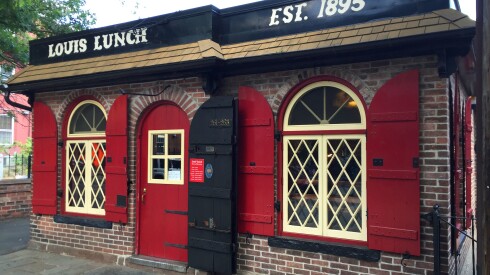
Like all good (and tall) tales, the hamburger sandwich has numerous origin stories and just as many folks who’d confidently poke holes in each of those claims. Even the 2016 recognition of Louis’ Lunch in New Haven, Connecticut, as the official “Birthplace of the Hamburger Sandwich” by the Library of Congress hasn’t quieted this long-raging debate despite proffering more written evidence than many claims based in oral history. All we know for sure is that the beefy handheld we know and love was born somewhere in America during the late 19th century.
The Connecticut-born story posits that a harried customer came into Louis’ Lunch one day, explaining that he was in a rush and asking for a meal to eat on the run. Owner Louis Lassen made a patty out of minced (ground) steak trimmings, grilled (broiled) it and then sandwiched it between two slices of white toast. If you need more proof, this fourth-generation, family-owned restaurant is not only still in operation, but still churning out its classic burgers on toast, which are cooked vertically in its three upright cast-iron grill (broiler) stoves dating back to 1898.
Of course, the state of Wisconsin begs to differ, claiming that back in 1885, Charlie Nagreen, who earned the moniker “Hamburger Charlie,” got the bright idea to squash the butter-sizzled meatballs he was selling at the Seymour Fair between two bread slices, for more portable snacking.
Meanwhile, in Athens, Texas, “Fletcher Davis,” known as Uncle Dave, supposedly invented the hamburger in the late 1880s, when he started peddling minced beef patties at his small café on the Henderson County courthouse square. Legend further has it that Uncle Dave took his sandwich to the 1904 World’s Fair, in St. Louis, where it was derisively nicknamed the “hamburger” by St. Louis citizens who viewed the practice of devouring (often raw) minced beef as barbaric — thus poking a hole in the aforementioned story of how the name “hamburger” came to be.
Texas is so sure of this version, by the way, that in 2007 the state legislature adopted a resolution naming Davis the hamburger sandwich’s inventor.
Wait a minute, though. Other reports tell us that around 1891 in Bowden, Oklahoma, Oscar Weber Bilby began grilling minced Angus meat on yeast buns — a claim that earned the Oklahoma governor’s support in 1995. Indiana has a pair of candidates, too, in Frank and Charles Menches, who replaced minced pork with minced beef patties in the sandwiches they were selling at the 1885 Erie County Fair.
Are you starting to see the problem?
Indeed, there’s no definitive way to prove who actually invented the burger as we now know it, as sure as its many claimants may seem. Luckily for us, threads still connect us to the burger’s rich American heritage in the form of restaurants that have stood the test of time, including Dyer’s Burgers in Memphis, Tennessee, which opened in 1912; Cozy Inn in Salina, Kansas, which debuted in 1922; Taylor’s Maid-Rite in Marshalltown, Iowa, which arrived in 1926; Miner-Dunn in Highland, Indiana, which opened in 1932; and White Manna, born in Hackensack, New Jersey.
Most of these timeworn storefronts are best reached by car, meaning you can experience their delicious, historical contributions the way generations before you have: by embarking on the Great American Road Trip, which itself came of age alongside the evolution of America’s favorite fast food meal. Plus, you should never get into a lively argument about burger origins on an empty stomach.
Excerpted with permission from “The Burger Bible: The Complete Lowdown on the Humble Hamburger (Welbeck),” by Maggie Hennessy.