The story behind former President Barack Obama’s missing tan suit starts with Maxmilian Grünfeld, who was 15 when he arrived at the Auschwitz Nazi death camp by cattle car with his mother, father, two sisters, brother and grandparents in the spring of 1944.
He was the only member of his family to survive the Holocaust.
He later came to the United States, changed his name to Martin Greenfield and became a famous tailor in Brooklyn, New York.
He made Obama’s tan suit.
Greenfield’s first sewing lesson was in the concentration camp.
I’ve been on the hunt for Obama’s tan suit. When he wore it to a press conference on Aug. 28, 2014, instead of his usual dark suits, right-wing critics deemed it unpresidential. The overblown response to the suit worn by the nation’s first Black president sparked a political and cultural flashpoint. It is not at the museum in the Obama Presidential Center in Jackson Park, which opened June 19. Reporters were told Obama gave the suit away years ago, after cleaning out his closet.
I want to tell you about the remarkable life of the man who made it.
Much of the story I am telling you comes from Greenfield’s memoir, “Measure of a Man, From Auschwitz Survivor to Presidents’ Tailor,” and from Jay and Tod Greenfield, his sons who now run the business.
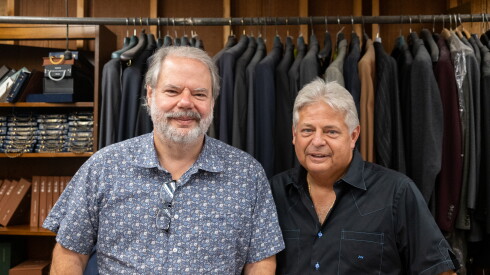
On Aug. 9, 1928, Greenfield was born in Pavlovo, a village in what was then Czechoslovakia, near the Hungarian border. It was the home to some 50 Jewish families. The town is now in western Ukraine.
Upon arrival at Auschwitz, Greenfield’s family faced Josef Mengele, the Nazi physician known for his horrific medical experiments. Mengele selected which prisoners would become slave labor and which would be sent directly to the gas chambers.
Greenfield and his father and a sister went into the slave labor line; the other family members went to their deaths. With men and women separated, Greenfield never saw his sister again. He last saw his father Joseph on their second day at Auschwitz.
Greenfield’s first job at Auschwitz was in the laundry, washing Nazi uniforms. He scrubbed the collar of an SS soldier’s shirt so hard it ripped. Greenfield wrote that the angry soldier “beat me until I bled.” The soldier threw away the torn shirt, but Greenfield kept it.
Another prisoner in the laundry knew how to sew. “He gave me a needle and thread and taught me how to sew a simple stitch,” Greenfield wrote.
He wore the Nazi’s mended shirt under his prison uniform. He believed he was treated better by the Nazis and other Jewish prisoners because the shirt seemed to convey a special status. He tore the shirt of another Nazi so he could have two.
“Of course, receiving your first tailoring lesson inside a Nazi concentration camp was hardly the ideal apprenticeship. I would have much preferred to hone my craft on [London’s] Savile Row or in the mills of Milan,” Greenfield wrote. “Looking back, though, that moment in the camps marked the beginning of the rest of my life. Strangely enough, two ripped Nazi shirts helped this Jew build America’s most famous and successful custom-suit company.”
The Nazis moved Greenfield and other prisoners from Auschwitz on Jan. 27, 1945. He endured a winter death march and train transport to arrive at the Buchenwald concentration camp on Feb. 5, 1945.
On April 11, 1945, American tanks arrived and Buchenwald became the first camp U.S. troops liberated.
The next day, Gen. Dwight D. Eisenhower, the Supreme Allied Commander in Europe during World War II, toured the “human ruins” there. Greenfield wrote that Eisenhower was “ten feet tall in my mind.”
A few years later, Greenfield would find himself making suits for President Eisenhower.
But I’m getting ahead of the story.
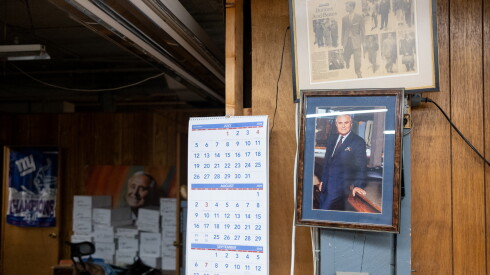
The war was over. Greenfield learned his father also ended up in Buchenwald, but the Germans shot him about a week before the liberation.
Greenfield was living in a displaced persons camp in Germany when his mothers’ siblings in Baltimore and The Bronx, New York, tracked him down. On Sept. 11, 1947, the 19-year-old boarded the SS Ernie Pyle in Bremerhaven, Germany, and arrived in New York Harbor on Sept. 18, 1947.
Greenfield, Obama and the Chicago tan suit connection
At first, Greenfield lived in Baltimore, where he worked in an upholstery factory. He was reluctant to talk about the Shoah — the Hebrew word for the Holocaust — because he didn’t think a person raised in America would believe him. Eventually, he moved to New York and got a job as a “floor boy” at GGG Clothiers. He added English to the Czech, Hungarian, German and Yiddish he already knew.
Greenfield learned all the jobs related to the hand-tailored menswear business. He got to know some of GGG’s celebrity clients on the East Coast and Hollywood. He eventually became a GGG executive and oversaw the production of suits for Eisenhower, continuing to make suits for him into his presidency.
Thirty years after arriving in America, Greenfield bought the GGG factory in 1977 and renamed it Martin Greenfield Clothiers. It’s still in the same spot. The business has endured as other manufacturers in New York failed, Jay Greenfield told me. It is a union shop.
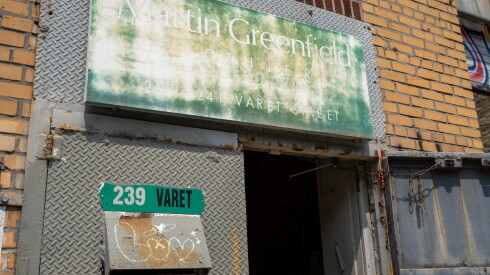
Through designer Donna Karan, Greenfield connected with then-President Bill Clinton. His first assignment was to make a set of white tie and tails for Clinton’s appearance at a Gridiron Club dinner with the Washington journalists in the club performing musical skits. Greenfield eventually made more than 20 suits for the 42nd president.
He recalled in his book that his relationship with Obama started in October 2010 “with an email Jay received from the legendary Chicago fashion retailer Ikram Goldman, owner of the Ikram boutique,” now at 15 E. Huron St.
“A style advisor to first lady Michelle Obama, Ikram had been asked to recommend an American tailor who could make fine suits for President Obama. She graciously recommended us,” Greenfield wrote.
Before Obama evolved toward custom menswear, some of his suits were from a storied Illinois company, Hart Schaffner Marx, founded in 1887 in Chicago.
At first, the Obama White House wanted to send suits for Greenfield to copy. Greenfield, through his son Jay, sent word that he did not copy suits made by others.
Obama was measured for his first Greenfield suit on Nov. 2, 2010, at the White House.
Greenfield wrote Obama is “built like a fitting mannequin,” a 40 long with a 33 ½ waist: “Virtually every suit he’s worn since February 2011 has been one of ours.” When the Greenfields started working for Obama, they had an ethics briefing from the White House. Jay said they were told “no special pricing because he’s the president.” They were instructed to charge “the full retail price,” which then was about $2,000.
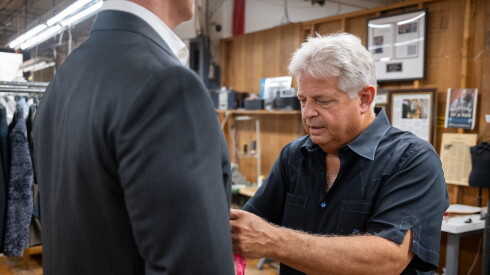
Ahead of the 2012 reelection campaign, Jay said in an interview that Obama told him he needed “summer campaign suits.” Obama pulled a suit out of his closet, a tan suit. He liked the color. It was, Jay recalled, “not quite beige, not quite khaki.” The Greenfields tried to match the color.
They made a few other suits “that were a bit lighter.” In all, Jay — who went to the White House eight times for fittings — estimates Obama ordered more than 15 suits over the eight years of his presidency, but only one tan.
Tod Greenfield checked the records and found the tan suit was in the works in March 2012. Obama wore it on June 16, 2012, when he attended the wedding of Valerie Jarrett’s daughter Laura. Jarrett, a longtime friend of Barack and Michelle Obama who served as a top adviser during his two terms as president, is now CEO of the Obama Foundation. She is also the person who told reporters in June that Obama gave away the suit cleaning out his closet. “We thought about a replica, but that would not be authentic,” she said.
Obama wore the tan again to Easter services on April 20, 2014, and a few months later at that press conference.
In 2012, the tan suit was made with pleated pants.
By February 2014, on Jay’s sixth White House visit, Greenfield recalls in his book, “[T]hey encountered a new influence on presidential fashion — the first daughters Malia and Sasha. ‘My girls tease me about my suit pants. … They say my pleats make me look old and uncool.’”
And so, in 2014, Greenfield made flat front pants for the suit so Obama could have two styles to choose from. Jay told me they were able to match the jacket because the mill was still making that fabric. It’s not known which pants Obama wore to the relevant 2014 press conference.
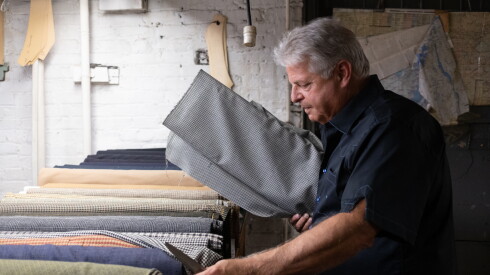
Through the years, Martin Greenfield Clothiers made suits for a who’s who of clients: President Gerald Ford, then-Vice President Joe Biden, former Secretary of State Colin Powell and a slew of stars in movies and TV shows. Greenfield’s shop provided clothes for the “Boardwalk Empire” cast for all five years of the HBO series. The client list also includes Rat Pack singers Frank Sinatra, Dean Martin and Sammy Davis Jr., comedians Jerry Lewis and Eddie Cantor, news anchor Walter Cronkite, basketball star LeBron James and film luminaries from Steve Buscemi and Jonah Hill to Denzel Washington, Leonardo DiCaprio, Paul Newman and Al Pacino.
If you think you picked up that tan suit in a secondhand store, it will be easy to verify it’s the real thing.
Greenfield, who died March 20, 2024, at the age of 95, added a special touch: There is distinctive red, white and blue hand-stitching in the lining.
Contact us: Please join us on this journey by sending tips, story ideas or suggestions on who to interview. Email: tansuit@suntimes.com.