Acknowledging the city’s persistent flooding problem, Mayor Brandon Johnson, flanked by other elected officials Tuesday, touted a West Side pilot project aimed at temporarily capturing rain underground before it can overwhelm Chicago’s outdated sewers.
The city is splitting the $12 million cost to build the underground storage along two streets in Austin with the Metropolitan Water Reclamation District, the government body that controls stormwater flooding and treats sewage.
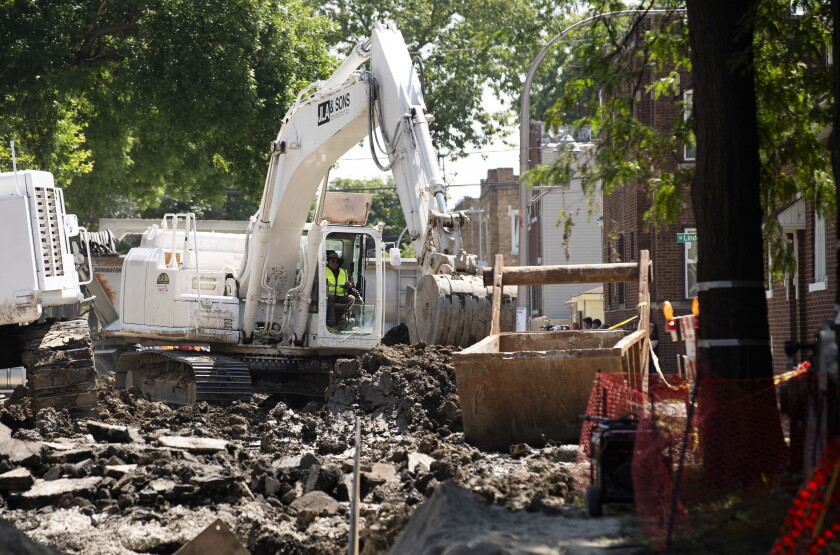
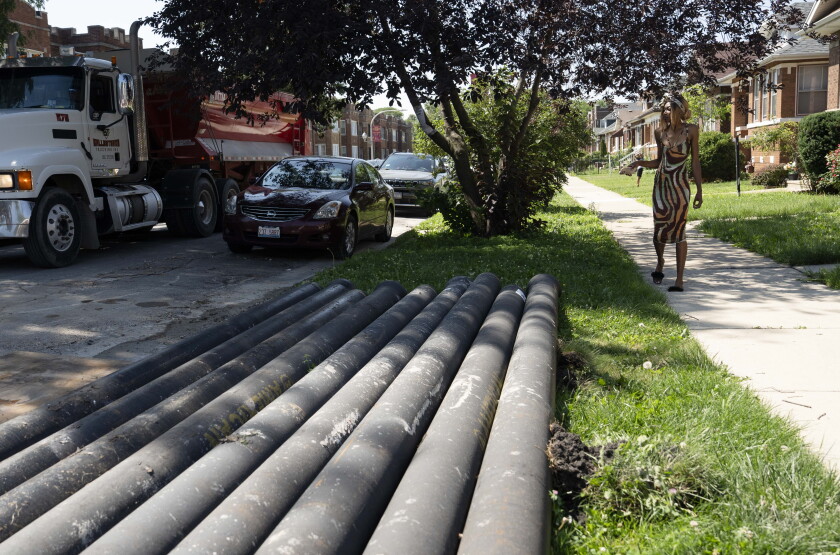
The pilot sites are on a stretch of West Le Moyne Street west of North Laramie Avenue, where the news conference took place, and a recently completed area of West Maypole Street immediately west of North Cicero Avenue. The Le Moyne project is expected to be completed by fall.
The West Side, where Johnson owns a home, experienced historic floods in 2023 due to a combination of storms intensified by climate change and aging sewer infrastructure that should have been replaced.
Designed many decades ago, Chicago’s sewers can handle 2 inches of rain in a 24-hour period before flooding becomes likely. The storms of 2023 dumped 8 to 9 inches of rain over short periods of time. About a month’s worth of rain was dumped across Chicago during the recent July Fourth weekend.
“We can only expect more storms to come as the effects of climate change hit Chicago’s communities,” Johnson said at a news conference in Austin. “And, of course, they hit the South and West side communities especially harder. It is well past time to update and modernize our infrastructure and build a city that works for everyone.”
Some West Side residents are still hoping for the city to provide financial assistance to fix damaged homes — in part from more than $520 million Johnson has vowed to spend. But on Tuesday the mayor focused on flood prevention.
“This approach is to build for the future, as we know the infrastructure here in Chicago has not had a significant upgrade in decades,” Johnson said.
While suburban areas with more open land can provide more options for flood control with added green space, solutions for Chicago’s neighborhoods, especially on the West Side, pose challenges.
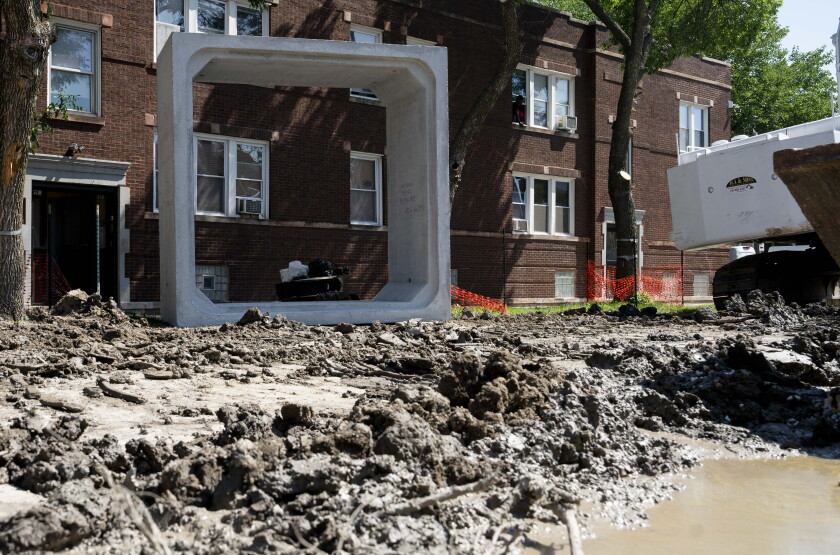
The floodwater storage is being built with 12-by-12-foot concrete sections that weigh 48,000 pounds each, according to Randy Conner, commissioner of the Department of Water Management.
“Adding infrastructure in dense urban neighborhoods is like putting pieces of a puzzle together,” Conner said.
About 50 to 60 sections are being installed on each block just under street level.
|
Pat Nabong/Sun-Times
|
Pat Nabong/Sun-Times

|
Pat Nabong/Sun-Times
|
Pat Nabong/Sun-Times

|
Pat Nabong/Sun-Times

|
Pat Nabong/Sun-Times

|
Pat Nabong/Sun-Times

|
Pat Nabong/Sun-Times

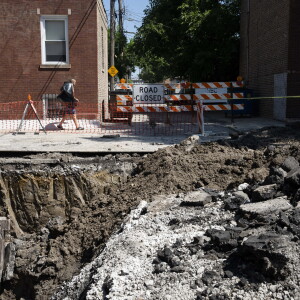
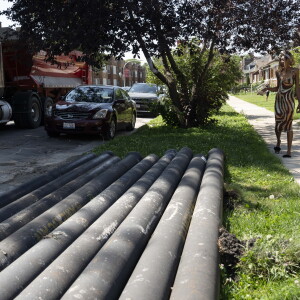




Together, the two projects are designed to hold 1.7 million gallons of water that will be held in the underground storage until additional stormwater that enters the sewers has a chance to drain into the so-called Deep Tunnel system. Chicago’s Deep Tunnel sends floodwaters through more than 100 miles of tunnels into three reservoirs. Built over a half-century, the system was created to protect Lake Michigan and other waterways as well as help prevent flooding.
The news conference followed the announcement a day earlier that the massive Deep Tunnel suburban reservoirs were nearly full after a month of heavy rain. The problem pointed to the need for additional flood control.
Those reservoirs were still mostly full Tuesday.
“There’s no one silver bullet,” said Kari Steele, board president of the water reclamation district.
As for concerns about the flood-control reservoirs nearing full capacity, Steele defended the multibillion dollar civil engineering plan, saying, “It is doing exactly what it was designed to do.”
Scientists have predicted more intense storms in the coming years, which adds pressure on planners and politicians charged with keeping people safe during extreme weather events. Johnson said that became clear to him after the 2023 floods.
“As I said three years ago, these 100-year storms were going to become more and more regular,” Johnson said.

Soaked


