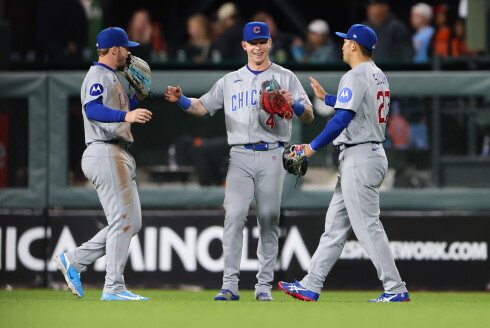
BALTIMORE — Coming in for a landing, my plane slammed down on the runway.
By the time the person sitting next to me lifted the window shade, we were back in the air.
Ten minutes later? Back on the ground.
It’s not the ideal way to fly.
When the flight attendant — playing to the heavy contingent of Cubs fans aboard — signed off with, ‘‘Let’s go, Cubbies!’’ it struck me that this was maybe not the ideal way to go through a baseball season, either.
But the up-and-down Cubs are making a run at it, trying to achieve their sky-high goals, all while their season has — to this point, anyway — jerked upward and downward with the frequency of a commercial jet.
You know the highs and lows by now. A 10-game winning streak. Then another. Then a 10-game losing streak to kick off a monthlong slump. Then the bats roared back to life.
They won a game by 20 runs. They lost the next by 16.
Whiplash, anyone?
These Cubs say they’re equipped to handle such a season, constantly trumpeting their ability to show up to the ballpark each new day having forgotten about the emotional highs and lows of the previous one.
That they held the top wild-card spot in the National League when that flight took off Tuesday shows they might be right.
They’re taking Ted Lasso’s advice and selling this roster as a collection of 26 goldfish.
‘‘In the first six weeks of the season or eight weeks of the season,’’ outfielder Ian Happ said Tuesday, ‘‘just the ups and downs of that certainly made it more important to understand that whether we win 10 in a row or lose 10 in a row, one two-week stretch isn’t going to determine whether we have a great year or not.’’
This might sound like Baseball 101. But considering how fans’ emotions have swung wildly between high and low during the Cubs’ numerous streaks and stretches, the guys actually going through it must be feeling something, right? They must be battling some sort of human nature to put weight on the moment, right?
How does one learn to wipe away what came immediately before in service of the now?
‘‘A baseball season teaches you to do that,’’ manager Craig Counsell said, ‘‘because you can have an emotional game end at 11 o’clock [one night] and there’s another game at 1 o’clock the next day. You get taught to do it through that.
‘‘In that sense, the game’s a really good teacher, and you learn that it’s required of you pretty fast, whether it’s a consistent season or a really streaky season.’’
You know who else were good teachers, at least for one Cubs player? The guys with rings on their fingers.
Happ made his major-league debut the season after the Cubs rode into Grant Park to celebrate winning the 2016 World Series and learned from players who had been to the mountaintop and knew what it took to get there.
Now he’s the connective tissue between that team and the one chasing a similar goal.
‘‘You have to be ready for the next day, and dwelling on what happened the day prior doesn’t really help,’’ he said. ‘‘You learn it when you’re young from veteran players. I learned it from that group that I came up with that had a ton of experience and won at the highest stage. You learn from those guys and kind of carry that forward.
‘‘It’s more from actions and coming to work every day. There’s definitely times when [someone is] going through something where some words help, just [letting them know that a] one-week stretch or two-week stretch isn’t going to define the season.’’
Experience can be a pretty effective teacher, too. And though they didn’t plan it, the Cubs now have the experience of riding through a streaky few months.
Can they use it to their advantage as the summer goes on? We soon will find out.