Most of the people in the pictures seemed amenable to being photographed. Or they pretended to be.
Motionless for minutes, they stared vacantly at their camera-wielding predators, likely unaware the images would be used to justify colonial subjugation and spread imperial propaganda.
Some wary Indians rebelled by refusing to pose as instructed, showing up late or skipping entirely the mid-19th and early 20th century photo sessions orchestrated by the British.
But even some maharajas donning diamond-encrusted turbans were as powerless as the dhoti- and sari-clad working class to fully subvert the patronizing Western gaze.
To give these long-gone photo subjects the agency they were denied, Pakistan-born visual artist Mehreen “Lali” Khalid turned the camera on herself as a form of collective retribution.
Serving as a “surrogate,” Khalid “reclaimed consent and control” by using the same albumen glass plate and silver gelatin print photographic processes that reduced countless pre-Partition South Asians to one-dimensional, “exoticized” specimens.
The defiant self-portraits, which Khalid snapped in January on the same walk she took for 12 days by the Blue Ridge Mountains in North Carolina, are now on display at Columbia College Chicago’s Glass Curtain Gallery, 1104 S. Wabash Ave.

A refusal to be erased
The picture series titled “Zid” — stubbornness in Urdu — speaks to Khalid and my larger South Asian and Muslim communities’ refusal to be “flattened” and erased in spaces where others can’t see beyond the stereotypes frozen in their heads.
When Khalid first arrived in the United States in 2007 as a Fulbright scholar at the Pratt Institute, she was stunned when her classmates in a city as cosmopolitan as New York asked her how she dodged terrorists in her homeland and could speak English so well.
“Come on, dude,” Khalid, 45, sighed, cringing at the memory.
The Logan Square resident had a similar experience last year when she asked her students at the Art Institute of Chicago, where she is a visiting artist, to blurt their first thoughts upon hearing the word “Muslim.”
“Ninety-nine percent of them wrote ‘suppressed, oppressed and veiled,’ and there I am standing in front of the class — a Muslim woman in a sleeveless shirt” who is the antithesis of those descriptions, said Khalid, noting that her friends who wear hijab aren’t subservient wallflowers either.
That mortifying classroom lesson inspired Khalid to expand her project showcasing Muslim immigrants, refugees and their second-generation children in Chicago, where Khalid moved in late 2022.
Not subjects, but collaborators
The resulting 17 photographs — adding to Khalid’s “First Light, the Skylarks Sing” collection — make up the bulk of Khalid’s multimedia exhibit, which runs through Oct. 3 at the Glass Curtain Gallery.

People attend the opening reception of Mehreen “Lali” Khalid’s “Juhd-e-Musalsal” exhibit June 25 at Columbia College Chicago’s Glass Curtain Gallery,1104 S. Wabash Ave. The exhibit, presented by Columbia College’s Museum of Contemporary Photography and School of Visual Arts, runs through Oct. 3.
Rummana Hussain/Sun-Times
Khalid, who partnered with the Chicago chapter of the Council on American-Islamic Relations for the exhibit, hadn’t met many of the participants until the day she took their pictures.
Through those encounters, she forged friendships, touched that men and women who are often smeared by outsiders and politicians were willing to face the camera and seize their narratives.
“I don’t consider them subjects. They are collaborators,” said Khalid, who titled each “Skylark” piece after the first name of the person in the photo and the number of years they’ve lived in the U.S., whether they are American-born or immigrated to the country.
Among Khalid’s favorites is “Uthman, 32 years” featuring a professor and architectural designer — who is the son of Nigerian immigrants — standing in front of Lake Michigan on the North Side beach where he often sits and reads Malcolm X’s writings.

Another picture, “Elham, 30 years” centers an anthropologist from Iran sitting at her dining table adorned with flowers, bowls of fruit, biscuits and amber-colored tea.
“It felt like home without being at home,” Khalid said of the latter photo shoot, which included discussions of the war that ignited after the U.S. and Israel launched coordinated, wide-ranging military strikes on Iran earlier this year.
Like other creatives with ties to Muslim countries and other maligned regions, Khalid’s work is designed to humanize populations the U.S. government has bombed in the past or continues to attack.
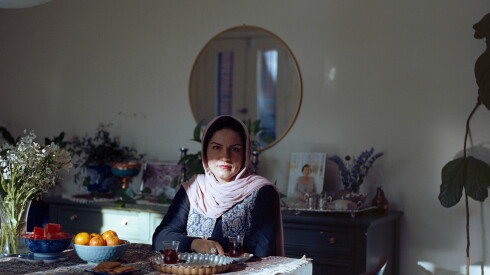
I asked Khalid if she genuinely thinks her portraits of mostly Black and Brown Muslims can sway bigots’ minds or influence U.S. foreign policy.
I could share a picture of myself stuffing my face with a cake on my third birthday in our family’s apartment in West Rogers Park, and a few Sun-Times readers would still respond with rants on 9/11, “Sharia law” and Islam’s “incompatibility” with the U.S.
“I’ve cried about this,” Khalid said about art’s limitations. “But my father once told me, even if one person takes notice or has a shift (in their worldview), you did your job.”
Khalid’s “Juhd-e-Musalsal” exhibit captures this “incessant struggle” to get others to see us as we see ourselves.
Khalid is helping adjust the lens.
The camera, as history has shown, can be used as a weapon. But in the right hands, it can also set us free.
Rummana Hussain is a columnist and leads the opinion coverage at the Sun-Times.