When Magic Johnson looks back at the 2004 U.S. Olympic team, he doesn’t start with the roster.
He starts with what didn’t happen.
Specifically, what LeBron James and Carmelo Anthony — two of the brightest young stars in the league at the time — didn’t do before the team ever arrived in Athens.
Because in Johnson’s eyes, the foundation of that team was never fully built.
Magic’s Message Was Simple — and Direct
During a “Two on Two” conversation that included Johnson and Larry Bird, Anthony reflected on how different the 2004 Olympic experience felt compared to the dominance of the 1992 Dream Team.
Johnson didn’t hesitate to explain why.
“I know you’re young, and I want you to do this,” he said. “Pick up the phone. Call the guys that you want to play with. Call them personally, that’s what I did. I made him (pointing to Bird) play. He wasn’t going to play. I was like, ‘I’m calling him.’ Michael Jordan wasn’t going to play.”
For Johnson, building a great team was never passive.
It required pressure. Persistence. Ownership.
“I was calling him, bugging him. You guys have to play, come on.’ And they all came, of course. If you want Shaq, pick up the phone and call him and put the pressure on him. And also talk to David Stern. You won’t come talk to him about it. Carmelo, you’re young in age, but you’re one of the best players. You’ve got to be aggressive,” he added.
The 2004 Team Never Had That Edge
The gap Johnson was describing showed up in Athens.
Unlike the Dream Team — where stars like Michael Jordan, Bird, and Johnson made sure the best players committed — the 2004 roster came together differently.
Top names including Shaquille O’Neal, Kobe Bryant, and Kevin Garnett declined to participate. The group that ultimately traveled to Greece was talented, but lacked continuity and, at times, identity.
The result was one of the most disappointing finishes in USA Basketball history — a 5–3 record and a bronze medal.
A Lesson Bigger Than 2004
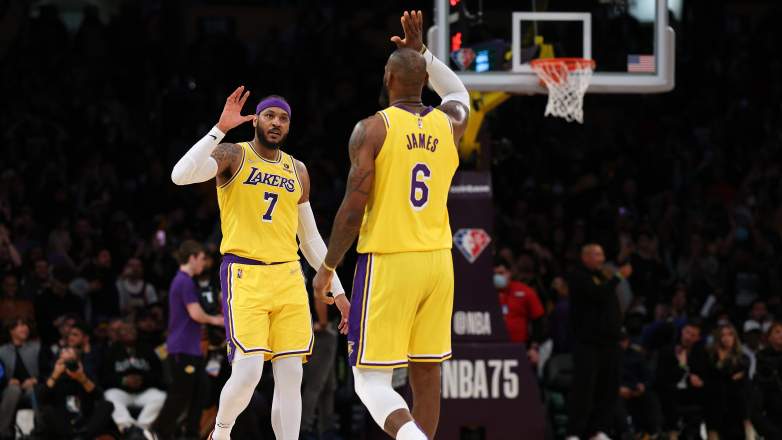
GettyCarmelo Anthony celebrates a three-pointer with LeBron James during a Los Angeles Lakers game against the Golden State Warriors at Crypto.com Arena.
To be clear, James and Anthony were 19-year-olds stepping into a global spotlight. They weren’t expected to control the entire process.
But Johnson’s point wasn’t really about age.
It was about leadership.
The Dream Team didn’t just happen because the league was full of stars. It happened because those stars made it happen.
And in 2004, that level of player-driven accountability never fully materialized.
Why It Still Matters Now
In today’s NBA, Johnson’s message feels almost obvious.
Stars recruit each other constantly. They build teams, shape rosters, and influence decisions across the league.
But in 2004, that mindset wasn’t yet the norm.
What Johnson was calling for — picking up the phone, applying pressure, taking ownership — has since become part of the modern NBA blueprint.
Which is why his reflection still lands.
Because long before superteams and player empowerment defined the league, Johnson understood something that still holds true:
The best teams aren’t just assembled.
They’re demanded into existence.
Like Heavy Sports’s content? Be sure to follow us.
This article was originally published on Heavy Sports
The post Magic Johnson Told LeBron, Carmelo to ‘Pick Up the Phone’ Before 2004 Team USA appeared first on Heavy Sports.