There’s the “boring suburban dad,” whose children told him to stand up for what’s right.
The son of an immigrant, whose family already knew the sting of a federal prosecution.
A rising political disrupter, who says her progressive campaign was weighed down by bogus criminal charges.
And a campaign worker she calls her friend, and a “literal hero.”
They’re individuals. But together, they’re the four members of the “Broadview Six” who nearly faced trial this spring at the Dirksen Federal Courthouse — until the high-profile case against them collapsed amid claims of prosecutorial misconduct. The revelations created a credibility crisis for Chicago U.S. Attorney Andrew Boutros and sent shockwaves across the country.
They are former congressional candidate Kat Abughazaleh, Oak Park village trustee Brian Straw, 45th Ward Democratic committeeperson Michael Rabbitt, and onetime Abughazaleh aide Andre Martin.
Finally free of the charges they faced for seven months, three of them agreed to speak with the Chicago Sun-Times after the case fell apart. They talked about the allegations against them, the legal theories surrounding it, and the price they paid for another troubled prosecution of protesters in Chicago that’s sure to find a place in the city’s history books.
Now that they’re also free to speak to each other, Rabbitt said they share a “very special bond.”
They’ve had to raise money to pay legal bills. Abughazaleh said she and Martin faced bankruptcy. Rabbitt worried about being detained when he arrived home from overseas. And Straw called it a “living hell for me and my family.”
That includes Straw’s young children, who he said “had nightmares related to this case.”
Six people originally faced charges, hence the “Broadview Six” moniker. Most are involved in local Democratic politics. Also charged were former Cook County Board candidate Catherine “Cat” Sharp and musician Joselyn Walsh, but their charges were dropped in March.
Prosecutors accused the six of a felony conspiracy for being part of a crowd on Sept. 26 whose members surrounded an immigration agent’s SUV and pushed, scratched and otherwise damaged it. Later, prosecutors sought to put the final four defendants on trial for misdemeanors.
None of the six defendants were ever specifically accused of causing damage to the SUV. The feds later argued the conspiracy was “spontaneous.”
Boutros defended the case, even after permanently dismissing the charges May 21. He said the behavior by the six and others in September during an Operation Midway Blitz protest was “unacceptable in a civilized society.”
But Abughazaleh said, “I think my conduct fits very well in a civilized society.
“A society where we get to dissent from the government, and we expect our rights to be respected,” she said. “I think that is extremely civilized conduct.”
They have stories to tell. About how Straw pressed legal issues in court when others might have given in. How Rabbitt confronted the trauma of his father’s federal prosecution in Missouri. And how Abughazaleh ran a political campaign while under indictment.
But their tales overlap — outside a suburban immigration facility, inside a courtroom in Chicago and in a common pursuit of justice in what comes next.
They noted they’ve each, independently, already taken a stand against the Justice Department.
“At any point, any of us could have taken a deal,” Abughazaleh said.
“And none of us did.”
A protest prompts charges
They first gathered together on a sunny September morning in the western suburb of Broadview, home to a U.S. Immigration and Customs Enforcement holding facility that became a hotbed for protests during Midway Blitz.
Many of the people detained during the deportation campaign wound up inside the facility. A federal judge would later hear testimony about people being crammed into a holding cell there 100 at a time, with nowhere to sleep but a dirty floor near an open toilet.
Rabbitt and Straw said they went to protest there for the first time Sept. 26. But Abughazaleh, in the midst of her congressional campaign, had already made news there with an infamous video of a federal agent tossing her to the ground.
The protesters engaged that morning in what’s known as a Jericho Walk, court records show. It’s a form of protest with spiritual roots. Though Broadview police purportedly helped clear a path through the crowd so other vehicles could pass through, court filings say an ICE agent decided to roll his SUV slowly through the gathering around 7:45 a.m.
Federal prosecutors alleged that the protesters, including the six who would be accused in the indictment, “swarmed the government vehicle” to keep the agent from going to work.
The “Broadview Six” saw it differently. Straw said he was “shocked to see a large SUV driving into a crowd of people.” Rabbitt said he was “stunned and alarmed.” Abughazaleh said her mind went back to a moment one week earlier, when she’d helped a fallen man whose head wound up in front of a car tire. She worried something like that could happen again — with fatal results.

Rabbitt can be seen on video placing a hand on the passenger side of the SUV. He said he did so because “you have to take action, you do not want to be a bystander.” He said he also yelled “stop.” Straw, seen on video wearing an orange hat that says “Do Good,” found himself facing the vehicle head on.
“I had people’s hands on my back,” Straw said. “There were folks to either side of me. And the SUV was not stopping once it started pushing into the crowd. It was pushing forward relentlessly. And I was worried that if I … tried to push out of the way of the SUV, someone else would fall. And I wasn’t going to put anyone else at risk.”
Abughazaleh disappears from view 15 seconds into a prominent video of the incident. A separate video shows that she fell back, retrieved a bullhorn and used it to tell protesters, “That’s private property back there, come back here now.”
Then she turned and complained to a Broadview police officer, “You just let him run us over. … He literally just ran over my foot.”
Once the agent pushed the SUV through the crowd — and the moment passed — Straw said he called his wife to tell her what happened. And then, he said, agents emerged from the facility “to shoot protesters with pepper balls and rubber bullets and tear gas.”
“No person in this country should be tear gassed for exercising their First Amendment rights and attending a protest,” Straw said. “Especially not immediately after a federal agent decides to drive through a crowd.”
Calls from the FBI
Federal authorities did not arrest the “Broadview Six” that day. They went about their lives. That is, until about a month later — when they began to get phone calls from the FBI. A grand jury on Oct. 23 handed up an indictment that accused them of a conspiracy to impede the agent.
Combined with a misdemeanor charge, the six each faced up to seven years in prison. A press release about the charges included a quote from then-Deputy Attorney General Todd Blanche, who said “no one is above the law and no one has the right to obstruct it.”
Blanche, President Donald Trump’s former private lawyer, is now the acting attorney general — the nation’s top law enforcement official.

Rabbitt said he got the news while on a long-planned vacation to Spain and Portugal with his wife to celebrate their 30-year wedding anniversary. He said he woke up one morning to find messages on his phone from an FBI agent, telling him if he didn’t surrender the next day there’d be a warrant for his arrest.
Abughazaleh was in the midst of an interview when her campaign staff began frantically trying to get her attention. She finished the interview. Then, she saw “call after call … of people trying to get ahold of me, including the FBI.”
For Straw, it was the middle of a workday.
“There was no part of my mind that was expecting that, a month later, I would be getting a call related to an ICE agent choosing to drive into a crowd of protesters,” Straw said.
Despite the conspiracy charge, some members of the group said they’d never met each other before. Rabbitt said he and Sharp are “friends,” and he said he’d once met Abughazaleh. But Straw said he’d never met any of them.
“I think I met Joselyn [Walsh] when we were getting processed at FBI headquarters for our mugshots, and then I think our arraignment was the first time I had met any of my other co-defendants,” Straw said. “It was a bit of an odd experience meeting my alleged co-conspirators for the first time in a courtroom.”
Brian Straw pulled legal threads

Straw is no stranger to Chicago’s federal courthouse. He’s practiced there as a lawyer. He even once appeared before U.S. Magistrate Judge Heather McShain, though it was during pandemic-era Zoom hearings.
Then, on Nov. 12, Straw and his co-defendants appeared before McShain for their arraignment.
“I love the architecture of the Dirksen building and the courtrooms,” Straw said. “But … it’s not an architecture that really makes you feel comfortable when you’re there as a criminal defendant.”
Arraignments tend to be simple proceedings. A defendant is informed of criminal charges, they enter a plea and the judge sets a schedule for the case. But in a sign of things to come, Straw attorney Christopher Parente objected to Straw having to turn over his passport.
It’s a standard condition of release for a defendant awaiting trial. But Parente told the judge that Straw protested at Broadview because the feds were demanding paperwork “for people who appear to be a certain skin color.”
Landscapers detained by immigration agents “can’t stand up to the government,” Parente said, but “Mr. Straw can. And Your Honor can.”
McShain decided not to collect passports from any of the defendants.
“It was important to me,” Straw told the Sun-Times, “that there would be no condition regarding our ability to continue voicing dissent. And it was important to me that, in a moment where folks on our streets are being asked to show papers demonstrating that they’re in our country legally, that our own documentation, our passports, weren’t taken away.”
It wasn’t just important to him, though. Children, he said, “have some of the best calibrated senses of what’s fair and just.” His kids are 6 and 11. And he said they told him, “You have to stand up. You have to fight. There are other people who wouldn’t be able to, but you can and you should.”
Straw later helped prepare a defense motion arguing that the conspiracy charge should be tossed based on the First Amendment, which protects the right to free speech, religion, the press and assembly.
Straw focused on assembly.
“The important point,” Straw said, “is the First Amendment guarantees our right of assembly. And the only real grounds for the conspiracy charge was that these six people were all assembled in the same place, at the same time. It’s a theory based on proximity and parallel action, which simply is no basis for a charge of conspiracy.”
“From the start, we just had concerns over how it was possible that a grand jury could indict a conspiracy charge based on what had actually happened in this case,” Straw added.
Defense attorneys sought transcripts of the grand jury proceedings as the case moved forward before U.S. District Judge April Perry. Parente pressed the issue to the point that Perry even entered an order scolding Parente in early May.
Eventually, Parente convinced Perry to look at unredacted transcripts of what went on in the grand jury — leading to the revelations of apparent prosecutorial misconduct that ended the case.
Perry said a prosecutor improperly put her credibility on the line to support the criminal charges. The judge said there were “substantive” communications with grand jurors outside the grand jury room, and that a prosecutor excused grand jurors who didn’t agree with the case.
Straw said he was “surprised” by “how far we had fallen, how fast.” A few weeks after the indictment, a threatening phone call forced Straw’s family out of their home for a night, he said. His younger child was asked on the playground whether her father would go to jail.
He said his goal, in addition to winning the case, was to tug on legal threads that others were unlikely to pull.
“I’m glad that I was there to fight those issues, because I don’t know what the outcome would have been if I wasn’t part of this case.”
Michael Rabbitt’s dad also fought the DOJ
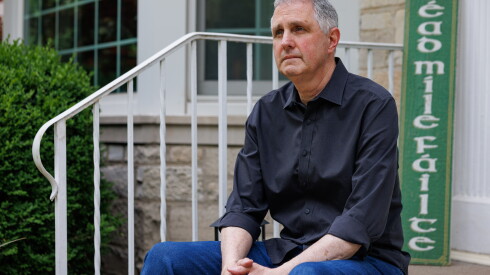
Learning of the indictment in a foreign country made Rabbitt feel vulnerable. That’s because having friends, family and attorneys nearby creates a sense of security, he said. People warned him he might be detained at the airport when he arrived home.
So, he said, “there were certain steps that I took with my congressman to have some protection in case that happened.”
“The fact that I actually had to take that step made the flight home rather stressful,” he added.
Rabbitt hails from St. Louis. His father was the speaker of the Missouri House of Representatives — and was once indicted by the Justice Department.
Richard J. Rabbitt was convicted of mail fraud and extortion in a political corruption trial in July 1977, according to archived newspaper reports.
“I went through the trauma at a young age of going through my father’s trial and his eventual conviction,” Michael Rabbitt said. “A number of those charges were overturned on appeal, but not all of them. And so he did have a 16-month prison sentence that happened while I was, I think, a sophomore in high school.”
The younger Rabbitt acknowledged his father’s case involved “very different circumstances.” But, he said, “there’s that common experience.
“It just made me think a lot about my late father, and all the great things he accomplished in his life,” Michael Rabbitt said. “And the fact that he, in the history books, is defined by one thing that happened to him, his conviction, and yet I had to reflect on, ‘What does this mean for me?’”
Given that Michael Rabbitt’s protest and indictment revolved around the Trump administration’s deportation campaign, he said he’s also been thinking about his mother, an immigrant from Ireland, as well as his mother-in-law, an immigrant from Poland.
“The cause of immigrants is important to us,” he said, “and the history of immigration here in Chicago, of course, is so important.”
Moments after the Broadview case fell apart May 21, Michael Rabbitt called on Boutros to resign. That call has since been joined by Evanston Mayor Daniel Biss, the Democratic nominee for Illinois’ 9th congressional district; and Lt. Gov. Juliana Stratton, the Democratic nominee for U.S. Senate.
“I think while Boutros resigning or being removed is something that needs to happen, there needs to be further accountability beyond him,” Michael Rabbitt said.
“I would love to see congressional hearings.”
‘We had nothing to apologize for,’ Kat Abughazaleh says

For generations, Chicago politicians have gone into hiding when indicted by the U.S. attorney’s office. Instead, Abughazaleh announced her indictment on social media.
“I wanted to be able to tell my own story and not have it told for me,” she said.
“And I don’t trust the government to tell that story honestly,” she added.
By the time of the indictment, Abughazaleh had become a high-profile Democratic candidate in the crowded 9th congressional district primary race. She ultimately came in second for the nomination won by Biss.
On the surface, it seemed the indictment from the Trump Justice Department might have given her campaign a boost. She certainly didn’t shy away from it.
“What else are you supposed to do but embrace it?” she asked.
“Because it’s happening,” Abughazaleh said. “And I’m not ashamed of being a target by this administration.”
She said “it definitely hurt the campaign,” though.
“It takes resources,” she said. “We had to pay legal bills. … Every single piece of communication that went out, we had to run by our lawyers. That costs money.”
There’s also the strain of being under indictment, which didn’t only affect her. Martin, a member of her campaign staff, had also been indicted. Abughazaleh called Martin a “friend” and “literal hero” who is “braver than anyone I know.”
“Two people on our staff were indicted by the federal government, and we still had to act like normal,” Abughazaleh said. “And it’s really hard. It’s so stressful.”
In fact, she said facing prosecution amid a political campaign “was one of the most excruciating things of my life.” One of her goals now is to prevent what happened to the “Broadview Six” from happening to others.
She said it could happen to anyone, and it’s OK to be afraid. She’s “afraid all the time,” she said.
“But we all have a lot of courage, especially here in Chicago,” Abughazaleh said. “And courage isn’t doing something because you’re unafraid. It’s doing something despite being afraid.”
And, she said, “we had nothing to apologize for.”
“We didn’t commit a crime. We were the victims. And we refused to let the government paint us as anything else.”