In 2021, Illinois passed a law requiring every public elementary and high school to teach a unit of Asian American and Pacific Islander history.
Five years later, many schools throughout the state have yet to fully implement the Teaching Equitable Asian American Community History Act.
The Illinois State Board of Education developed a resource guide to help schools build out AAPI history curricula. State Rep. Jennifer Gong-Gershowitz, D-Glenview, says she’s proud of the progress that’s been made so far — but there’s still work to be done.
Some advocates say they were met with mixed results while doing outreach to schools.
“Roughly 25% of teachers and students in the state of Illinois have had some participation with the Asian American curricular resources that have been made available since the bill passed,” Gong-Gershowitz, a sponsor of the bill, told WBEZ.
In 2026, WBEZ talked to Chicago-area educators, students and lawmakers about the TEAACH Act to see how the law has taken shape in some local schools.
What led to the TEAACH Act?

Gong-Gershowitz said the momentum for the bill was prompted largely by high-profile cases of anti-Asian hate crimes during the COVID-19 pandemic. She presented the bill in committee the day after a mass shooting in March at several Atlanta-area spas killed eight people, including six Asian women.
A coalition of more than 35 organizations, including Asian Americans Advancing Justice Chicago, championed the bill — the first of its kind anywhere in the United States.
Some of the bill’s opponents said decisions about curricula should happen at the local level, rather than being mandated by the state.
The bill ultimately passed the Illinois State House 108-10 on May 31, 2021. A committee of local educators worked together to organize resources and standardize a curriculum.
The TEAACH Act was unfunded when it first passed, but in 2025, Illinois committed $2 million to inclusive K-12 history mandates. Some of that money was allocated to meeting the TEAACH Act’s mandate. But a standardized statewide Asian American history curriculum still hasn’t been established.
Why is it important to teach AAPI history?

Education researchers have found that students who participate in ethnic studies are more academically engaged, develop a stronger sense of personal empowerment, perform better academically and graduate at higher rates.
A WBEZ analysis of census data showed the Asian population in metro Chicago grew by an estimated 11.6% since 2020, more than double the rate of growth for the next highest group. Roughly 9.4 million people lived in the Chicago metropolitan statistical area in 2024, and around 764,000 identified themselves as Asian — almost 80,000 more than in 2020.
Laura Ouk, board president of the National Cambodian Heritage Museum and Killing Fields Memorial in Chicago, wants more teachers to get on board with the TEAACH Act because she’s seen the impact of education on young people.
“Something that I think a lot of Asian American/Pacific Islanders can identify with: We weren’t always proud of who we are, and I think a lot of it was because we didn’t really know who we were,” Ouk, who has been an educator for 14 years, said. “Now, the younger generations are just so proud of who they are, so that they [don’t] have to repeat that cycle of not knowing how that impacts them later on in life.”
What are schools doing to teach AAPI history now?

Andrew de Alas, youth program coordinator at HANA Center, talks to Isha George and Akshaya Sathish Kumar as they work on a presentation about the Dalit Panthers and Black Panthers during a meeting at the HANA Center – Northwest Center in suburban Prospect Heights, July 30, 2026.
Tyler Pasciak LaRiviere/Sun-Times
The Albany Park-based immigration rights nonprofit HANA Center surveyed 113 students, teachers and parents about the TEAACH Act in fall 2023. It found 73% of student respondents say they received “little to no” education focusing on Asian American communities during the previous school year.
Some educators have seen those percentages play out in the classroom.
John Lee teaches an Asian American Studies elective at Niles West High School in Skokie. He estimates he instructs up to about 13% of the senior class.
Lee says about half of his students haven’t heard about fundamental moments from Asian American history in his curriculum before starting his class. It includes historical events like the Chinese Exclusion Act of 1882 and the Immigration and Nationality Act of 1965. Niles West didn’t respond to Lee’s comments when asked. Instead, the school shared a description for its semester-long Asian American History course.
The Illinois State Board of Education said in a statement that individual school districts determine how schools meet the requirements of the TEAACH Act within their local curriculum.
What are Illinois schools doing about the TEAACH Act mandate?

WBEZ checked in with several Chicago-area schools to get a sense of how they’re implementing the mandate.
In a statement, Chicago Public Schools told WBEZ: “The District’s Social Science Department actively curates lessons and offers content and pedagogical resources for K-12 teachers. These materials align with the IL Mandated Units of Study, including the TEAACH Act, and support the development of more inclusive Social Science classrooms, where all units of study are explored from multiple perspectives.”
Township High School District 214, which covers multiple suburbs north of Chicago, said in a statement that its U.S. history curriculum provides “opportunities to explore the contributions of Asian Americans throughout U.S. history”.
“When the TEAACH Act was first introduced, I think over the course of the five years we’ve made meaningful progress,” said Bradford Hubbard, the district’s Associate Superintendent for Teaching and Learning. “I also think at the same time we can certainly do better.”
Hubbard said he’s working to create a new process that would help administrators evaluate whether the course is fulfilling the state’s mandated units of study, including Asian American history.
That change could be a slow, multiyear process, Hubbard added. The district is considering bigger changes to their larger social sciences department.
“Does the current graduation requirement need to be evaluated? Are we able to fit everything in that we feel like we need to, but then we’re also mandated to, into what we currently offer?” Hubbard said.
Laura Ouk does outreach to school administrators to introduce them to Asian American history resources. She said in the years since the TEAACH Act passed, some schools still aren’t making the material a priority.
“Sometimes, it’s as indirect as just not responding to our emails and our calls,” Ouk said. “And then sometimes, it is more direct, where we are in meetings and hearing them just not want to prioritize it, because maybe it’s a combination of time and not having enough teachers who are teaching a certain class.”
Resources for teachers who want to learn how to teach Asian American history are already being offered. They include free workshops and online training from the University of Illinois that allows teachers to work toward an ISBE microcredential in Asian American history. The nonprofit Asian Americans Advancing Justice Chicago said it organized 63 professional development workshops related to the TEAACH Act from July 2022 to June 2023.
Have other states passed laws similar to the TEAACH Act?

Drummers from HANA Center’s Pungmul group perform during the Umbrella Arts Festival at Fountain Square in Evanston, May 13, 2023. The festival, which featured cultural performances, small businesses, food, and arts and crafts, aims to celebrate Asian, South Asian and Pacific Islander art and culture and raise awareness to prevent anti-Asian violence, according to their website.
Pat Nabong/Sun-Times file
Some states have established AAPI requirements through a patchwork of different laws and standards.
A California law signed in 2021 requires all high schools in the state to offer an ethnic studies course. The class will be a statewide graduation requirement beginning in 2030.
In 2022, New Jersey became the second state after Illinois to require schools to teach Asian American and Pacific Islander history. The act went into effect the 2022–2023 school year. The mandate was also unfunded when it passed.
What do students say about Asian American history courses?
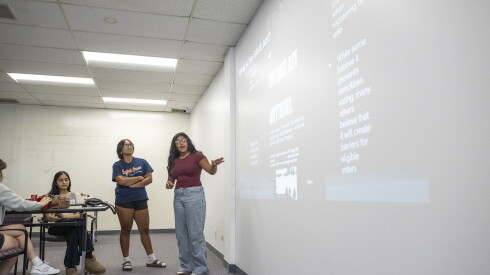
In April, members of the HANA Center’s Suburban Youth Council spoke at Chicago-area board of education meetings in several school districts. The group is pushing the districts to fully implement the TEAACH Act. That includes ensuring accomplishments by Asian American people are included in history curricula and including at least two pieces of Asian American literature in English courses.
Ahir Naveen, a junior at John Hersey High School in Arlington Heights, is working to collect student signatures in support of their demands and return to leadership with the petition.
“I think that with knowledge comes power, and with knowledge comes understanding of other people and perspectives broadening,” Naveen said.