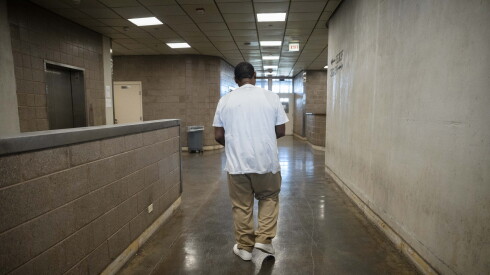
Inside the Cook County Jail’s “super max” division, Ivy Kelly goes about his daily shift, serving lunch to fellow detainees, until correctional officers interrupt him.
The officers escort Kelly to a cramped room where detainees meet with their lawyers. Today, there’s no lawyer — just me and a photographer.
Kelly, 51, sits across from us. His hair is short, parted and styled into waves. He wears eyeglasses with a dark browline. He looks bookish. No nonsense.
Kelly has always insisted he’s innocent of the 1999 killing that led to his decades-long prison sentence.
In 2014, an appeals court raised doubts about his trial’s fairness. Eventually, prosecutors made Kelly an offer: He could walk free — if he just admitted guilt.
We’ve spoken a couple times online, but I’ve come to the jail to ask in person about his response to the offer — a response that has weighed heavily ever since.

WBEZ’s Chip Mitchell records Ivy Kelly in a jail corridor after their interview in a cramped room where detainees meet with their lawyers. Kelly spoke of his response to a 2022 offer from Cook County prosecutors to enable his immediate release if he admitted guilt in the murder of a man he calls his best friend. Kelly’s decision has weighed heavily since.
Pat Nabong/Sun-Times
We don’t have much time in the jail room. So I proceed chronologically, starting with his connection to the murder victim, Joe Ward.
Kelly says they met as students at Polaris, a former college-prep high school in Oak Lawn.
“He became, actually, my best friend,” he says.
Kelly needed a best friend. He says his stepfather was abusive to him and his mother.
“My mom also had an abusive childhood,” Kelly says. “I understood why she probably allowed things to go on, probably fearful for her own safety at times.”
Throughout high school, Kelly bounced among their home, his grandmother’s place and an aunt’s house.
Some nights, when he had nowhere else to go, he’d sleep in a car.
Other times, Ward took him in.
“He would sneak me into his basement,” Kelly says. “His mom would come down in the morning. She would just look at me because we’d never asked, ‘Could I spend the night?’”
Then, she would go up to the kitchen and feed him breakfast, just like her own kids, he says.
Kelly managed to graduate from high school. Later, in trade school, he learned about heating, ventilation and air conditioning. And he had five kids.
But he was convicted of a felony for firing a gun during what Kelly says was an altercation. And he dealt drugs — with Ward.
“The plan was to start buying and rehabbing houses so that we could stop selling drugs,” Kelly says.
That plan went off the rails on Dec. 10, 1999, when two men approached Ward outside a Robbins house. At least one fired shots, killing him.
More than three months later, Robbins police officers arrested Kelly and another man. They were charged with Ward’s murder. Prosecutors said Kelly was tired of Ward pestering him to settle a drug debt. They had statements from two purported eyewitnesses identifying Kelly as a shooter.
Kelly countered that he was blocks away at the time of the shooting. But both men were convicted. Kelly was sentenced to 30 years in prison.
He ended up at Menard Correctional Center, 340 miles south of Chicago. That maximum-security prison, built in the 19th century, is known for poor conditions.
There, Kelly kept fighting to clear his name. He found a fellow inmate who knew how to prepare and file a petition to challenge a conviction.
“I came back to him, and I asked him, ‘What do I owe you?’ And he said, ‘You got a bag of coffee?’” Kelly says. “Somebody who cared enough to help me, all he wanted was a bag of Maxwell House coffee that cost a buck-forty.”
In the filing, Kelly argued that his trial lawyer had made mistakes so severe they violated his constitutional rights. The lawyer, when I reached him, admitted the errors. He chalked them up to early-career inexperience with murder cases.
The errors included failing to question one of the eyewitnesses about a criminal case of his own and about having been paid by the federal government to provide information. Such questioning would have raised doubts about the credibility of that witness.
Kelly later accused prosecutors of hiding exculpatory evidence, including contemporaneous reports about the killing written by the Robbins detective in charge of the case. The detective, Jerome McGee, pleaded guilty in 2001 to a federal racketeering charge for taking cash to protect a drug dealer. He spent more than six years in prison.
Kelly also accused prosecutors of hiding a 1999 assault charge against the Robbins officer who replaced McGee as the murder case’s lead detective.
“Why withhold the detective’s background?” Kelly says.
The prosecutors said they didn’t withhold anything material to the murder case.
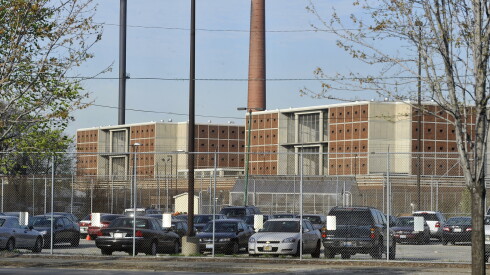
So there was Kelly in prison, convicted years earlier of killing a man he calls his best friend. He kept trying to prove his innocence. Eventually, his claim gained traction, leading to a gut-wrenching decision.
Here is how the decision went down.
The 2014 appellate ruling required Cook County Circuit Judge Michele M. Pitman, a former prosecutor, to hold an evidentiary hearing on whether Kelly was entitled to a retrial.
In 2022, as that hearing finally drew near, prosecutors offered Kelly a deal. They would agree to a sentence reduction of nearly eight years. He could get out of prison immediately. But only if he admitted guilt in the shooting.
This sort of bargaining leads many pretrial defendants to plead guilty in exchange for a lighter sentence.
But the dealmaking can also happen years after a conviction — before a post-conviction hearing or before a retrial.
More often than not, experts say, the person who’s locked up takes the offer. One study examined 250 cases across the country from 2010 to 2020. In each case, a pro bono group had agreed to represent someone trying to overturn a conviction for a serious crime, such as murder or rape.
“The cases go through extremely rigorous vetting,” says University of Wisconsin law professor emeritus Keith Findley, who led the study. “The groups only spend their resources on … really powerful claims of actual innocence.”
The study found that nearly a quarter of the claimants were offered a sentence-reduction deal — typically allowing them to go free immediately in exchange for admitting guilt, like the offer to Kelly.
Of those claimants, Findley says, 59% “succumbed to the pressures” and took the deal.
When the prosecutors in Kelly’s case informed Pitman they had offered him a deal for immediate release, the judge ordered him to stand before her.
“I want to make sure the record is clear,” Pitman told him, according to the court transcript.
“We don’t know what’s going to happen with this hearing,” the judge said, referring to the post-conviction proceeding, not mentioning the years it could take from there to get a retrial. “The state is telling me they’ve tendered you an offer today for time served on this case. Is that correct?”
“Yes, ma’am,” Kelly answered.
“And have you considered that offer, sir?”
“I’m innocent.”
“My question is: Have you considered that offer?” the judge pressed Kelly, stressing that, if he took the deal, he “would be released today.”
“Yes, ma’am.”
“And you’ve talked about that with your attorneys?”
“Yes, ma’am.”
“And it’s your desire to reject the offer for time served?” Pitman asked.
“Yes, ma’am.”
In 2023, almost a year later, the judge threw out Kelly’s conviction.
But prosecutors under then-Cook County State’s Attorney Kim Foxx decided not to drop the charges. They would retry him for the killing and, until then, he’d have to remain behind bars because, they argued, he was a safety menace.
Kelly says he could not understand that.
“They argued that I was a threat to the community, a threat to a witness, and the judge ordered me detained,” Kelly says. “I was confused the whole time because I’m not dangerous if I plead guilty, but I’m dangerous because I maintain my innocence.”
Under State’s Attorney Eileen O’Neill Burke, Foxx’s successor, prosecutors have stuck with pursuing the murder charges and keeping Kelly in jail.
I asked O’Neill Burke’s office why prosecutors consider Kelly more dangerous for fighting to clear his name. A spokesperson responded there would be no comment on a pending case.
Foxx, who stepped down as state’s attorney in 2024, says she has “no recollection of this matter.”

By the time the conviction was thrown out, Kelly had been moved to Dixon Correctional Center, 100 miles west of Chicago, putting him closer to friends and family. Years of good behavior behind bars had led to minimum-security status, he says.
“It was like a college campus,” Kelly says.
Pending a retrial, though, the judge ordered him moved to the Cook County Jail.
Kelly says he was first put in a detox unit full of drug addicts — dozens to a room, most in withdrawal.
Then, he was moved to the jail’s Division 9, where he has had to put up with young men charged with serious crimes.
“It’s the worst division in the county jail,” he says.
At one point, Kelly found out his mother had cancer. And, less than three months after his transfer from prison to the jail, she died.
It was all too much for him.
The plea offer was still on the table, according to Kelly’s attorneys. Ahead of his mother’s funeral, he says he considered taking it.
“I was ready to give up then,” Kelly says, voice faltering and eyes welling with tears. “I was ready to just give up and go home so I could be there when they buried her.”
But he says his lawyer and friends all told him the same thing: “You’re strong. You got to keep fighting. You came all this way. They stole a quarter century of your life. You can’t just give up like that.”
He knew the fight for exoneration could keep him behind bars for years longer. But again he dug in.
“I want to go home. I miss my kids. I’m estranged from my kids now. But, at the same token, I know I’m innocent,” Kelly says. “If I got to sit, I got to sit.”
Kelly has been locked up for 26 years.
His retrial is set for Nov. 2. He knows he might lose. If he does, he might not get out of prison until 2030.