For a century, there’s only one place in Chicago that can make you feel like you’re in a Moorish castle courtyard during a rock concert.
It’s where you can watch shows from fancy alcoves, marvel at a star-studded ceiling and feel the excitement of the ground moving (for better or worse) as 5,000 people jump to the same beat. It’s also where you might have seen Two Door Cinema Club on the same night 39 years after your parents saw the Ramones (and you probably both griped about the sound).
“Everyone’s got a story about the Aragon,” said John Blick, director of business services at Uptown United about the beloved concert hall that inks its centenarian status this month. As the neighborhood’s economic development anchor, Blick’s office has heard many of the tales firsthand, from the hundreds of couples who had meet-cutes on the ballroom dance floor decades ago to those who bring in mementoes found when moving or renovating. “We’ve got some really cool artifacts,” he said. “Somebody even found a menu from the Aragon in their wall.”

Opened July 15, 1926 during the height of the Roaring ’20s and Prohibition, the Aragon was built as a sophisticated dance hall where you could pay $0.90 to waltz along to big bands like the Glenn Miller Orchestra and the Jimmy Dorsey Orchestra.
“The Aragon opened during this second building boom in Uptown when the neighborhood was (and still kind of is) an entertainment district for the North Side,” said Robin Simon, a Chicago Architecture Center docent and the co-director of Uptown neighborhood tours. The original owners, Andrew and William Karzas, had a similar popular spot on the South Side, the former Trianon at 62nd Street and Cottage Grove. They wanted to replicate it up north where the Riviera and Uptown Theatre were already popular movie spots and the Green Mill attracted the jazz crowd.
“The brothers were really intent on cleaning up the moral image of dance halls,” Simon said, adding that at the Aragon, there was a strict dress code, chaperones and a no-alcohol policy. “Prior to this, dance halls were kind of sketchy. You wouldn’t be dressing up or finding high society there. But when the Karzas brothers opened up the Trianon Ballroom in 1922, it changed everything, similar to what Balaban and Katz did for movie palaces in Chicago.”

The Karzases teamed up with architects Huszagh & Hill (also behind the Viceroy Hotel and Sheridan Trust and Savings Bank) for a Spanish Baroque-style stucco building, settling on the name Aragon, a 1400s kingdom that preceded modern Spain. The exterior complemented the interior by movie palace architect John Eberson, who decorated the ballroom to evoke the feeling of being in the courtyard of a Moorish castle from Aragon. Tandem with the jutting balconies was an atmospheric ceiling that once had moving clouds and twinkling stars meant to make you feel like you’re enjoying an evening outside.
Simon points out today you can still see symbolic ornamentation on the facade of the Aragon that represents Spain’s King Ferdinand and Queen Isabella. “If you look at the windows on the Lawrence facade, you’ll see three little faces, two being the royals and the one in the middle the wedding gesture, like the emcee at the wedding,” Simon said.
Another of the original features that still exists is the spring-loaded floor; under the maple wood floorboards is a layer of cork, felt and springs that were added to make it more comfortable for the dancers — hence why it feels like you might go airborne when audiences get riled up.

There’s also allegedly an underground tunnel between the Green Mill Gardens and the Aragon’s old speakeasy, which was run by bootlegging king Hymie Weiss and the gang of Charles “Deanie” O’Banion — an Al Capone rival who was gunned down in 1924 — but no one interviewed can corroborate that urban legend. “The only thing relative to that whole storyline is that there are water lines that come in from Lake Michigan that used to be connected to a drinking water reservoir underneath the parking behind Just Tires and Demera [Restaurant],” said Blick.
To this day, the Aragon still looks much the same as it did in 1926 — one of the benefits of the strict governance around the Uptown Square historic district, which was added to the National Register of Historic Places in 2000. Over the years, the Aragon has had significant improvements and updates, including a reported $5 million renovation in 2005, says Simon, and work done to the west side of the building after a massive snow mound in 2021 caved in part of the roof and wall. The venue has also had many different full and part owners, including Latin concert promoters Willy Miranda and Jose Palomar and late La Raza newspaper publisher Luis Rossi with partners Ivan Fernandez and Mercedes Fernandez who brought Spanish language programming to the venue for a time. Today Live Nation is part owner of the venue.
But after years of hosting ballroom dancing, a roller rink, disco, boxing matches and a brief stint when it was renamed the Cheetah Club from 1966-68, Aragon most significantly transferred hands to independent promoter Jam Productions in 1973. It operated with an exclusive lease for 40 years and helped usher in Aragon’s present-day Brawlroom concert era.
Jam owner and President Jerry Mickelson was a fan of many of the holdover features from the ballroom days, but says there was one that was a bit of a hamper.
“The dome design was acoustically challenging because it swirled the sound around it,” he said. To help the issue, Jam came up with the idea to put some curtains in the dome to improve the acoustics. “It’s still challenging, but it’s a lot better than what it was,” he added.
Patrick Stump, front man of Chicago pop punk vets Fall Out Boy, knows those challenges well. “The Aragon is both an iconic and kind of a tough show to play,” Stump said, whose band performed at the venue several times in 2005 and 2006.
“It creates this hum of reverb that makes it really hard to hear what’s going on as a musician. I hate to say it, but if anyone who saw us play there, your guess is as good as mine whatever notes I was singing because onstage I just couldn’t compete with the noise of that swirling cavernous room. I wasn’t singing so much as making a series of musical educated guesses,” Stump joked.
Regardless, the Glenview native still holds the venue close to his heart. “The first time we played there, I remember thinking it was the first show where I really couldn’t see the end of the audience. Up to that point my wildest dream was playing the Metro, which seats about 1,500 people. Aragon at 5,000 was more people than I could literally fathom. Plus, it also had this slightly otherworldly Casablanca vibe that felt a little like playing a massive block party at Jabba’s Palace or something. … I’m still one of those guys who will always call it Sears Tower and say John Hancock, and I’ll always love and dream of the Aragon Ballroom.”
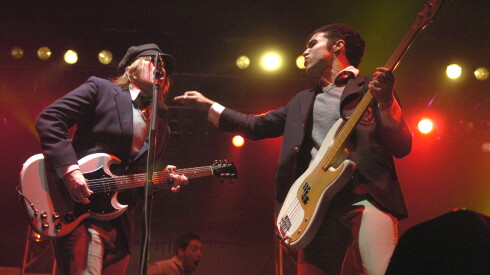
Pop-punk rockers Fall Out Boy performed at the Aragon several times in 2005 and 2006. Front man Patrick Stump still holds the venue close to his heart. “I’m still one of those guys who will always call it Sears Tower and say John Hancock, and I’ll always love and dream of the Aragon Ballroom.”
Sun-Times file
His love of the Aragon hints at a possible reason why some bands like Metallica in 1998 and Nine Inch Nails in 2018 have chosen to play Aragon rather than upgrading to much larger spaces like Soldier Field or United Center, even when demand is there and multi-night residencies have to be scheduled to accommodate.
“The Aragon is legendary and performers want to play legendary places that others have already been at,” said Mickelson, comparing the venue to San Francisco’s Fillmore Auditorium once run by legendary concert promoter Bill Graham. “Aragon was recognized throughout the country by agents and managers and bands as the place to play if you were a rock ’n’ roll band.”

Jam’s massive concert log speaks for itself. From 1973 to 2013 (after which Live Nation took over day-to-day operations), Mickelson and former partner Arny Granat booked everyone from Aerosmith to KISS, Black Sabbath, Prince, Lou Reed, Queen, The Rolling Stones and David Bowie (and would’ve hosted Amy Winehouse in 2007 but she ended up canceling her tour). Several acts like Green Day, Kraftwerk and The White Stripes also used their Aragon gigs to record live albums. And there were some oddball events from private bookings like when Blind Melon, Live and PiL shared a bill in 1992 for a Northwestern event and when Groupon booked Color Me Badd for a holiday party circa 2011-12, according to attendees. It hasn’t all been concerts; President Obama hosted his 50th birthday party there in 2011 and “Public Enemies” starring Johnny Depp filmed onsite in 2009.
But Jam Productions found a magic formula for booking shows that always drew a crowd. It was something Granat and Mickelson gathered from being young concertgoers themselves (Mickelson was only 19 when they started) and documenting everything over a year span in 1972 when they first started out at the Aragon running security for then-promoter Jan Winn before eventually taking over the booking reins. By 1975, they’d done so well for themselves, they were also curating music at the Uptown Theatre and Riviera.

“Security was where we learned a lot,” said Mickelson. “It gave us really good insight and we learned firsthand what shows were selling and what weren’t … what genres made sense and which didn’t, and then we used our own ears and gut to choose what bands we wanted to bring in.”
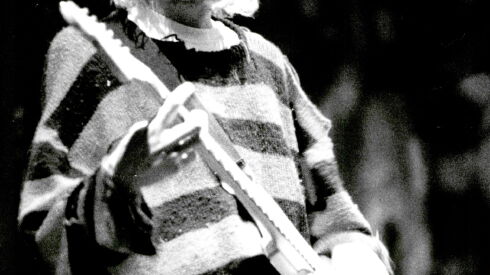
There were so many great shows in Aragon’s heyday that it’s hard to pick a favorite, says Mickelson, running through a short list of highlights. “The Rolling Stones [in 2002] were amazing and Bono walked on stage for a song. Alanis Morissette. Soundgarden had some killer shows there. Morrissey was always good. Foo Fighters were always great. How about in ‘75 with Aerosmith and Rush opening? The David Bowie Show [in 1997] was a Miller Lite show, and it wasn’t announced until he walked on stage. Nirvana in 1993 was amazing. That was when they were just so popular and were on fire. I’ve been blessed to see a lot of shows.”
If Mickelson has a say, he hopes the long-discussed idea of an official Uptown Music District (once championed by former mayor Rahm Emanuel) will happen. “That’s still the goal,” he said. Of course, that would mean reigniting Jam’s much-beleaguered Uptown Theatre, which has been closed to the public since 1981 (and would require a whole other article to cover), and maybe winning back Double Door, which just vacated its spot at the old Wilson Theater earlier this year.
“There’s been more talk of all that recently,” Blick said, noting that Rep. Mike Quigley just announced his mayoral bid inside the lobby of the Uptown. For now though, Blick says he’s grateful that such historic spaces like Aragon are still thriving in the neighborhood. “I think it’s incredible we’ve got these 100-year-old spaces that are still active and still have a life to them yet.”