In 2016, singer-songwriter Lucy Dacus made her debut at Lollapalooza, in Grant Park. Then just 21, she was an early, first-day act on the BMI Stage, one of the festival’s smallest — a slot that has become dubbed the “Lady Gaga” slot, after the pop icon performed there the year before her breakthrough album “The Fame.”
“I was super nervous,” Dacus recounted in a video call from her home in Los Angeles. “I lied about how big my crew was to get my friends in. I was like, ‘Yeah, this is my assistant, this is my other assistant, and this is my stylist.’”
Dacus, who went on to perform at Pitchfork and multiple times in Chicago on tours, is now shaking off nerves ahead of another Downtown performance, timed almost exactly 10 years to the day from her first Lollapalooza set.
This one, though, takes place on a stage that’s a little bigger: the Pritzker Pavilion in Millennium Park, where she will appear July 19 and perform orchestrated selections backed by the Chicago Philharmonic.
This is Dacus’s first time performing with a live orchestra.
“Maybe that’ll be fun for everyone to know that I’m completely out of my element,” Dacus, 31, said. “I guess it’s that feeling of enjoying being the fool — just entering a world I’ve never entered before, and trying to wrap my head around it.”
In the decade since her Lollapalooza set, Dacus has become one of the industry’s leading indie rockers, both for her own music and membership in boygenius, her band with fellow singer-songwriters Phoebe Bridgers and Julien Baker.

Phoebe Bridgers (from left) Lucy Dacus, and Julien Baker of boygenius pose in the press room with the awards for best rock performance and best rock song for “Not Strong Enough,” and best alternative music album for “The Record” during the 66th annual Grammy Awards in 2024.
Richard Shotwell/Invision/AP
She has also lent her voice — literally and figuratively — to progressive causes. Earlier this year, she performed at the inauguration of New York mayor Zohran Mamdani, and, for a time, she officiated mass weddings at her shows to counteract government threats to LGBTQ+ rights.
You won’t, however, hear wedding bells at July 19’s show. “[The concert weddings] took so much effort on behalf of my management team. I would love to do more of them, but I want to give my team a break,” Dacus said.
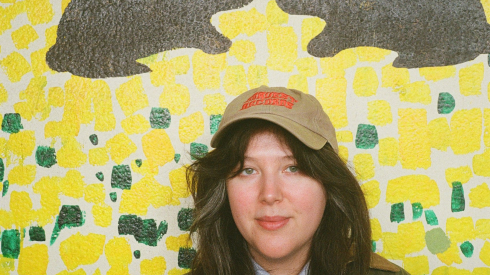
But to Dacus, this Chicago concert is more than a date on a busy tour calendar. She grew up visiting Millennium Park as a child, on road trips to Chicago; her mother, a recently retired music teacher, grew up in the western suburbs. Her dream college was the School of the Art Institute — and she would have attended, had the school given her enough scholarship money.
A family member will even share the stage with her at the pavilion: Her aunt, Deb Stevenson, is an oboist in the Philharmonic.
“There’s always a little piece in my heart in Chicago,” Dacus said. “I always thought that I would move there at some point.”
Dacus isn’t the first artist to cut her symphonic teeth with the Philharmonic. Originally founded by musicians from the Lyric Opera Orchestra, the ensemble has gained a reputation as a coveted cross-genre orchestra. To date, it’s supported artists like Laufey, Tank and the Bangas, Weird Al Yankovic, Tony Bennett, and, yes, even Lady Gaga.
On July 1, the Philharmonic became the first orchestra invited to perform at the Obama Presidential Center. It reunited with the cult singer-songwriter and violinist Kishi Bashi for the occasion.

“You see it in their eyes at the first rehearsal, when they hear their music in this way for the first time,” said Philharmonic executive director Terell Johnson of the orchestra’s many pop collaborators over the years. “It’s such a special experience for them.”
In some ways, Dacus’s orchestral foray is a natural progression from “Forever Is A Feeling,” the album she released last year. Bucking expectations, Dacus swapped her electric guitar with an acoustic for the intimate, stripped-down record.
That sensibility is established in the very first track: “Calliope Prelude,” a layered, ethereal violin solo by Dacus’s bandmate Phoenix Rousiamani. (Dacus herself doesn’t sing until the second track.) Also an accomplished composer of classical music, Rousiamani arranged Dacus’s music for the Millennium Park show, as well as another forthcoming symphonic concert at the Hollywood Bowl in September.
Dacus wouldn’t divulge which songs, exactly, Rousiamani has arranged for the occasion. But she says the 200-page score adapts songs from all over her discography. Some of the deep cuts surprised even her.
“I was like, ‘I would not have thought of that — that’s so old, and I never sing it,’” she said. “Phoenix is really creative . . . The songs are really reimagined, and there’s super interesting instrument choices and methods of playing them.”
Dacus’s show comes at a time when symphonic pop seems to be having a resurgence. Spanish singer Rosalía took the world by storm when she pivoted from danceable avant-pop to the lushly orchestrated “Lux” last November, featuring classical musicians prominently in her music videos and live tour. Guitarist and singer-songwriter St. Vincent also embarked on an orchestral tour this year; she’ll appear with the Chicago Symphony at Ravinia on July 25.
Dacus thinks that renaissance is no accident. She wonders if it might be “a natural reaction” to the upheaval she — and many other artists — are experiencing as generative artificial intelligence and other automated means of creation continue to boom.
“I mean, I love computer music, and I love electronic music. But there does seem to be this highlighting of human effort, because it takes so long to become good at these instruments,” Dacus said.
“I think a lot of musicians relate to that general desire to honor hard work and artistry… I don’t want that to disappear.”