The way Bob Singh sees it, the taxi industry has drastically changed, but he and other cabbies are still playing by the old rules, struggling to stay afloat as rideshare companies like Uber and Lyft dominate the market.
“Financially, it’s devastating,” Singh, 57, said.
But in the last few years, rideshare drivers have hit their own speed bumps. The app-based companies control their fares and the trips available to them, take an ever-changing percentage of their pay and sometimes cut off drivers’ accounts at a moment’s notice. City and state lawmakers recently took steps to support cabbies and rideshare drivers alike, but some worry it may be too little too late.
Since the pandemic, major commuting pattern shifts have hurt both taxis and rideshare services. And then there’s the emerging threat of autonomous vehicles looming over all drivers.
Still, cabdrivers have had the roughest road to navigate as the industry evolves. The competition from rideshare apps has sharply reduced the demand for cabs and therefore the value of taxi medallions — the government-issued permit required for taxis.
In Chicago, the price of a taxi medallion peaked in 2012 at nearly $400,000, according to city data. Now, they go for around $5,000, which has left many Chicago cabbies in significant debt.
A taxi driver for 36 years, Singh said he feels “stuck” in the business. He was just a kid when his family moved from India to the U.S., and he started driving taxis at 21.
Singh bought his first medallion in 1991 for $20,000. Two decades later, when he and his brother bought another medallion, it was valued at $360,000. But as the market for those medallions has plummeted, they still owe around $490,000 on the loan, with a monthly payment of nearly $3,500.

“[I’m] under a lot of stress,” Singh said. “I had to put my kids [two sons] through college. One is still in college. It was not easy, but I mean, what can you do?”
On a typical day, Singh makes about $80 from six rides, though he’s scaled back his driving in recent years to focus on managing his other vehicles and spending more time with family. Based on conversations with the drivers he works with, he estimated that the average Chicago taxi driver makes around $20 per hour, if not less. An exact citywide average is not publicly available.
‘An albatross around the neck of the taxicab industry’
A July 1 fare hike of 20% is the first increase since 2016. When it was being considered, some speculated it might reduce cab ridership. While it’s too early to assess its overall impact, after a couple of weeks Singh said his drivers “are happy.”
“So far, I think it’s a positive step,” Singh said.
Cabdrivers say the pay bump was long overdue to help them keep up with rideshare competition and skyrocketing costs.
“Will this increase help? Yes, but it probably doesn’t even catch us up to what we’ve lost over the last 10, 12 years,” said John Moberg, a former driver and current president of Checker Taxi Affiliation and Yellow Cab.

P.S. Sriraj, a transportation professor at the University of Illinois at Chicago, agreed with Moberg, saying the biggest issue in the taxicab industry is “not the operating cost. It’s the sunk cost.”
Medallions “are an albatross around the neck of the taxicab industry,” Sriraj said. “And those debts are still to be paid, and there is no wrangling out of that.”
Cabbies say that despite providing the same service, they’re placed on an unlevel playing field with rideshare drivers, who are not required to complete training or obtain a chauffeur license.
In most cases, rideshare drivers like Ebony Echevarria, 28, can apply online and start driving within a couple days.
“I was anxious the first time I took a ride because the whole time I felt like I was doing something wrong because it was so simple,” said Echevarria, a driver for Uber and Lyft for the last year and a half.

In Chicago, rideshare companies operate in the city’s Transportation Network Provider program, created in 2014 to regulate app-based services.
As of May, about 85,000 rideshare drivers were registered in Chicago, according to city data. That compares with about 2,600 active taxi licenses in the city.
Nearly a decade ago, in 2017, there were almost 25 million total taxi rides in the city. But as rideshare companies gained a foothold in Chicago, the market was upended.
In November and December 2018, the first two months of available rideshare data, the companies racked up 17.5 million rides, almost as many rides as cabs had that entire year. The following year, rideshare riders made nearly 112 million trips, the most ever. Meanwhile, taxi ridership dropped 21%.
Fast forward to this year. On an average day in May, Chicago riders took about 22,000 cab rides — but about 250,000 rideshare trips. That’s despite cab rides being typically cheaper per ride compared to a rideshare service, based on an analysis of city data before the new taxi fare hike went into effect this month.
A day in the life of a cabbie
Singh’s day usually starts at 3:30 a.m. when he awakes at his home in Palos Park.
He drives his yellow Dodge Caravan to Chicago for the first of three regular customers he drives to work each weekday. That takes from around 5 a.m. to 7 a.m.

He then cruises around the city to pick up more customers until around 10 a.m. Street hails are far less common than in the past; most taxi customers are connected through the rideshare app Curb or, since 2024, the Uber app.
After that, Singh drives to the Yellow Cab office in Irving Park, where he keeps tabs on the 14 other taxis he and his brother own before ending his day around 1 p.m.
On a recent weekday, the Chicago Sun-Times rode with Singh for several hours and accompanied him for one of his cab’s twice-a-year city inspections.

At 6:45 a.m., Singh is the first car in line at the city’s public passenger vehicle inspection facility at 2420 W. Pershing Road in McKinley Park. The facility opens at 8 a.m., and by that time, a dozen or so vehicles are lined up and waiting as cars get a thorough inspection one at a time.
Rideshare drivers, on the other hand, are required to have only one vehicle inspection a year. They’re typically done through a private mechanic and are not as onerous as taxicab inspections.
Singh’s inspection lasts about 30 minutes, but his two hours at the inspection office is time not spent picking up passengers. At the end, Singh gets a new medallion decal and inspection certificate.
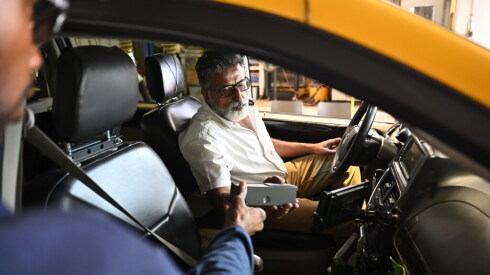
Soon after, Singh gets a customer. The $18 ride from Pilsen to the Magnificent Mile was booked through Uber.
Singh receives another ride request less than 10 minutes later. He drives to Old Town, where he picks up Fan Sun for a ride to his job near LaSalle and Adams streets.
Sun’s ride was also booked through Uber, but he chose the taxi option because it was $13, compared with $17 for an Uber driver. Having lived in New York, Sun is accustomed to taking taxis.
“I definitely had a special feeling with taxi drivers representing the culture and the ability to really go through many hurdles in terms of getting the medallion, maintaining it,” Sun said. “A lot of them are immigrants just like me, and I think that represents the spirit of the city really well.”

‘They are scraping by right now’
Despite its pole position in the market, rideshare driving comes with its own set of challenges.
While the barriers to entry are lower than the taxi industry, many rideshare drivers find themselves earning modest incomes while remaining heavily dependent on platforms that dictate the terms of their work.
That led to a push by rideshare drivers to pass a state law in May allowing them to form unions. The bill awaits Gov. JB Pritzker’s signature.
“Because affordability is at the top of everyone’s mind with gas prices rising, drivers really can’t wait. They are scraping by right now,” said Bailey Koch, spokesperson for the Illinois Drivers Alliance. “This is their full-time job, it’s how they pay their bills, and they just cannot keep up. And there’s absolutely no way they can make a change in their workplace without forming a union.”
In a statement, a spokesperson for Uber said the company supports the state law “because it preserves the flexibility that drivers consistently tell us they value most while creating a statewide framework for benefits, representation and workplace protections.”
A spokesperson for Lyft said the company looks forward to “working collaboratively” on the bill’s implementations and “addressing some of the rider impact concerns we have during rule making later this year.”

Echevarria, who lives in Rogers Park, drives long enough each day to at least earn the money needed to fill her 2023 Honda CR-V with gas, which has increased lately.
Before taking on a bigger role this year with the Illinois Drivers Alliance, Echevarria would drive about 12 hours a day — from 7 p.m. to 7 a.m. while someone was available to watch her young daughter.
On average, she makes about $20 per hour, driving roughly 20 hours per week.
“It’s impressive if you’re able to make over $200 in a day, and that’s before the expenses of taking care of your vehicle and before gas,” Echevarria said.
The AI-driven algorithms that rideshare apps use to determine prices act like a reverse lottery system that results in customers paying less but also drivers earning less money. A ride request will go to whichever driver in the area accepts the lowest fare.

The driver doesn’t take all of that fare. Rideshare companies take a cut, but the exact percentage can vary and is not disclosed. A spokesperson for Uber said, “A significant and growing portion of the fare goes toward covering insurance costs.”
Lyft takes about 14% of what passengers pay for a ride, and the company caps that share at 30%, according to a company spokesperson. After Lyft takes its share, then an undisclosed amount goes toward insurance, taxes and government-mandated fees, the driver takes home the rest.
“Unfortunately, there is not a real breakdown of [pay],” Koch said. “That is, I think, what’s really frustrating because there’s no transparent reason as to why a ride is a certain amount of money. And, say there’s a surcharge because of traffic or whatever else, drivers aren’t necessarily getting a bigger cut of that pie.”
Another big concern for rideshare drivers is sudden deactivations due to a rider complaint or poor rating.
“In the blink of an eye, a driver could be kicked off the app and not have an income,” said Koch, with the Illinois Drivers Alliance. “And there’s no way for them to give their side of the story, to have a process to get their job back, and usually when they’re reaching out, they’re not even talking to humans to try to repeal it, so they’re just stuck.”
‘What am I going to do?’
For the taxi industry to survive and coexist with rideshare services, legal reforms for cabbies and more regulations for rideshares are needed, said Sriraj, the UIC professor.
Chicago could implement a medallion debt relief and restructuring program like New York City did several years ago, he suggested. Outstanding medallion mortgages were reduced to $170,000, and monthly loan payments were capped at around $1,200.
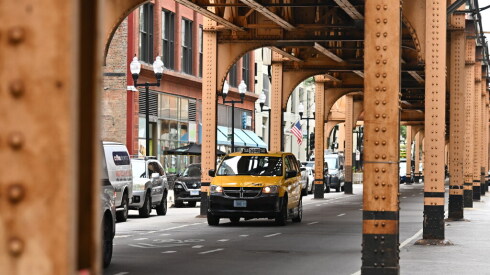
Singh said he would be in favor of debt restructuring. He remains in the business “until hopefully it will get better and then one day, hopefully, I can retire.”
“I’m stuck in this because I have no choice. I mean, what am I going to do? I’m 57 years old, where else am I gonna go?” Singh said. “Just roll with the punches and see how it goes.”
Still, the jovial taxi driver, whose favorite part of the job is talking with customers, has learned to keep things in perspective.
After driving for so many years, “You realize money’s not everything,” Singh said. “Health is really important. If you’ve got a complete family, count your blessings.”

For Echevarria and other rideshare drivers in Illinois, the future is just as uncertain but a little less gloomy.
Forming a union could help rebalance their relationship with rideshare companies. And it might provide some protections from the growing autonomous vehicle industry led by companies like Waymo.
“In the same way that the Uber and Lyft drivers have taken away from cabdrivers, those [autonomous vehicles] are trying to take away from us again,” Echevarria said. “So imagine in one generation being a cabdriver that then has had your job taken away [by] Uber, and then you become an Uber driver, and then you have your job taken away [by] Waymo.”
Contributing: Cam Rodriguez