Faith Hernandez waited a month for the Chicago Housing Authority to find her an apartment so she could get away from her abuser.
Then she waited a year for grab bars to be installed in the new home. Once installed, it took the city agency another two years to relocate her to a place closer to the hospital where she was getting treatment for multiple disabilities.
While she waited, her health worsened.
And she’d spend weeks stuck in her apartment with her infant son, unable to leave due to poor building conditions.
“I literally felt like I made a mistake, like I shouldn’t have left,” Hernandez, crying, said. “And that’s a horrible feeling, feeling like I shouldn’t have left my abuser for this situation.”
It can take years for CHA residents like Hernandez to move into another unit, after filing relocation requests with the agency over safety concerns. Some have been in limbo for as long as seven years. Some have died waiting, according to records.
Nearly 400 households currently are on waitlists to move, records show. About 150 of the requests are labeled an “emergency” by the CHA. And 241 of the transfer requests are to accommodate disabilities.
Among the other reasons CHA residents have sought emergency transfers: “infestation … mold … fire.” Records also show 103 transfer requests cite the Violence Against Women Act, and 24 are described by CHA as “not habitable.”
In February, a CHA employee filed a whistleblower complaint accusing the agency of failing to follow its reasonable accommodations process for residents with disabilities.
This comes as about 18% of the CHA’s roughly 21,400 public housing units — 3,978 apartments — are vacant, most of them because they are uninhabitable, records show.
CHA officials declined an interview request.
In a written response to questions, a housing authority official said: “The majority of CHA’s vacant units are pending comprehensive rehabilitation to ensure residents have the reliable housing that enables them, and Chicago communities, to thrive.” That work will cost tens of millions of dollars, according to the agency.
The agency supports 65,000 households, is the biggest owner of rental housing in Chicago and operates with a yearly budget of $1.4 billion.
When Hernandez moved away from her abuser to the CHA’s Dearborn Homes in 2019, she questioned doing so, experiencing broken elevators and crime. Because of her disabilities, Hernandez can’t easily go up stairs, especially to her sixth-floor apartment.
“No domestic violence survivors should have to feel like: Should I leave?” Hernandez said. “They should feel like they have the support of CHA and not like they are the enemy. I felt like I was fighting them this whole time. If I didn’t have Legal Aid support, I would probably still be at Dearborn.”
With Legal Aid Chicago, Hernandez filed a complaint in 2020 to HUD against the CHA after months of inaction from the authority following her move to Dearborn. She accused the CHA of being in violation of Section 504 of the federal Rehabilitation Act of 1973, the Fair Housing Act and the Violence Against Women Act. Section 504 is part of the federal civil rights law that bars discrimination against people with disabilities in programs that get federal funds.
In a 2024 letter, HUD said the CHA had violated Section 504 and the federal Americans with Disabilities Act by failing to provide Hernandez with reasonable accommodations.
As a result, HUD told the housing authority to provide Hernandez with monetary relief, reform its reasonable accommodations policies and comply with federal law — steps to be outlined in a voluntary compliance agreement between the CHA and HUD, records show. The federal agency is still investigating Hernandez’s fair housing and domestic violence claims, according to Julie Pautsch, a Legal Aid Chicago lawyer who wouldn’t discuss the status of the voluntary compliance agreement, citing ongoing negotiations.
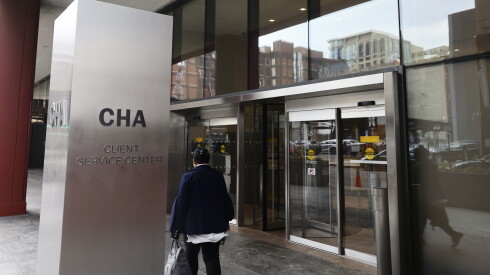
In a 2024 decision, the federal Department of Housing and Urban Deveopment found that the Chicago Housing Authority had violated Section 504 and the federal Americans with Disabilities Act by failing to provide CHA resident Faith Hernandez with reasonable accommodations.
Anthony Vazquez / Sun-Times file
The CHA and HUD also have been negotiating a voluntary compliance agreement to resolve issues from a 2018 complaint similar to Hernandez’s, according to public records and sources involved in the negotiations. The CHA previously came under a compliance agreement from 2006 to 2013 for Section 504 and ADA violations.
CHA spokesperson Matthew Aguilar said no voluntary compliance agreements are currently in place and the agency hasn’t received new drafts from HUD. HUD officials wouldn’t comment.
In February, the housing authority established what it calls a Reasonable Accommodations Task Force to review its practices and find ways to improve its process working with residents who have disabilities.
The housing authority has a long legacy of neglecting its properties and has pointed to a lack of federal funding to maintain its units. The CHA took austerity measures in its latest budget, citing existing and anticipated federal cuts. Historically, HUD funding hasn’t kept up with public housing authority needs.
The CHA, which is the third-largest public housing authority in the country, is in the midst of a significant transition. Keith Pettigrew recently came on as CEO after the agency had gone 17 months without a permanent leader. The agency has faced high turnover among its top ranks and frustrations from its residents over what they say are dire property conditions.
The Mayor’s Office for People with Disabilities declined to comment, referring the Sun-Times to the CHA.
At Dearborn Homes, Hernandez said the CHA repeatedly told her it would accommodate her needs but never did, leaving her feeling like she was “fighting them this whole time.”
When the housing authority offered her a different unit in 2020, she rejected it, saying it was near her abuser’s house and at least an hour by public transit from her hospital.
In December 2021, as a result of the negotiations over her HUD complaint, the CHA offered Hernandez an emergency housing voucher to use to find a privately-owned place to live, records show. She said it took about six months to find a landlord who would accept the government housing subsidy. Though it’s illegal in Illinois to discriminate against a renter based on source of income, many property owners are reluctant to take housing vouchers.
Hernandez remembers standing in her doorway, where she got better cellphone reception, when she heard HUD had sided with her complaint. She said she cried.
“I couldn’t believe it,” she said.
But Hernandez is still waiting for the CHA’s negotiations with HUD to be resolved. For herself and others, she said, she wants complete accountability from the CHA.
She still faces consequences from waiting on the CHA. Hernandez said her back problems have gotten worse, making it harder to walk down the street to a park with her son, who is now 7.
“I can’t get back my health,” Hernandez said. “I am suffering even more now, and … it takes away from my son.”