Students, parents and teachers at a private school run by the University of Chicago are rallying against a policy they say limits what students are exposed to at school and hurts teachers’ ability to support marginalized students.
A new policy at the University of Chicago Laboratory Schools, which serve around 2,000 students from preschool through high school, establishes “standards for viewpoint-neutral education” and gives teachers guidance on how to handle “contested issues.”
School administrators say the policy, which had gotten pushback since a draft was first shared in January, is meant to encourage students to become “independent thinkers” and support “open inquiry.”
“The purpose of viewpoint-neutral education is not to limit inquiry or discourage engagement with difficult, important, or contested topics,” the policy states. “Rather, the goal is to ensure that Lab classrooms and school spaces remain… places where students can encounter, explore, and evaluate important questions without being steered toward or away from particular conclusions by the authority of adults.”
But dozens of parents, many of whom are faculty at the University of Chicago, say the policy actually restricts conversations in the classroom and could prevent teachers from creating an inclusive environment for students.
Some faculty members, led by the university’s chapter of the American Association of University Professors, gathered on the school’s Hyde Park campus Friday to deliver a petition to administrators opposing the policy. Many wore shirts that read “free teachers raise thinkers” and held signs with the phrase “Love is love, neutrality enables hate, let our teachers advocate.”
“Usually rules that restrict what people can say are called censorship,” Patrick Morrissey, a professor of poetry at U. of C., said at the protest.
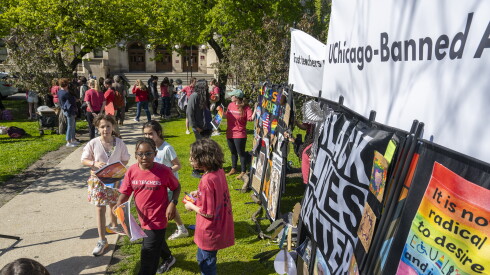
The University of Chicago and the Lab Schools didn’t respond to requests for a response to the protest.
The new policy has attracted attention because the Lab Schools are known for their academic rigor and experiential learning and some worry the policy will undermine that approach.
Other parents support the policy, saying that teacher advocacy had begun to overshadow academics in the classroom, according to reporting in the University of Chicago’s student newspaper, the Chicago Maroon. Some parents said the policy encourages multiple viewpoints on current events and sticky real-world issues.
“If you care about diversity, you should be delighted that there’s an emphasis now on diversity of viewpoints,” a parent who declined to be named told the Maroon.
The policy says teachers are allowed to take a stance on “widely settled historical judgments,” like denouncing slavery and the Holocaust, but taking a position on current debates is discouraged.
A “frequently asked questions” document related to the policy identifies several “active areas of disagreement in contemporary public debate” where teachers should remain neutral, including abortion, immigration laws and enforcement, policing and climate policy.
The policy says Lab School classrooms will still be welcoming to all students, but protesters worry some students’ identities and beliefs are tied up with ongoing political debates, and that could make them feel ostracized.
For example, some worry the policy is especially difficult for transgender students, as the Trump administration continues to put forward policies that target trans people. Federal officials are investigating Chicago Public Schools for allowing trans students to use the bathroom that aligns with their gender identity and other schools in Illinois over whether parents are allowed to opt out of lessons that talk about gender identity.
“Let’s be clear that neutrality that refuses to protect vulnerable children is not neutrality at all,” said Michele Friedner, a U. of C. professor who has a transgender child at one of the Lab Schools and felt like her child was already separated from other students when they were made to room with the only other trans student on a school field trip.
“Think about what this means for a child, for children, to walk into a school and understand that the institution is debating whether you deserve recognition, protection, or dignity at all,” Friedner said.
The debate at the Lab Schools takes place against the backdrop of the Trump administration’s attacks on diversity, equity and inclusion in K-12 and higher education and efforts to remove instruction about LGBTQ people and themes from school lessons. Some see this policy as similarly controlling classroom conversations.
“Let’s be clear, that’s what contested issues are: Anything that might upset the Trump administration, its collaborators, and those who wish to curry favor with him,” Morrissey said.
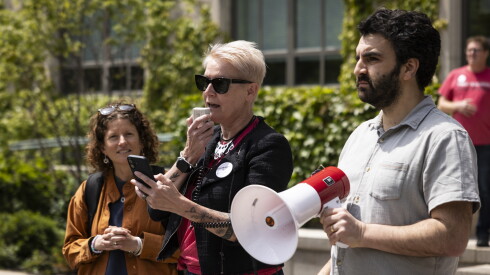
University of Chicago professor Jessica Darrow (center) said her seventh grader has seen how the new policy can limit classroom conversations and prevent teachers from taking a stance on issues, such as whether students should try to put a stop to bullying if they see it happen.
Ashlee Rezin/Sun-Times
And while the U. of C. takes a similar approach by not taking stands as a university on certain political and social issues, faculty members raised concerns that a similar policy could be adopted that would more directly affect how they teach. Jessica Darrow, a professor in the university’s Crown School of Social Work, said social justice is central to her work and a neutrality policy could go against her profession’s code of ethics.
“My students need to be able to learn to take a stand on social issues and not remain value-neutral on issues,” Darrow said.
Darrow has two sons who’ve attended the Lab Schools. She commended several parts of how the schools work, including their focus on experiential and play-based learning.
But she thinks administrators are overstepping with this policy.
Darrow’s younger son is in seventh grade at a Lab School, and he also takes issue with the policy, she said. He appreciates hearing his teachers’ thoughts and feelings during lessons, and he learns more about how to interact with others when his teachers aren’t worried about violating the policy.
Darrow said her seventh grader saw the policy’s negative effects during a recent classroom conversation about bullying. His teacher explained the difference between a “bystander,” someone who merely observes bullying or other harmful behavior, and an “upstander,” someone who tries to put a stop to it. Darrow’s son told her the teacher stopped short of recommending which path students should take because he didn’t want to be reprimanded for violating the policy.
“I think that’s where the problem lies,” Darrow said. “The chilling effect of these standards on our teachers’ ability to really do their jobs well.”