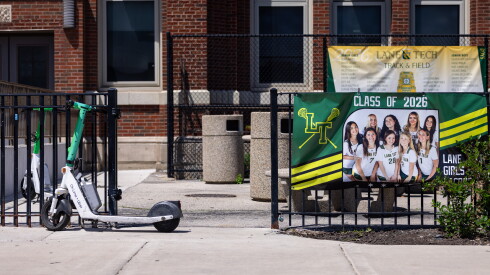
With summer break days away, Julian Hosek pulled up to Lane Tech College Prep on an e-scooter and locked it to a pole. He was running late to class.
“I use [scooters] because I usually get to the train stops a little late,” said Hosek, a 17-year-old junior. “The bus is slower than the scooter. Or sometimes the bus won’t come.”
The bell rang, and more students arrived the same way — mostly boys, none wearing a helmet. They left the e-scooters strewn along the sidewalk, against fences, beside street signs.
For them and many other Chicago teenagers, e-scooters have become part of their daily life, a faster, flexible alternative to buses and the L.
Their popularity among teens — some who ride them despite being too young to do so legally — is growing even as the city is seeing a rise in scooter-related crashes. That’s raised safety concerns among doctors and city officials.
Two teens have died in Chicago this year while riding e-scooters.
“I do worry that we will see an increase in injuries as it’s getting warmer and more people are utilizing these devices and just increasing the opportunity for injury,” said Dr. Caroline Chivily, a pediatrics resident at Lurie Children’s Hospital.
Booming ridership
The city of Chicago launched its first e-scooter pilot program in 2019. By 2022, Lime and Divvy e-scooters became fixtures around the city, with their fleets growing significantly since then. Lime, owned in part by Uber, had 1,000 scooters in Chicago in 2022. It’s now up to 11,000. Divvy, operated by Lyft, has expanded its fleet to 2,800 e-scooters.
Combined e-scooter ridership for the two companies totaled nearly 7 million trips last year, according to the city of Chicago Department of Transportation.
As their fleets have grown, so has the number of crashes. The Chicago Fire Department responded to nearly 200 e-scooter-related incidents in 2022. Within three years, that number had more than tripled.
Though Lime and Divvy require riders to be 18 or older — or at least 16 with parental consent — underage riders still use them. An evaluation of the city’s 2020 e-scooter pilot program found that minors accounted for roughly 13% of reported injuries.
Lane Tech freshman Kaylee Hassman, 15, said she has had no problem renting a Lime e-scooter. “I rented one for, like, 10 minutes to get home because it was just more convenient,” she said.
Lurie Children’s Hospital has found that, among young people, kids 10 to 15 years old suffer the most injuries, from skin burns to skull fractures.
“Oftentimes, kids don’t have the gross motor skills needed to operate the devices,” said Chivily, who said they could have issues with balance, coordination “and the ability to assess and navigate really complex traffic routes.”
But Chivily said a lot of injuries are the result of distracted riding, having more than one person on a single scooter and riders wearing headphones.
“A lot of these injuries are preventable,” she said.

Big with boys
Outside Lane Tech, most of the riders are boys. The city’s e-scooter pilot similarly found that 60% of riders are male.
“I think that’s because guys like to be together on scooters, and it’s more of, like, their manly, weird thing,” said Lane Tech junior Ramona Scott, 16, who said she’s never ridden one. “Girls find it unsafe and not fun.”
“I’ve fallen off of them like once or twice,” said Taylor Clay, 17, a Lane Tech junior who said he rode e-scooters last summer whenever he was late getting to football practice.
Another junior at Lane Tech said he got hit by a car one time while riding.
“My backpack flew everywhere,” the boy said, not wanting to give his name. “Nothing really happened to me. I mean, the scooter locked, so it didn’t let me get anywhere. I just didn’t go to school that day.”
Despite the crash, he said he still scoots home sometimes — a 30-minute commute to the West Side for him during rush hour.
For some, the cost is what keeps them from riding more often.
“It was on the weekends for fun,” said Milo Zima, a Lane Tech senior who said he used to rent one to hang out with friends. “But, like, at the time, I wasn’t really making enough money to have like multiple hours on an e-scooter.”
A Lime scooter typically costs about $0.44 a minute to ride, plus $1 just to unlock it.
Hosek said he spends about $60 of his monthly allowance on e-scooters.
Luciana Lindemann, 17, said renting e-scooters a few times a week would be too expensive. But she’s considering buying one. It would be cheaper than buying a car, she figures. And she’d spend less on buses and trains.
Lindemann said she knows about the danger of riding on a busy street.
“I’d probably ride on the sidewalk,” she said, “even though that’s illegal.”