Adam Hirsch has a favorite phrase about the industry his family has been in for 80 years.
“When the country goes to hell, we do well,” he said.
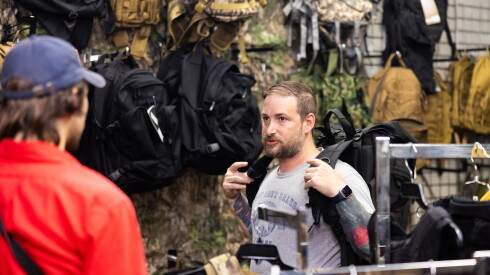
Hirsch, 42, took over the Lake View store Army Navy Sales from his father in 2012, returning to his hometown from Los Angeles, where he was a television producer.
Now, he spends his days in the store — clad in an Army Navy Sales T-shirt — sorting through a seemingly endless inventory of military surplus goods.
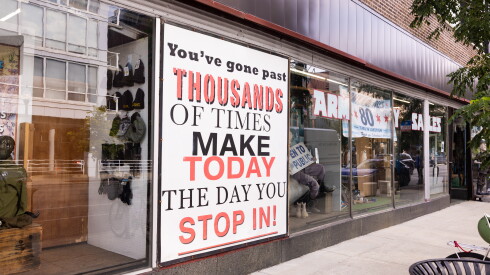
This year, the business, at 3100 N. Lincoln Ave., which touts itself as the last authentic military surplus store in Chicago, marks its 80th anniversary.
The surplus industry stems from the excess military goods following World War II, when entrepreneurs began buying items in bulk from the government to resell to the public. But the business isn’t as popular as it once was, Hirsch said.
“A lot of young people don’t know what surplus is. A lot of young people want to buy brands,” he said. “They want to buy Patagonia. They want to buy North Face. What we sell is government surplus, so it’s not really branded stuff. It’s stuff that the government made, but it’s very high-quality, American-made stuff.”
Hirsch’s grandfather Soloman Schrek started the business after escaping Nazi Germany. In the United States, he became a translator for the Army. Then, Schrek got married and moved to Chicago, planning to become a dentist.
“He was in a surplus store looking to help, looking to get a job,” Hirsch said. “He helped out some customers. The person in charge saw he was doing a good job and hired him.”
The job blossomed into a partnership until Schrek and the owners divided the store’s locations between them, resulting in Army Navy Sales officially starting in 1946. Schreck and his wife Pauline, who was a lieutenant in the Army Medical Corps, teamed up to run the business, which at one point had four locations.
“He knew military surplus,” Hirsch said of his grandfather. “It was a much more popular category back in the ’40s.”
Army Navy Sales has remained in Lake View, but it wasn’t until 1972 that the couple moved to the Lincoln Avenue storefront to consolidate in one location.
Schreck died in 1998 while packing for a trip to source surplus goods from Las Vegas. He was 75. Pauline Schreck died the following year, at 82.
Hirsch’s parents took over Army Navy Sales and launched its e-commerce site in 1999. Hirsch’s father retired about a decade later, handing the reins to Hirsch.
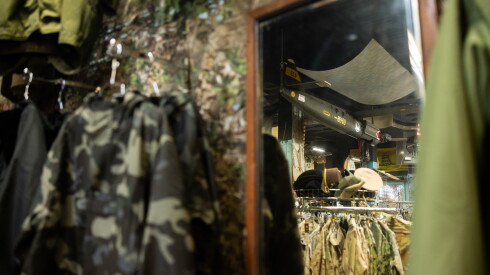
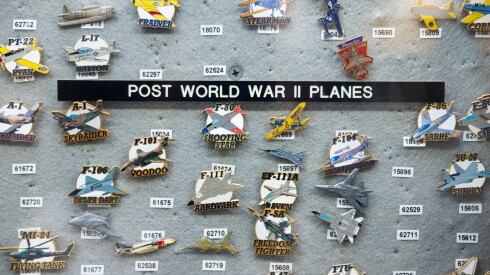
A WWII drone, once used for target practice, hangs from the ceiling in the 3,500-square-foot store, above all of the pea coats, boots, camouflage pants, flight jackets, cargo pants and gas masks. Survival manuals from the 1970s decorate the shelves, along with a varied inventory of backpacks and combat boots. Some of the items were made as long ago as the 1960s. Many have never been worn.
There also are things like an M1945 cargo field pack, made in 1950 and unused — an army green bag priced at $49.99.
The business has two warehouses and rents two other spaces.
Surplus stores like Army Navy Sales can source directly from the government and soldiers as well as from businesses that are being liquidated, manufacturers of commercial reproductions and specialized manufacturers. But Hirsch said he hasn’t had to source inventory in a long time. It’s an industry known for its “buy-and-hold” philosophy, with inventory built over decades.
“People are always looking to surplus stores for high-quality, American-made stuff that’s inexpensive, and so, when the economy is not doing as well, that’s when people are looking to maximize what they can get,” he said.
Over the years, times of crisis — like the period after the Sept. 11, 2001, attacks and the COVID-19 pandemic — have seen sales rise.
“COVID was actually really good for us,” Hirsch said. “People were convinced the world was going to end, They needed supplies for the world ending.
“A bigger event for us was the start of the Ukraine war. We had people coming in buying large quantities of items that they could send over to Ukraine.”
He said Army Navy Sales donated 5% of its sales to support Ukraine.
Protesters are also frequent customers, he said, going back as far as 1968, when demonstrators bought helmets and protective gear ahead of the Democratic National Convention. Black Lives Matter protests in 2020 led to another spike in business.
People also come in looking for Halloween costumes.
Military apparel has also been “at the forefront of fashion,” Hirsch said. “A lot of fashion trends start in the military: pea coats, bell bottoms, chevron designs — all that’s out of the military. . . And fashion designers have taken that sort of thing and made it nice and pretty.”
Army Navy Sales has worked with fashion designers and will be exhibiting in the Strut Fashion Show this winter as part of a World AIDS Day event.
Hirsch hopes to eventually turn over the business to his two children — if they’re willing. Surplus stores tend to be family-run.
“And what we’ve seen over the past 20 years is the family member gets older, they want to retire, there’s no one new to come in and take over,” he said. “We see a lot of stores closing up just because there’s no one to take over.”