Good morning, Chicago. ✶
🔎 Below: More than a year after Illinois signed a first-of-its-kind climate migration law, little has been achieved.
🗞️ Plus: Why some homeowners are building for severe weather, showtime for the White Sox and Cubs — and more news you need to know.
📝 Keeping score: The Bears beat the Eagles, 27-7.
🌤️ Today’s weather: Partly sunny with a high near 76.
📧 Subscribe: Get our morning newsletter delivered to your inbox weekday mornings.
⏱️: An 8-minute read
TODAY’S TOP STORY 🔎

Illinois passed the nation’s first climate migration law. The effort has languished since
Reporting by Juanpablo Ramirez-Franco
How it started: Last fall, Gov. JB Pritzker signed the Climate Displacement Act, legislation aimed at anticipating how climate-driven migration could transform life for Illinoisans and those arriving after climate disasters elsewhere. The law established a task force to investigate and publish reports on how climate migration patterns could test Illinois’ infrastructure, resources and residents.
How it’s going: State officials have largely neglected their plans. Lawmakers have pushed back reporting deadlines and are yet to convene the task force, even though the first report is due in December. Pritzker, the state’s top lawmakers and the heads of several state agencies were supposed to appoint members to the board. Until last week, one appointment had been made.
Key context: Climate disasters force millions worldwide to leave their homes every year, growing the population of climate migrants. In the aftermath of floods, fires and droughts, they face the challenge of finding a new place to rebuild their lives. The number of climate migrants is expected to climb as the planet grows hotter.
HOUSING AND DEVELOPMENT 🏠
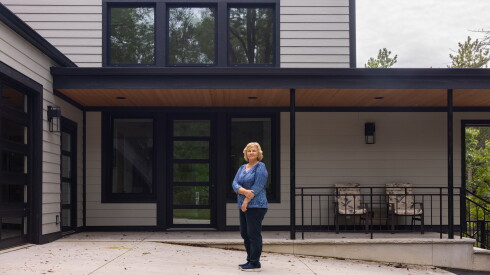
Some see passive homes as severe weather answer
Reporting by Abby Miller
Passive aggressive?: One growing response to severe weather and rising energy bills is passive building, a green energy standard that focuses on insulation and making homes airtight to reduce heating and cooling loads. Passive homes drastically reduce energy use and carbon emissions. In Chicago, passive building is being seen in single-family homes and also in a mixed-use development set to be the city’s largest passive home project.
For example: When storms pummeled northwest Indiana in August, Beverly Shores was without power for days; some in the region were powerless for weeks. Violeta Burokas’ home was fully powered thanks to energy stored from her rooftop solar panels. Her property was built with triple-pane windows, an extra-thick layer of insulation and thicker walls. Extra energy in her home is stored in batteries. Her electricity bill last month was $37.
SMALL BUSINESS 🪖
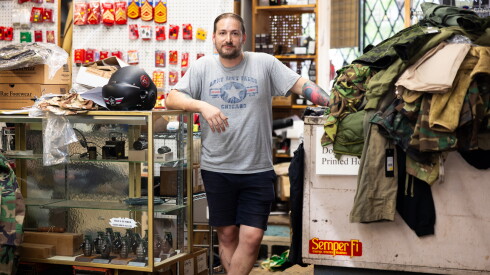
Military surplus store marks 80 years in business
Reporting by Mariah Rush
Marking a milestone: This year marks 80 years since Adam Hirsch’s grandfather started Army Navy Sales in Lake View after escaping Nazi Germany. Hirsch, 42, took over the store from his father in 2012, and spends his days sorting through a seemingly endless inventory of surplus goods. The business touts itself as the last authentic military surplus store in Chicago.
Key context: The surplus industry stems from the excess military goods following World War II, when entrepreneurs began buying items in bulk from the government to resell to the public. But the business isn’t as popular as it once was, Hirsch said. “A lot of young people want to buy brands. … What we sell is government surplus … it’s very high-quality, American-made stuff.”
MORE NEWS YOU NEED 🗞️

- Ridge Avenue rescue: At Ridge, Wayne and Hollywood avenues in Edgewater, officials broke ground Monday on a hybrid beacon — a kind of traffic light activated only when a pedestrian pushes the call button.
- Man charged in baby’s shooting: Davaris Washington meant to pull the trigger on a power drill when he accidentally fired a gun and struck his girlfriend’s 1-year-old, prosecutors said.
- Planes fly afoul: Fifteen private planes violated a temporary flight restriction put in place Sunday during President Trump’s nine-hour trip to Illinois, with flares being deployed at two planes.
- Budget boundaries: One year after rejecting Mayor Brandon Johnson’s corporate head tax, 29 opposition alderpersons are trying to establish boundaries for the current budget debate. At the top of the list — no property tax hike.
- Remembering Bill Linden: A former Sun-Times page designer, Mr. Linden was known as “Captain Fun” — never missing an opportunity to make people smile. He died Sept. 15 at age 79.
- Airfare costs to takeoff: Travelers planning to fly this holiday season should expect to see higher airfare costs thanks to rising fuel prices, experts say.
- CSO rebrands: Chicago Symphony Orchestra’s parent organization is changing its name to just Chicago Symphony, and dubbing its Michigan Avenue home the Chicago Symphony Center — a rebrand it hopes will entice audiences.
ON WBEZ 91.5 FM 📻
In the Loop with Sasha-Ann Simons, 9 a.m.
- Climate migration law: WBEZ’s Juanpablo Ramirez-Franco and Illinois State Sen. Graciela Guzmán join the show to discuss the legislation’s progress.
- Unsealed time capsules: A new Harold Washington Library exhibit displays pieces students left in a 2021 time capsule, revealing young people’s perceptions of life during the COVID-19 era.
-
UIC milestone: How the Rafael Cintrón Ortiz Latino Cultural Center at University of Illinois Chicago is celebrating its 50th birthday.
Say More with Mary Dixon and Patrick Smith, 10 a.m.
- Fandoms: What are you a fan of? Callers and a guest expert weigh in.
CHICAGO MINI CROSSWORD 🌭

Today’s clue: 5D: Candy company whose headquarters are located on Goose Island
FROM THE PRESS BOX 🏈⚾🏒

- Passed and presence: Journeyman Case Keenum delivered an unforgettable performance Monday for the Bears in relief of QB Caleb Williams. Here’s how we graded the rest of the crew.
- White Sox’ moment: Sox slugger Munetaka Murakami says he’s ready for a “big, long postseason run.” He’ll get his chance Tuesday night in Houston. On the mound, Hagen Smith will open things up.
- Making the difference: Will Pete Crow-Armstrong bring his MVP show to the playoffs? Will Alex Bregman keep hitting through facial fractures? Will the Cubs’ bullpen be lights out late? All this and more could be the difference between advancing or going home vs. the Padres. The Cubs will lean on Matthew Boyd for Game 1.
- The fun times?: After years of rebuilding pain, will this season finally be the Blackhawks’ takeoff point? Ben Pope gives his take ahead of Tuesday’s season opener.
BRIGHT ONE 🔆

Artists strive to connect neighbors via viaduct murals
Reporting by Genevieve Bookwalter
A recently painted mural under the CTA Red Line viaduct at Cermak Road and South Clark Street is the first of three to encourage residents to walk between Bronzeville, Chinatown and Pilsen.
The three communities of color are separated by social and physical boundaries, say Consuela Hendricks and Angela X Lin, co-presidents and co-founders of People Matter, a nonprofit whose goal is to end racism.
By improving the viaducts, which often serve as geographical neighborhood boundaries, they hope to encourage residents of Bronzeville, Chinatown and Pilsen to explore each other’s communities.
Hendricks and Lin are passionate about improving race relations between Black, Asian and Latino communities. The mural project, titled Breaking Community Bubbles, aims to do just that.
“We can walk into each other’s communities and learn,” Hendricks told the Sun-Times.
YOUR DAILY QUESTION ☕️
What Chicago neighborhood feels like a small town? Tell us why.
Reply to this question via email (please include your first and last name). We may run your answer in a future newsletter or story.
On Monday, we asked you: What’s an example of Chicago architecture that you think is overlooked?
Here’s some of what you said, edited for length and clarity:
“Brewster Apartments, 2800 Pine Grove. Romanesque exterior and preserved original interior details.” — John Kovach
“There is a little control room on the Clark and Lake bridge. I wish I could rent it out to live in. So cool.” — Terrence Camodeca
“Joseph Lyman Silsbee’s contributions to the city, such as the quirky little cottage south of the Brauer Cafe, the Lincoln Park Conservatory building, the May chapel in Rose Hill Cemetery, the interiors of the Potter Palmer Mansion, to name a few.” — Howard P. Mock
“The work of Zachary Taylor Davis. Everyone knows Wrigley Field and Comiskey Park, but far fewer people know the architect behind them or the remarkable range of his work. His residential, commercial and industrial buildings are part of the architectural fabric of Chicago, yet his contribution remains surprisingly overlooked. I may be slightly biased, he was my great-grandfather.” — Todd S. Davis
PICTURE CHICAGO 📸
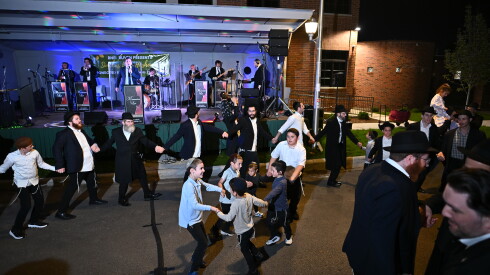
Dancers form a circle in the street Monday night during “Dancing in the Streets” outside Congregation Bnei Ruven in West Ridge. It was part of Simchas Beis Hashoeva, celebrated during the Jewish holiday of Sukkot, which marks harvest season.
Victor Hilitski/For the Sun-Times
Thanks for reading the Sun-Times Morning Edition!
Got a story you think we missed? Email us here.
Written and curated by: Matt Moore
Editor: Michael Lansu
Copy edited by: Satchel Price