The Obama Presidential Center had to overcome many hurdles before coming into existence, including continual protest and two federal lawsuits. The same is true for the parkland the center rests upon, which from the start sparked debate and litigation. Even the park’s name was once subject to “universal” outcry.
When formed in 1869, the Chicago South Park Commission faced seemingly insurmountable obstacles. First, it had no money — its authority to raise taxes ended up in front of the Illinois Supreme Court. Second, it had no land: The property it wanted was in the hands of people who demanded “exorbitant prices” or passionately refused to sell. Third, its legal right to exist was questioned.
Or, as the Chicago Times wrote, reporting on the commission’s first annual meeting in 1870:
“Many persons owning property within the park and others on general principles and for various reasons manifested strong opposition to every measure tending to produce this result and proclaimed that, as advised by ‘counsel learned in the law,’ the South Park Act was unconstitutional and void.”
But a bond of $1,642,000 was floated, with $918.87 for office furniture and $1,500 to Olmsted, Vaux & Co. to assess the suitability of the area around Drexel and Kankakee avenues as a future park for a city whose population had nearly tripled in the previous decade.
The landscape firm was headed by Frederick Law Olmsted, famous for turning the ruins of “pig-sties, slaughter-houses, and bone-boiling works” into New York’s Central Park and more recently carving 1,600 acres of Cook County farmland along the Des Plaines River into the nation’s first planned suburb, aptly named Riverside.

In his 1871 “Report Accompanying Plan for Laying Out the South Park,” Olmsted wistfully invoked “the great roaming grounds” of London and Paris before delivering the bad news about the barbell-shaped, 1,000-acre property that Chicago wanted to render into parkland.
“Your territory lies at the distance of six miles from the center of business of Chicago and quite beyond its corporate limits,” he wrote — indeed, Hyde Park would not join Chicago until 1889. “Its neighborhood is mostly uncultivated country, much of it unenclosed and sparsely inhabited.”
The city could double and double again, Olmsted wrote, and yet the park “will not be much used by the citizens of Chicago.”
Here he was mistaken. While Jackson Park would never become the central civic feature that downtown’s Grant Park would be, it would serve the recreational needs of the city’s vibrant South Side, include two popular beaches, and bask in international attention as host of the 1893 World’s Columbian Exposition. It would leave a legacy of one cultural landmark, the Griffin Museum of Science and Industry, and another frequently overlooked gem, La Rabida Hospital — leading eventually, despite furious efforts to thwart it, to the Obama Presidential Center.
Olmsted’s task, and his obstacles
Back in 1871, though, Olmsted bemoaned the land he was given to work with.

“The first obvious defect of the site is that of its flatness,” he wrote. What is needed is “a mountain glen with a dashing stream and cascades.”
That being impossible, Olmsted’s view fell upon an undeniable “highly picturesque” feature already right there: Lake Michigan.
Olmsted envisioned a series of lagoons connected by a mile-long canal, the Midway Plaisance — an old French word for “pleasantness” — the assumption being that most Chicagoans making the journey would go by boat. The first L tracks wouldn’t be laid until 1892.
Fate had other ideas, namely the Great Chicago Fire of October 1871 that destroyed the South Side Park Commission office — along with most of Olmsted’s plans.
With the city furiously rebuilding, the landscaping needs of a new South Side park were set aside. Though rubble from the burned districts would be shoved into the lake and become the foundation of Grant Park, nothing much was done for Jackson Park for nearly 20 years except to give it a name in 1881. The western section was dubbed Washington Park and the eastern Jackson Park, which, in the view of the Chicago Tribune, warranted an “inquiry into how this offensive partisan name came to be given.”
Controversy over Jackson Park’s naming
The Tribune didn’t view Andrew Jackson as unworthy of the honor because of his brutal treatment of Native Americans, but because he was a Democrat. The fiercely Republican newspaper questioned whether the park had even been named for the seventh president.
“The people are in doubt whether it was called after Gen. Andrew Jackson, the sponsor of the spoils system in American politics, or Gen. ‘Stonewall’ Jackson, the idol of the Confederates,” it sniffed.
In 1890, after Chicago won a furious tug-of-war with New York over rights to hold the world’s fair, Olmsted was again called on to fashion the park. He initially declined — why bother designing something temporary? But a member of the fair’s board, James Ellsworth, president of a local coal mining company, went to Maine and begged Olmsted in person, and he relented.
The fair could have gone anywhere. Jackson Park, one of seven potential sites, was “a wasteland of sand hills and swamps with a few unloved trees thrown in.” Jackson Park’s emptiness became a plus: It was a blank canvas on which to create a fairgrounds. Plus, the new rail line went by.

The 1893 World’s Columbian Exposition drew 26 million visitors and was a key transformative event in the history of Chicago, second only to the Great Fire. Space hardly permits listing all of the products that debuted at the fair, starting with the first Ferris Wheel (the idea being, “Let’s make an Eiffel Tower that spins”) to the moving walkway, the zipper and Cracker Jack. The mechanical dishwasher, invented by an Illinois society matron tired of her servants breaking her china, debuted, as did Cream of Wheat, Shredded Wheat and Juicy Fruit gum. Pencils are typically yellow to this day because the Koh-I-Noor company made a splash at the exposition with its display of pencils enlivened with 14 coats of golden-yellow lacquer.
At the fair, Pennsylvania caramel manufacturer Milton Hershey saw German chocolate-making equipment that inspired him to try a new line of products. A St. Louis newsman chaperoned teachers who had won a contest to the fair, leading Theodore Dreiser to pen his groundbreaking modern novel “Sister Carrie.” The fair’s “White City” also was the model for the Emerald City in another book by a local newsman, “The Wizard of Oz,” by L. Frank Baum.
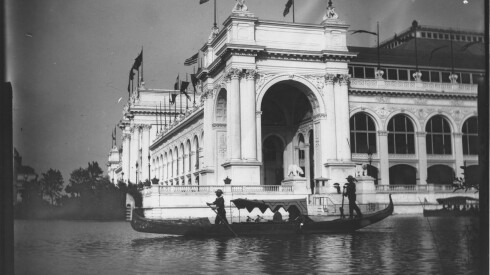
Nor were the fair’s effects limited to commerce and literature. Those imagining the struggle for civil rights began in the 1950s should remember that Ida B. Wells, incensed that the accomplishments of Black Americans were overlooked at the fair — which would not hire them even as janitors while 100 villagers were imported from West Africa and displayed like animals in a zoo — she produced a pamphlet, “The Reason Why the Colored American Is Not in the World’s Columbian Exposition,” and picketed the fair. The event’s organizers reacted by setting Aug. 25 as “Colored American Day,” a gesture Wells denounced as a patronizing, inadequate gesture.
Fair’s other lasting legacies
Three fair buildings left legacies. The World’s Congress Auxiliary Building, built far north of the fairgrounds, became the Art Institute of Chicago. The Hall of Fine Arts was rebuilt into the Griffin Museum of Science and Industry.

The third gift to the city was La Rabida Children’s Hospital. The government of Spain constructed, as its fair pavilion, a reproduction of the Convent of La Rabida, where legend had it that Christopher Columbus sought refuge before his voyage to America. After the fair, the building was run as a charity hospital for children by Chicago’s Spanish consul, then donated to the city, becoming in 1896 a summertime fresh-air sanitarium for children suffering from chronic illnesses like typhoid, scarlet fever and diphtheria. The lake breezes were supposed to be healthful.
The decaying building was abandoned in 1920 and destroyed in 1922 — but 10 years later, money was raised, and a new hospital, its Spanish architecture and tile roof echoing the original, was built on the site for children with heart ailments. Now it is a small, 39-bed hospital for children with chronic conditions like diabetes and sickle-cell anemia that does most of its care on an outpatient basis.
In the 1950s, a Nike missile site was located in Jackson Park along with a lakefront radar installation on Promontory Point, designed to intercept Soviet missiles that might be heading to the city. “The Blues Brothers” movie filmed a scene there — Henry Gibson’s clownish Illinois Nazis rally in Jackson Park and jump off a bridge into the East Lagoon to avoid being run over by the Bluesmobile.

Equally important was what wasn’t built in Jackson Park. In 1959, protesters chained themselves to trees to oppose Mayor Richard J. Daley’s plan to reroute Lake Shore Drive through the park.
Over the past dozen years, the Army Corps of Engineers has worked to revitalize Jackson Park, dredging lagoons and restoring native plants. In 2014, the Garden of the Phoenix opened, with an installation by Yoko Ono installed two years later.
Then, this month — June 2026 — after much controversy and fanfare, the latest development in Jackson Park opens: the Obama Presidential Center.
