It used to be that if you showed up at the old Diplomat Motel over on Lincoln Avenue, you were probably in for quite a time.
What kind of time likely couldn’t have been discussed in polite company.
But no longer.
The former motel, 5230 N. Lincoln Ave., — repurposed and redesigned — reopened this month as Haven on Lincoln, a transitional shelter for unhoused people.
Haven provides 37 private sleeping rooms along with on-site medical and mental healthcare, all designed to get folks back on their feet.
The facility is the city’s first totally non-congregate shelter, giving each resident their own private, bathroom-equipped room. North Side Housing and Supportive Services operates a men’s shelter at 7464 N. Clark St., but residents sleep two-to-a-room and share a bathroom.
The Chicago Department of Housing and Gensler architects deserve a tip of the hat for turning the two-story, hot pillow Diplomat into a bright, smart-looking facility with livable spaces that give residents a measure of comfort and privacy.
“Everyone has their own room; everyone has their own front door; everyone has their own HVAC unit,” the project’s architect, Gensler Senior Associate Sean McGuire, said. “The concept of having these simple [room] modules arrayed across this California motel-type circulation pattern. So, really, the framework of what is operationally best for a shelter was already there. The structure and the framework were there.”
“We’re excited for the folks who are going to live there and be able to benefit from this,” Chicago Department of Housing Commissioner Lissette Castañeda said, adding Haven’s design is “really focused on dignity and healing and the overall well-being of residents.”
The Department of Housing bought the Diplomat for $2.9 million in 2023 and has spent $14 million converting it into transitional housing. Cornerstone Community Outreach operates the facility.
The Diplomat was one of 14 postwar motels built along Lincoln Avenue, between Foster and Devon avenues, back when the thoroughfare — which is U.S. 41 — was the city’s northern gateway.
The motels were a type of California-style roadside modernism: low slung, brightly-colored with prominent, free-standing lighted signs and plenty of parking. And they were affordable. Places like the Spa Motel, 5414 N. Lincoln Ave., or the Summit at 5308 N. Lincoln Ave. There were also the Apache, the Stars, the Tip Top, the Riverside and more.
The motels started to fall from favor in the 1960s when the Interstate 94 supplanted U.S. 41 as the main North Side automobile route in and out of town.
By the 1990s, the Lincoln Avenue motels’ reputations were as low as their room rates. And then-Mayor Richard M. Daley put the buildings on his hit list.
The Riverside Motel, at Peterson and Lincoln avenues, was the first to go — razed in 2000 to expand Legion Park. The Spa was wrecked for a police station. The Acres Motel, 5600 N. Lincoln Ave., got plowed up to build the Chicago Public Library’s Budlong Woods branch.
But the Diplomat was among the 10 or so motels that hung on.
For all their faults, the places did provide cheap lodging for unhoused Chicagoans. Haven continues the mission.
“This isn’t gentrification,” McGuire said. “We’re going back and we’re servicing that same population, now with wraparound services.”
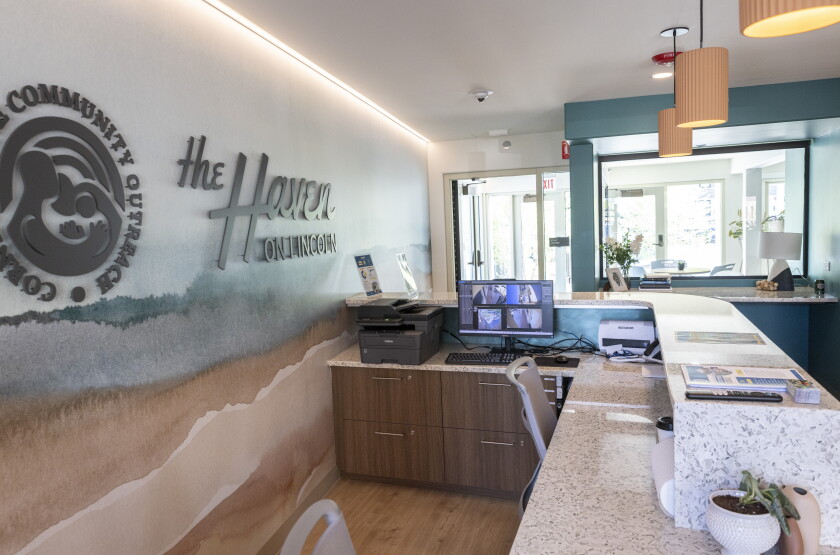
Gensler’s redo brings light, color and style to the former motel. They reclad the building, combined and reconfigured rooms and adjusted some structural elements.
The firm revived the Diplomat’s original Pop Art-like color scheme — lost in a previous renovation that erased much of the building’s postwar charm — and applied it to interiors, doors and outdoor furnishings, making for a cheerful, lively building.
And that good cheer gets brought to the street by way of a joyful floral mural by artist Ryan Tova Katz that adorns Haven’s facade.

|
Manuel Martinez/WBEZ
|
Manuel Martinez/WBEZ

|
Manuel Martinez/WBEZ

|
Manuel Martinez/WBEZ

|
Manuel Martinez/WBEZ

|
Manuel Martinez/WBEZ
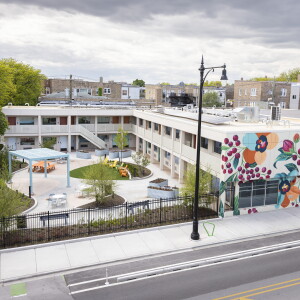


“That mural gives a vibe,” Castañeda said. “And that vibe is that it’s not institutional, that it’s going to be a place where you can lay your head at night and get rest and heal. That’s really exciting.”
The Haven’s 200-square-foot units are modest but well-done. Each residence features a bathroom with a shower, a wall-mounted TV, desk with a lamp and storage for clothes. Rooms also have an HVAC unit and a large window that faces outside.
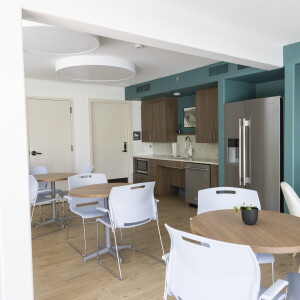
Haven has a kitchen with a community dining room on its first floor, along with spaces for healthcare and social services facilities.
The all-electric building even has an array of rooftop solar panels with a battery to store energy. McGuire said the setup will keep Haven functioning in the event of a power outage.
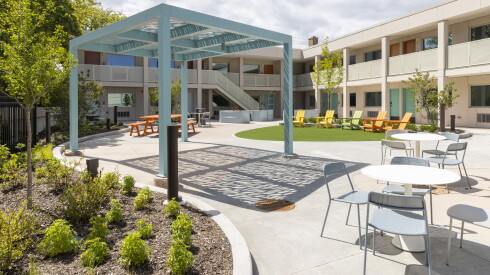
One of the Haven’s best features is a courtyard by landscape architecture firm Site Design Group and built on what was the Diplomat’s south parking lot.
Residents can sit in colorful Adirondack chairs or table-and-chair sets. They can catch some shade beneath a minimalist pergola, or tend to the courtyard’s herb garden.
Done-up in corals, blues and oranges, on a sunny day, the space looks like a slice of Southern California.
This is “trauma-informed design,” which uses color, natural light, access to green space and soothing, textured surfaces to assist the healing process.
“This model was tested during COVID [and] it was successful, both at preventing transmittable diseases but also in improving mental health,” Castañeda said. “When our mental health is at our best, it means that we can do our best in attaining permanent housing and all of those pieces.”
Castañeda said the Department of Housing is looking to build more non-congregate shelters.
“It’s important for us to continue to advance our vested interest in developing housing for all Chicagoans, regardless of income,” she said.