After being auctioned last year, blood-stained gloves Abraham Lincoln had when he was assassinated and that once were showcased at his presidential museum in Springfield have now turned up about 2,000 miles away in southern California.
The rare artifact, which was sold last year to a mystery buyer for $1.5 million, is being exhibited at the Ronald Reagan Presidential Library and Museum until mid-September. It’s part of a display at the Simi Valley, Calif., museum commemorating America’s semiquincentennial.
It’s still unclear who bought the gloves.
But the fact they are back in a museum, even if for just a short time, represents the latest wrinkle in a saga over a tranche of prized Lincoln showpieces once intended to be permanently housed at the Abraham Lincoln Presidential Library and Museum in his hometown.
The gloves — and a now-discredited stovepipe hat originally touted as one belonging to Lincoln himself — were part of a $25 million acquisition of Lincoln artifacts in 2007 by a foundation established to stock the then-newly opened, state-run museum with antiquities tied to the 16th president.
But that collection was carted away in 2022 after relations between the Lincoln Presidential Foundation and museum soured, and items like the gloves were later auctioned off to help pay lingering debt tied to the original acquisition.
The fact the gloves have re-emerged in a West Coast museum may be a loss for Illinois residents who once could view them in Springfield, but one of the country’s top historical artifact experts says it’s still a win for the general public.
“It’s quite obvious to me that the gloves were purchased by a private collector who is steeped in history and is eager to have them exhibited and shown to the public, which I think is a very positive thing,” said Marsha Malinowski, a nationally known historic books and manuscripts expert in New York City.
And the gloves, by far, have been one of the most popular draws this summer at the Reagan museum.
“It’s the first case people want to see, and it’s actually about halfway through the exhibition,” said Melissa Giller, who heads marketing and programming for the Ronald Reagan Presidential Foundation and Institute. “To see them in front of you really brings history to life in a way that reading a book or seeing a documentary can’t.”
Gloves were to have been owned by the state
The once-ivory gloves have yellowed over time, the kidskin leather flaking and cracking in some areas. But apart from the elastic bands at the wrist coming apart, the gloves have mostly stayed intact and bear unmistakable splotches of brown blood stains near the right thumb and the base of the left glove.
The 16th president was carrying them in his left coat pocket when he attended the comedic play, “Our American Cousin,” at Ford’s Theater in Washington, D.C., on April 14, 1865. As the play entered its third act, actor and Confederate sympathizer John Wilkes Booth fatally shot Lincoln in the back of the head.
It didn’t take long before Lincoln’s coat became soaked in blood. After he died the following morning, his coat, with the gloves still in the left pocket, was given to his eldest son, Robert Todd Lincoln, who then passed it on to his mother, Mary Todd Lincoln. After struggling financially, the president’s widow sold the gloves in 1868 to a family friend and collector of presidential memorabilia, Captain Benjamin Richardson.
In 1990, California-based Lincoln collector Louise Taper purchased the gloves from a descendant of Richardson’s. She held on to the gloves until 2007, when she sold it and other Lincoln items she owned to the foundation.
The intention originally was to transfer ownership of the gloves and other pieces of Taper’s collection to the Lincoln museum once a $23 million loan to acquire the items was repaid, but that transfer never happened.
Instead, the museum’s relationship with the foundation turned contentious, in part, over friction regarding the authenticity of a stovepipe hat that was regarded as the most valuable piece in the Taper trove.
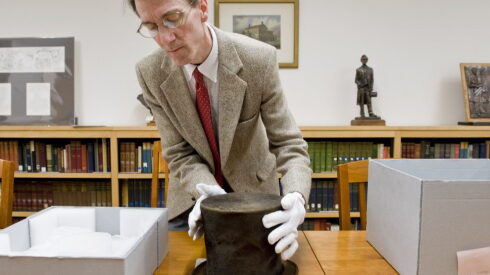
The hat was billed to be one of only three surviving hats once worn by Lincoln and at one point was appraised at $6.5 million. Both the Lincoln foundation and museum contended the hat had been gifted by Lincoln as a show of appreciation to a southern Illinois farmer and then passed down to the farmer’s son, Elbert Waller, who was a one-time Illinois legislator.
But the Chicago Sun-Times first disclosed serious questions about its authenticity in 2012, unleashing an uproar that eventually led the museum to remove the hat from public display and the foundation to secretly and unsuccessfully test it for signs of Lincoln’s DNA.
A 2019 report by Illinois’ then-state historian Samuel Wheeler stopped short of concluding the hat was a fake but laid out a series of previously unknown details that cast far deeper doubts about its authenticity. The report said the hat did not appear to be in Lincoln’s size, that it was once sold to a downstate antique shop for just $1 by Waller’s widow, and descendants of the hat’s original owner were unaware of its purported Lincoln lineage.
The hat’s squishy provenance hindered the foundation’s ability to raise money, prompting the organization to turn to the Illinois General Assembly for help in retiring what then was a $9 million debt from acquiring Taper’s collection. But that legislative effort failed in 2019.
In 2022, the Taper collection was transferred out of the Lincoln museum and, after over a century of changing hands, the gloves were auctioned in Chicago in May 2025.
Before the gloves were sold to an anonymous buyer, Taper told WBEZ she was “appalled” that more than 140 of her former Lincoln relics were being “dispersed to the wind.” Her wish, when selling to the foundation, was for the historical items to “reside in a place for the public to enjoy and learn from.”
“Never would I have thought that a foundation representing a museum would act separately and take everything away and put it up for sale,” Taper told WBEZ last year.
Buyer’s identity still a mystery
The Reagan Museum had been working on the America 250 exhibit for about a year and a half before it opened May 22. For the Civil War portion of the exhibit, Giller said the museum was able to acquire an actual cannon used by Union soldiers during the Battle of Gettysburg.
But she said they wanted more items related to Lincoln. So, the museum staff got in touch with Christie’s Auction House, which connected them to someone who had recently purchased Lincoln’s presidential campaign buttons.
“The person said to us … ‘By the way, if you’re interested in more items, I also have the gloves he was wearing on the night he was assassinated that have his blood stains on them, and the handkerchief that was in his pocket. Would you like those?’” Giller said.
Giller declined to identify the gloves’ owner, who sought anonymity while loaning the item to the Reagan museum until the close of its exhibit Sept. 13.
That the gloves would be one of the most popular items now on display at the Reagan museum makes sense to Jacob Friefeld, director of the Center of Lincoln Studies at the University of Illinois Springfield. Lincoln, he said, is “the most famous American who has ever lived.”
Friefeld serves on the Lincoln presidential museum board and previously worked as a research historian for the museum, which has an original copy of the Gettysburg Address bearing Lincoln’s signature. He said the museum still houses many rare Lincoln items, but the gloves leaving Lincoln’s hometown is still unfortunate.
“Of course, it’s a loss for the people of Illinois. For a long time, they were at the museum where, every so often, when they went on display, people could see them and have that relationship with history,” Friefeld said. “And of course, it’s his blood. What’s more Lincoln than his blood, right?”