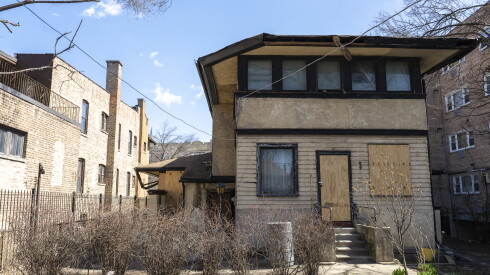
A dilapidated Frank Lloyd Wright home that has needed a savior for the past 30 years has found one at last — right in its own backyard.
The nonprofit community group Austin Coming Together announced Wednesday that it bought the vacant J.J. Walser Jr. House, 42 N. Central Ave., for $125,000.
Built in 1903, the buff-colored wood-and-stucco Prairie School design is among a set of circa 1900 residences along Central Avenue that mark the Austin’s early years as a Chicago neighborhood.
Austin Coming Together Executive Director Darnell Shields said the organization and the community want to make the home a place where visitors can learn about the house, as well as the neighborhood’s architecture, culture and history.
“And while they’re here, [visitors can] support our businesses and restaurants along Madison,” Shields said, adding that Wright’s open plan design of the home’s first floor would make the space conducive for hosting events and gatherings.
“We’re really excited about the possibilities,” he said.
Shields said it could take at least $3 million to rehab and restore the home, a protected city landmark.
But Austin Coming Together has a track record of getting things done. The organization co-led the $41 million conversion of the former Robert Emmet Elementary School, 5500 W. Madison St., into the Aspire Center for Workforce Innovation. The center, which specializes in job training and wealth-building, opened in 2025 and is located across Central Avenue from the Walser house.
The nonprofit’s acquisition of the Walser could be a positive reversal for the fortune of the rotting, but important, 123-year-old building.
The home is among Wright’s first Prairie School designs. Its horizontal lines, overhanging eaves and second-floor band of windows presage what he would later do with his larger and more celebrated residential commissions of the time.
The home was bought by Hurley and Anne Teague in 1970. But after Anne Teague died in 2019, the National Register-listed house fell further into disrepair and would spend the next seven years in foreclosure and demolition courts.
The government-backed Federal National Mortgage Association — popularly known as Fannie Mae — acquired the house in January and put it up for sale.
Shields said Chicago’s nonprofit Community Investment Corporation bought the house from Fannie Mae for $125,000, then sold it to ACT for the same price.
As part of the deal, the CIC gave ACT a $60,000 grant to help cover the purchase price. ACT paid the remaining $65,000, Shields said.
“It took a lot of finagling and repositioning and everybody working together … to try to cut through red tape [and get] the property at a cost we could stand and look at it as feasible,” Shields said. “Because you know we’ve got a much longer journey ahead.”
Shields said it could take $300,000 to $550,000 to just stabilize the home.
In addition to the crumbling stucco and rotting exterior wood, there are a legion of other big-ticket problems, including severe roof leaks, a weakening load-bearing interior wall and overall building deterioration.
“There are a number of things that need to be addressed,” Shields said.
Along with ACT, the Frank Lloyd Wright Building Conservancy, Landmarks Illinois and Preservation Chicago have worked to keep the Walser standing.
Together, the groups have attended court hearings, raised public awareness — and even boarded up the house and trimmed its overgrown foliage.
Frank Lloyd Wright Building Conservancy Executive Director Barbara Gordon said she supported ACT taking ownership of the home.
“ACT understands the potential waiting to be unlocked by revitalizing this landmark Frank Lloyd Wright design, celebrating Austin as a destination for notable architecture,” Gordon said in a news release. “The organization’s deep roots in the community mean they know the rich stories the house can tell about how it has changed over time, and what Austin residents envision for its future.”
Landmarks Illinois Advocacy Manager Kendra Parzen praised ACT “for its vision and determination to preserve … a nationally recognized architectural and cultural asset on Chicago’s West Side.”