It’s very hard to write a review of “A Strange Loop,” a many-laureled musical that first ran off-Broadway in 2019. It lives in, even wallows in, its meta elements, occasionally passing judgment within the text of the show on its own efforts to sketch out conflicting characters and stories. So if it’s already looking at itself and self-criticizing, who am I to pile on? (Not to mention that I am supposed to avoid using “I” while writing this.)
As is explained in the show, right after warning the listener “don’t fall asleep,” a strange loop is a cognitive science term about self-observation and self-referentiality, and how self-definition arises from those self-recursions. So, naturally, a show called “A Strange Loop” does a lot of talking about itself, looking back at itself and defining its own identity.
An ambitious task, but “A Strange Loop” succeeds in it, creating something wholly individual. It dishes out a lot of amusement, clever rhymes and good tunes along the way. Conversely, there’s some harsh negativity and jarring language, giving the show an ache at its core, not merely an empty hall of mirrors.
It’s “A Strange Loop,” and it’s a strange loop. If that sounds too cute, then this show isn’t for you. If you’re dying to unpack what that means, you’ll love it.
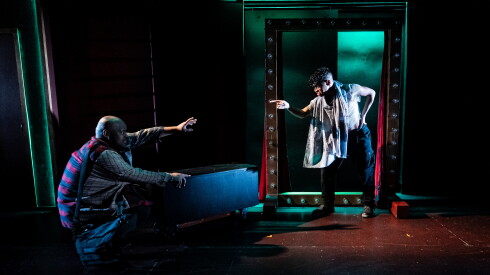
The main character of “A Strange Loop,” Usher (Eddie Weaver), is a Broadway usher working on a musical called “A Strange Loop,” about a Broadway usher — you get the picture. The ensemble around Usher consists of six flexible performers who step in and out of many roles. They’re billed as Thought 1 through Thought 6, according to their early-show introduction as embodiments of Usher’s anxieties and insecurities.
The show unfolds in a series of episodes, with some narrative connections among them, but no overarching conflict-driven story. It’s essentially a character sketch of Usher, who calls it a “big Black queer-a** American Broadway show.”
Unpacking that self-description: It was indeed a Broadway show, in 2022 and 2023. That production was nominated for a raft of Tonys, winning two, for Best Musical and Best Book of a Musical. The show and its creator, Michael R. Jackson, also won the 2020 Pulitzer Prize for Drama. This mounting, a co-production by Raven Theatre and About Face Theatre, marks the show’s Chicago premiere.

Eddie Weaver stars as a Broadway usher named Usher in “A Strange Loop.” The ensemble around Usher consists of six flexible performers who step in and out of many roles. They’re billed as Thought 1 through Thought 6, according to their early-show introduction as embodiments of Usher’s anxieties and insecurities.
Joe Mazza
It’s also rooted in the Black experience. Usher struggles not only with what it means to be Black in society, but also what it means to be a Black artist. His foil is Tyler Perry, whose work Usher’s family urges him to emulate, because Perry “writes real life.” Usher is offered a gig writing a gospel play, and we get two takes on this idea through the lens of Usher, the creator. One savages Perry’s storytelling as lazy tropes, the descendant of minstrelsy. The other actually is a short gospel play, but dark, demonic and angry, wholly unlike Perry’s oeuvre.
And it’s queer. Usher is gay, and his family has not truly come to terms with it. Some of the most poignant moments arise from the loneliness that wafts off Usher around his unrequited desire and his talking-past conversations with his parents.
Let’s also take a moment to talk about the “a**” in “queer-a**.” This show has a lot of strong language. Just on the word level, we hear the c-word, the f-word and legion instances of nasty words with internal g’s. Then on the sentence level, there are also many hurtful things said, and not in an insult-comedy way, because they are not supposed to be funny.
Loops curve, and “A Strange Loop” does a lot of swerving. For example, when Usher’s mother is leaving him a voice message, her stream-of-consciousness verbosity threatens to devolve into caricature. But from behind her, Usher — who almost never leaves the stage — begins to harmonize with her on phrases such as “hell is real,” and you can hear his love for her, even as you also know he feels unknowable to her.
The show’s most impressive success is to use the slippery registers — satire, meta-commentary, sudden mood shifts — as a way to establish complexity. To the question “What is this show?”, no easy categorization fits. It’s not a satire, because there’s too much earnestness. It’s not a standard musical, because there’s no single story.
What it is is itself. It’s “A Strange Loop,” and it’s a strange loop.