A cappella, as a musical form, draws a lot of mockery from those who aren’t true believers. Its doom-doom-doom bass lines, all the splashes of lyrics from the backup singers, and especially vocal percussion strike outsiders as silly.
But what a cappella lovers love is the magic that the music can spring out of nothing but the gathered singers. It’s there, lying in wait, needing only the reedy tone of a pitch pipe to blossom.
The musical “Octet,” the brainchild of Dave Malloy (“Natasha, Pierre & the Great Comet of 1812”), distinguishes itself from a 95-minute, no-intermission a cappella concert only by having the singers play characters, with some spoken dialogue. Offering a chance to lend some cool to a cappella, Lin-Manuel Miranda recently announced his plan to direct a film version of “Octet,” which premiered off-Broadway in 2019.
The story providing the frame for the music is that the eightsome has gathered for a support group for internet addicts. During the course of the show, each character shares their individual digital dysfunction, presented as a solo (usually) accompanied by the other seven singers. One woman has been publicly humiliated (“Refresh”), a man has a game addiction (“Candy”), another indulges in hyperverbal conspiracism (“Actually”), et cetera. It’s “A Chorus Line” for the smartphone generation.
A few oddities mar even this skeletal story. The support group is organized by a shadowy figure named Saul, who has no online presence and no physical presence in the show. What the leader calls “teatime” turns out to involve consuming a fast-acting psychedelic. Some of the ensemble numbers are referred to as “hymns.” It gives a quasi-cultish vibe, a counterproductive choice for characters we’re supposed to see part of ourselves in.
Raven Theatre’s production, the company’s first musical and the Midwest premiere of the show, takes place on a squarish raised stage with eight folding metal chairs and few other props. The actor-singers soft-open the show as if showing up for the support group and stay onstage for the duration. They wear lavalier microphones even in the small space, a necessity for the sub-basement bass part sung by the character of Ed, portrayed by Ryder Dean McDaniel. (Kudos to the sound mixers, who balanced the singers in a way that made it seem as if they were unmiked.)
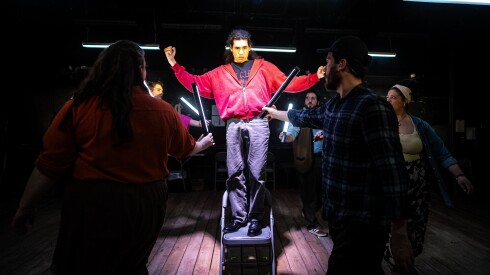
The style of a cappella isn’t the vocal-percussion-heavy beatboxing sort, avoiding the most embarrassing cliches of the form. There is some light percussion in some songs, with chair-seat or thigh slapping, and one number uses a metronome for the pulse. Most of the characters carry pitch pipes, which they use orchestrally during the psychedelic trip. Malloy’s arrangements ease into some of the tropes of a cappella, rendering them less distracting, as in the first solo number, “Refresh,” when Ed’s “mm-hm” morphs from simple agreement to a rhythmic ostinato underpinning the song.
The singers in Raven’s production have solid musical-theater voices. Elliot Esquivel, playing Toby, showed particular facility during his solo turn in “Actually,” hitting his marks vocally while delivering his maniacal screed. However, the range required by many of the songs stretched too high for the singers to belt, betraying strain or not reaching the pitch.
The singers’ choral moments were not as strong as their musical-theater voices. Clean, triadic harmonies rang out purely, but jazzier added-tone chords got squirrelly. Unaccompanied solos had wandering pitch. Timbres did not adapt to background singing with the agility called for by the score.

Miranda, in announcing the cast for the “Octet” movie, told journalists he was seeking actors with not just musical-theater experience, but also choir experience, and it’s easy to see why: This show demands more choral chops than almost any other musical, and without accompanying instruments, there is nowhere to hide.
Still, the show presents compelling short stories, with creative music that does conjure that a cappella magic of being in the space where chords and melodies emerge from nothing more than living, breathing human bodies. Malloy cannily has chosen the topic of internet alienation—the loneliness people fall into when seeking connection online—to contrast with the live-performance alchemy of the a cappella form. His takeaway message, from the closing number, “The Field”: “Beyond right and wrong, there is a field. I will meet you there.”
That’s why Miranda’s decision to make a film out of “Octet” seems off. Once it’s set down on film, and the sound editors can take every singer’s best take and splice them all together to make the music as close to pitch-perfect as possible, “Octet” will lose the oomph in its message about human connection. When Miranda’s “Octet” reaches streaming, many people will watch it alone, staring at their phones.