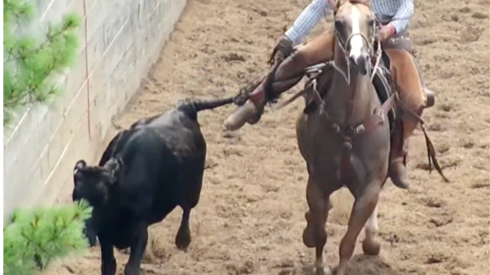
A man on horseback in a corral rides feverishly alongside a fleeing steer while reaching for the animal’s tail, which he quickly but skillfully wraps around his right cowboy boot while maintaining a grip on the appendage.
As intended, the maneuver causes the steer to twist and tumble to the dirt.
The rider — part of a “backyard rodeo” in the far northwest suburbs last summer — gallops off, holding something grotesque in his hand: part of the steer’s tail, which was ripped free.
Called “degloving,” the injury is common at these types of events, according to local animal rights activists who have been trying to stop “steer tailing” in Illinois for years, saying it amounts to animal abuse that’s clearly illegal under state law, though not enforced nearly enough by local police and prosecutors.
An exception is in McHenry County, where three men were sentenced Wednesday to a year of conditional discharge, similar to probation, on animal cruelty charges stemming from last summer’s event in unincorporated Woodstock. Imposed by Judge Justin Hansen, the sentence included $250 fines and barred the men from “intentional contact” with animals, with some exceptions, during the term.
The men were prosecuted, at least in part, based on drone footage of the rodeo taken by the animal advocacy group SHARK, which stands for Showing Animals Respect and Kindness. The organization has documented similar events in far south suburban Will County and areas downstate, including Ogle County.
Court records say one of the men in McHenry County, Alfredo Magallanes, “participated in a rodeo steer-tailing event” at which he “knowingly pulled the tail of a live steer with sufficient force which caused a degloving injury that was captured on drone video.”
“The act caused pain and exposed the animal to further harm and infection, constituting cruel treatment of the steer, contrary” to state law.
A 24-year-old Marengo resident, Magallanes pleaded guilty, as did two other men similarly charged, records show.
Each apologized in court Wednesday and portrayed the tail injuries as unintentional, with their attorney Garrett Fisher telling Hansen: “These were all accidental events” in what’s “a very physical and demanding sport” that “in no way rewards or encourages” harming animals.
Prosecutor Joe Creager responded: “To call this a sport or even a demanding sport is offensive to rodeo . . . this is punishing cows for sport.”
A juvenile from Lockport was also initially cited, but that case was dropped.
A fifth person, 68-year-old Socorro Barrientos, already went on trial but a judge hasn’t yet rendered a decision, according to court records that say the defendant kicked “a steer in the head over 10 times” at the same event as the others “while it was on the ground and not posing a threat.”

Chicagoan Jodie Wiederkehr, SHARK’s campaigns director, doesn’t believe steer-tailing and backyard rodeos are necessarily becoming more common in the region, but rather more attention is being paid to them because activists are highlighting the maltreatment that often occurs.
“The reason it’s going on is because there’s a lot of money being made,” Wiederkehr says, noting tickets to attend the private events can run $50 apiece and they are fashioned to be festive, with “dancing and drinking and having fun” in addition to the rodeo displays.
She says the treatment of steers amounts to torture, even when their tails aren’t torn away.
Another SHARK video from a backyard rodeo there shows a steer limping off with an apparent broken leg after being taken down by a rider on horseback.
Wiederkehr says the animals are sometimes poked or hit with sticks, shocked with cattle prods, worked until exhausted and even bitten on their tails by rodeo participants in an apparent attempt to stimulate the creatures.
“These animals are often left to suffer for hours without veterinary treatment or pain relief,” says Wiederkehr, who was instrumental in getting the City Council to vote in 2020 to ban horse-drawn carriages in Chicago over concerns about their well-being.
Illinois’ Humane Care for Animals Act says: “No person or owner may beat, cruelly treat, torment, starve, overwork or otherwise abuse any animal.”
Animal owners must provide “veterinary care when needed to prevent suffering.”
SHARK president Steve Hindi, who’s based in Kane County, said that too often authorities in Illinois don’t enforce the law, even in the face of clear evidence.
One argument Hindi’s group has heard: The statute doesn’t specifically ban steer tailing.
To which Hindi says: “There’s no law that” explicitly “says you can’t throw a puppy out a window,” but the anti-cruelty statute would clearly cover that.
“We shouldn’t need a new law,” he says.

Even so, a bill was introduced by state Sen. Rachel Ventura (D-Joliet) in the General Assembly last year to specifically ban steer tailing. The measure read in part: “No person may intentionally drag or pull any bovine by its tail by any means for the purpose of entertainment, sport, practice, or contest.”
Co-sponsored by state Sen. Li Arellano Jr. (R-Dixon), the bill failed to advance this year. Passing instead in the Illinois Senate was a non-binding resolution that frowned on steer tailing, saying “we discourage all acts of bovine tailing and its associated harms.”
There’s been some resistance to cracking down on steer tailing, called “coleadero” in Spanish, because of its place in Mexican rodeo culture dating back centuries.
Arellano says that doesn’t change the fact that the “the injury rate is higher than almost any other rodeo event,” and he knows of no reputable U.S. rodeo organization that currently promotes steer tailing, whether Mexican-style events or the western-style rodeos more common in the U.S.

Arellano says he’d compare steer tailing “to cockfighting and bullfighting,” adding: “The day for coleadero is over, and we need to figure out how to do it.”
He anticipates discussions continuing this year in the Legislature.
Gov. JB Pritzker’s position on a crackdown is unclear, but Hindi slammed him for not engaging an agency under his authority, the Illinois Department of Agriculture, to do more.
A spokeswoman for the agency says it’s “not a unit of law enforcement” and
“does not have the authority to file criminal charges.”
But animal activists say the agency is supposed to assist law enforcement on this front.
The cases in McHenry County are misdemeanors.
Members of the McHenry County Board also recently considered a measure to explicitly ban steer tailing, though it failed to move forward amid opposition from the McHenry County Farm Bureau, which represents agricultural interests in the area.
“We support the animal welfare laws, they’re on the books for a reason, and people are being prosecuted for doing things that are inappropriate,” says the farm bureau’s Dan Volkers.
“Our primary concern is really interpretation and unintended consequences” of the proposed county measure, Volkers said. “If the wording isn’t just perfect, something that’s common practice” on a farm or ranch “could be viewed by an animal rights person as abuse.”
Instead of additional criminal statutes, “I think there are things that can be done on the zoning side that’d limit those types of activities,” he said.
Some of the troublesome rodeos are put on with permits granted beforehand by local governments, while some events are held without necessary permits, officials say.
In Will County, the state’s attorney’s office has pursued temporary restraining orders in recent years when officials learned of an upcoming rodeo that raised concerns — whether about the treatment of the animals or “the land use aspect” dealing with crowds, traffic or questions about “the proper permitting,” says Assistant State’s Attorney Toni Renken.
In at least two instances, Renken says, “the property owners did come in, speak with us” and reach an agreement “to not do any horse tripping, cattle prodding, tail pulling” and the like.
“We believe” steer tailing “is inhumane treatment toward animals, it is horrific, it should be prosecuted, we believe it falls under the Humane Care for Animals Act,” which her boss, Will County State’s Attorney James Glasgow, was involved in creating years ago.
That said, a new law specifically targeting steer tailing would help “clarify for the judiciary that this is an abuse,” Renken said, noting some in the judicial system have questioned whether it falls under the existing statute. “And it’d also simplify the process for prosecutors.”
“We are zealous about this and would work with anyone about drafting legislation” that all sides “would be comfortable with,” Renken said.
Elyssa Ford, an associate professor of history at Washington State University who has studied rodeos, echoed that, saying it’s important for any legislative discussion to be “inclusive.”
“There are things that are hundreds of years old that we as a society” now “say is not OK,” Ford says. “We’ve seen this with bull fighting.”
If and when steer tailing is further legislated out of practice in the U.S., it should “include various constituent groups and interest groups in those conversations.”
In 2023, Glasgow’s office prosecuted a rodeo rider from Batavia for beating a horse during a Joliet area rodeo in an incident that also was captured on video by a SHARK drone.
In Ogle County, west of DeKalb County, a permit for a rodeo was recently surrendered following a lawsuit by SHARK and others.
Wiederkehr got into trouble in Ogle County last year for calling dispatchers to report animal abuse at the venue and, unsatisfied police weren’t going to be sent, said there was a shooting in an apparent attempt to force a response.
She was convicted last month of false reporting and harassment but hasn’t been sentenced.
Her attorney is seeking a new trial.