More than a century after Wrigley, Brach’s and Mars helped turn Chicago into a candy epicenter, a trio of artists with an unabashed candy obsession brought their gummy candy startup to the shuttered former Jelly Belly plant in suburban North Chicago, ushering in a new era for this storied city of sweets production.
The actor Martin Starr and musicians and identical twins Ezra and Adeev Potash cofounded Sweet Stash last fall with an additive-free gummy with the complex flavor and texture dimension of candies they discovered over years of globe-trekking.
“We are obsessed with candy beyond what’s normal and maybe even healthy,” Ezra said. “We’ve been candy people long before we became candy vendors.”
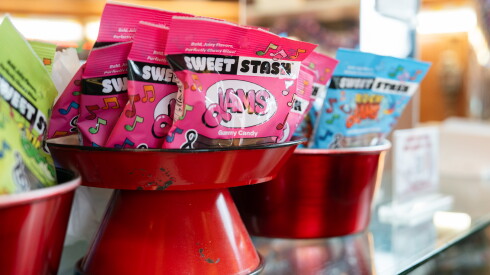
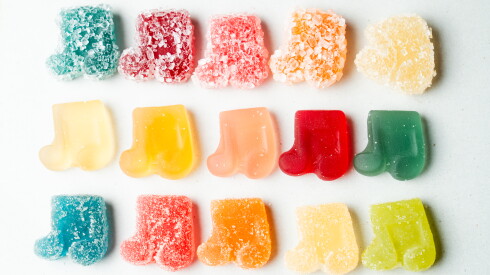
After months of routinely selling out on Amazon amid swelling requests from retailers for their toothsome, musical note-shaped Jams gummies in flavors like Prickly Pear, Strawbarb and White Peach, the fledgling company moved production from Albion, Nebraska (the twins’ home state) to Ferrara’s 113-year-old Jelly Belly factory in April, effectively quadrupling the previous output in a fraction of the time. The move doesn’t just mean taking on bigger orders and getting onto more indie store shelves while maintaining consistency in a product free from gluten, synthetic dyes and corn syrup. This self-starting trio can also keep making candy limited mostly by their imaginations in a city known for confectionery innovation — a rarity for an industry dominated by profit-seeking conglomerates.
“We’re a small band of creative people going up against billion-dollar companies that make candy by the tank,” Adeev said.
On a hot and sticky recent Thursday, the bespectacled twins and I scooched into a taped-up booth beneath a wood-paneled wall full of bric-a-brac at the 105-year-old Margie’s Candies in Logan Square. The historic shop carries the original Jams, along with the crunchy sugar-coated Rock Jams and tart Sour Jams Sweet Stash that the trio launched this summer.
“If there’s a place we had to be in Chicago, it was here,” Adeev said. “This is an institution for a century. I mean, the pope was just eating Margie’s [three weeks] ago. That’s the reason I love Chicago and the candy world here. It’s a place that loves new things, but that also respects the history.”
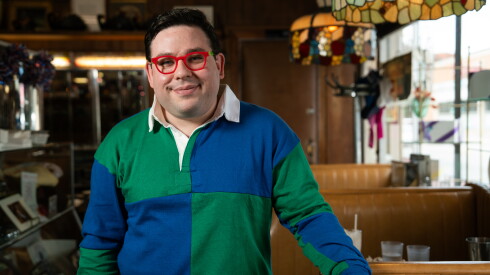
Adeev (trumpet) and Ezra (trombone) are musicians first, discovered and mentored by the trumpeter and composer Wynton Marsalis. They’ve released three albums and written scores for the likes of “RuPaul’s Drag Race.” They have also hosted television series for Travel Channel, Bravo and Food Network. As touring musicians, the twins (who divide their time between Los Angeles and Omaha) developed a habit of popping into bodegas after shows in search of candy they’d never tried.
“After years of doing that, we kind of became pseudo-experts on what was available to the public all over the world,” Ezra said. Apparently, candy invention is even in their DNA. In the 1800s their great grandparents owned Wolfberg’s General Store in Wakarusa, Indiana, where they said their great-grandfather, rather presciently, invented the giant jelly bean.
They met Starr in 2022 at a charity event, hosted by celebrities including Jason Sudeikis and Paul Rudd, where the trio became fast friends.
“It was late at night and I think somebody was eating Haribo Goldbears,” Adeev recalled, then Ezra interjected. “We probably said something nerdy, like, ‘I think they’re just the perfect texture, but the flavors are a bit flat.’ And then Martin was probably like, ‘What the hell did I just see?’”
“They didn’t even like candy until they met me,” Starr quipped, reached somewhere in New York on Ezra’s phone.
Known best for his role as the cynical, deadpan Bertram Gilfoyle on HBO’s “Silicon Valley,” Starr has worked as an actor and producer across television and film, including series like the Paramount drama “Tulsa King” (where Sweet Stash makes a handful of cameos), Starz’s “Party Down” and films including “Knocked Up” and “Adventureland.”
Starr’s candy obsession runs deep, too. He recalled as a kid eating gummy bears “to the point where my parents stopped giving me an allowance, because all I spent the money on was candy.”
A few months after they met, Starr invited the “the boys” to his home in L.A. (Starr also lives part-time in Austin, Texas.) Ezra and Adeev remained skeptical of Starr’s candy mania until they glimpsed his cupboards dedicated to candy from around the world, grouped by country and ingredient list, as in, vegan, containing gelatin and gluten-free.
“We’re like, we’ve actually met our match,” Adeev said.
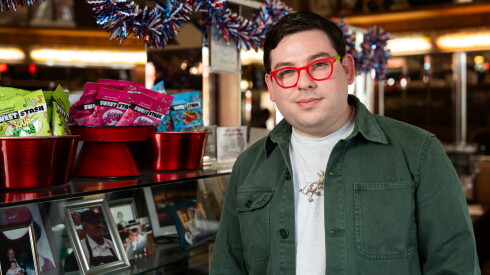
What’s the ideal amount of chew in a gummy? Can one replicate the physical sensation of peach fuzz in a candy? What should the color green taste like? Such Wonka-esque questions increasingly occupied the minds of the three as their friendship deepened. They wondered why all the confections they love most, featuring layered flavors and invigorating textures, had to be imported from Japan or Australia. They lamented that American candy conglomerates were directing innovation budgets toward injecting sweets with fiber or protein rather than cleaning up their ingredient lists.
“If you want fiber, eat something natural that has fiber it; don’t put in my f—— candy,” Starr said.
They decided to join forces and start a candy company of their own, debuting with an American-style gummy made with high-quality ingredients, a texture that “bites back” and the flavor dimensionality of Japanese and Swedish candies they love. Using their own funds, they recruited candy scientist Tessa Porter, former chief innovation officer of Ferrara, to help develop the additive-free gummies. The designer Ellen Van Dusen, of cult housewares line Dusen Dusen, created the brightly colored packaging. In a nod to the public arts programs that were foundational to the trio’s careers, they donate a percentage of Sweet Stash’s profits to arts education initiatives.
Jams come in six flavors — er, technically 18 if you ask Ezra — which took six months to develop. The three spent hours at a time hashing out each color and accompanying flavor journey. Take Prickly Pear, which starts out tart and pineappley then melony with a tropical, almost floral finish as your teeth slowly work through that springy confection (which by the way isn’t nearly as chewy as these nerds like a gummy). Or Grape, which can, in fact, be green.
“Sorry, but grape doesn’t need to be purple and taste like cough syrup,” Adeev said, munching on a crisp Green Grape Rock Jam enrobed in fat sugar crystals. “It could actually taste like the best, juiciest grape you ever had in your life.”
They expected to sell the candy online only until Rudd, who owns a sweets shop in New York’s Hudson Valley, asked to be their first retail customer. Before long, other indie retailers came calling with orders, then reorders. More than 300 specialty retailers nationwide now carry Sweet Stash, including 10 to 15 in Chicago, such as RAYGUN Clothing, Pop/Culture Chicago and the Chicago Athletic Association.
When it became clear Sweet Stash was rapidly outgrowing the Omaha facility, the founders pledged to keep production in the Midwest, which significantly shrunk the pool of plants that could produce a formulation of their standards at scale, they said.
“Production is already allotted to a lot of the big companies; we were lucky to find a place we could grow with in Chicago,” Starr said.
The North Chicago plant churns out 160,000 bags per month, four times the 40,000 bags produced over a months-long run at the Albion plant. With more sophisticated equipment, the team can also maintain precision and consistency over product texture and flavor as it scales and fulfills larger orders.
“It’s still crazy that we have a candy company,” Adeev said. “To see it made in a facility that’s been making one of the most famous candies for 100 years, it’s amazing.”
The move represents a bright spot for a city that has lately seen high-profile confectionery plant closures like Blommers’ and Mars Wrigley’s in addition to Ferrara, which shuttered the Jelly Belly plant in 2024. More sweet news came for Chicago in April, when the National Confectionery Sales Association announced that the city would house the permanent location of the 60,000-square-foot Candy Hall of Fame Experience, at 830 N. Michigan Ave. It is slated to open in 2027.
As far as Sweet Stash is concerned, Chicago remains “Candyland USA,” Ezra said. “Every major candy brand is manufactured here, all the innovation is happening here.”
The latter now includes a trio of candy-obsessed artists, whose enthusiasm seemingly has them leapfrogging confectionery science in the name of whimsy, as they hinted about a potential gummy innovation “so out there that we have to literally wait for the science to catch up,” Ezra said.
Then again, maybe this industry of “billion-dollar Goliaths” needs a little more Willy Wonka energy.
“We’ve been told what we want to create is not possible all the time — as candy even more so,” Adeev said. “For us, making Sweet Stash is like being an actual kid in a candy store. How do you make an everlasting gobstopper? What’s the thing you can’t do?”