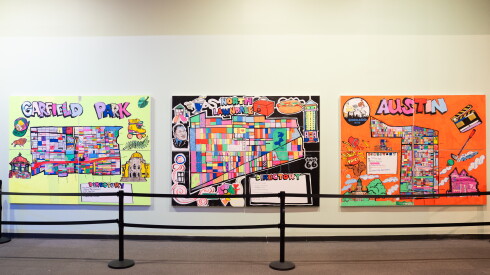
Nestled on the second floor of the Chicago History Museum are three colorful, six-by-eight-foot maps of Chicago’s Austin, North Lawndale and Garfield Park neighborhoods. More than street grids, these maps highlight cultural landmarks like the famous Buck 50 watch hat and the former Sears Tower that help define each community.
For nearly a year, West Side residents Drea Slaughter, Jay Simon and Corey Dooley Johnson, known as the Capstone Clique, partnered with the Chicago History Museum to help their neighbors document and preserve their stories.
Answering the question: What would a map look like if the neighborhood’s residents got to decide what belonged on it?
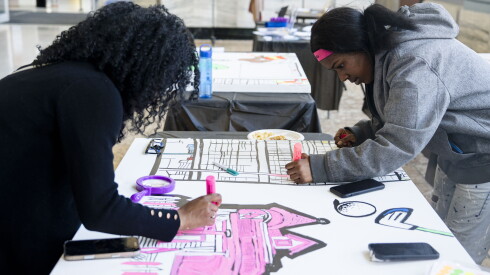
Working alongside artist Kent Jones, they created large-scale maps of Austin, North Lawndale and Garfield Park, inviting residents to mark the places that mattered most to them — from family homes to neighborhood chicken spots.
The result is three large-scale, rainbow-colored maps now on display in the museum’s permanent exhibition, “Chicago: Crossroads of America” until March 2027. These maps are filled with landmarks selected by people who call these neighborhoods home and know these neighborhoods best.
“When you think about Chicago, we glorify the North Side, we glorify the South Side, and the West Side is just kind of there,” Simon said.
To address the forgottenness that some West Siders feel, in 2024, the Capstone Clique created a documentary titled, “Love Letter to the West Side.” It was then they noticed that the Chicago History Museum lacked pictures and videos to help them tell their story.
That discovery led them to start the Westside Love Map Project — a community mapping initiative to preserve neighborhood histories that might otherwise go undocumented.
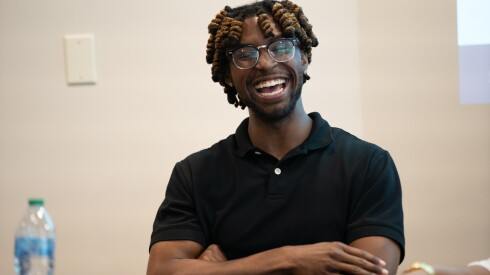
“My hope is that they take away the beauty of the West Side,” Simon said. “also that they will feel comfortable going and visiting and patronizing those places, because those places have businesses, they have youth centers.”
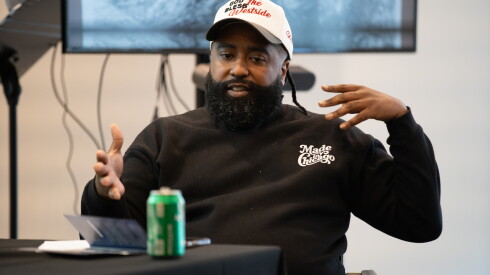
Dooley Johnson says the Capstone Clique prioritized Austin, Garfield Park and North Lawndale due to time constraints and funding.
“You often don’t see the archives and the stories of these neighborhoods,” Dooley Johnson said. “So we took it upon ourselves to show the light of the community and all the beautiful things that are there.”
Capstone Clique also patronized Black businesses within these neighborhoods to reinvest dollars locally and honor the Black history of key landmarks like the First Church of the Brethren and the historic Austin Bank building.
Erica Griffin-Fabicon, director of education at the Chicago History Museum, sees Chicago as a reflection of intersecting systems of oppression.
“We’re talking about racism. We’re talking about capitalism. We’re talking about class,” she said. “We’re talking about these things that shape how we see places and spaces and stories.”
The Chicago History Museum was founded by some of Chicago’s wealthiest and most influential citizens as the Chicago Historical Society in 1856, and Griffin-Fabicon said it has long played a role in shaping how the city’s history is preserved and presented. Its early collecting practices reflected the priorities of those with the power to determine which stories were worth preserving, leaving many experiences underrepresented, she said.
“Unfortunately, when you think about the Black and Brown community,” Griffin-Fabicon said, “the value of their papers, their stories, their images, their things that tell the stories of them are not always valued.”
Rebekah Coffman, the museum’s curator of religion and community history, describes the intentional omission of historical facts and perspectives as a form of “archival silence” — one that has been coupled by the displacement of Black Chicagoans.
“If you’re constantly migrating, constantly moving, constantly being forced out, how much can you bring with you?” Coffman questioned. “You can only bring the most precious things so of course, you’re going to keep it at home. You’re not going to give it to some institution.”
The Capstone Clique hosted several events over the past year to invite residents to do so safely — from learning how to store and file family photos, to teaching young people to burn CDs and use flash drives, and encouraging elders to record their family stories on tape so their grandchildren can have them forever.
“The value of the work that Capstone Clique is doing is, it’s creating a system of trust,” Coffman said. “You can do both: you can keep [your stories] with you and you can share the story,” Coffman said.
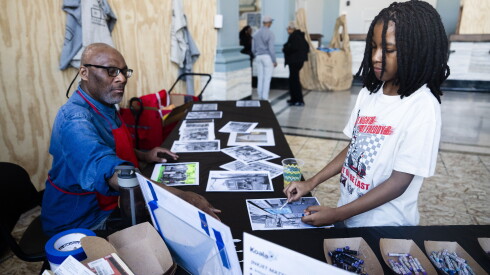
For Griffin-Fabicon, creating that space — and seeing communities represented within the museum — fills gaps in the historical record, helps people recognize the value of their own experiences, and begins to repair the harm caused by generations of exclusion.
Austin resident Natasha Smith-Walker said finally seeing them hung on the walls of the Chicago History Museum made her want to “well up and cry.”
“Anytime we hear about these communities, it’s generally a shooting or something violent or something terrible,” Smith-Walker said. “But to see the beauty, the tapestry, and the uniqueness here just shows that all of these communities have beautiful, quality assets that need to be either reinvested in, or amplified, or supported in ways that young people can feel good about who they are and where they live.”