The last time Davorian Ware drove his 2010 Mitsubishi sedan, he was heading to Midway Airport from Champaign. It was August 2021, and he was taking a trip to Las Vegas. Before leaving, he parked in one of the city of Chicago’s overnight airport parking lots.
It was late when he got back three days later. The only thing on his mind was that he’d need to safely make the drive back to Champaign.
But Ware says, “When I came back, my car was booted.”
The city’s booting program — immobilization, as city officials call it — was established in 1987. The threat that drivers with delinquent traffic tickets might find one of the yellow metal devices latched onto one of their vehicle’s wheels to make it undriveable was meant as a way to get them to pay up.
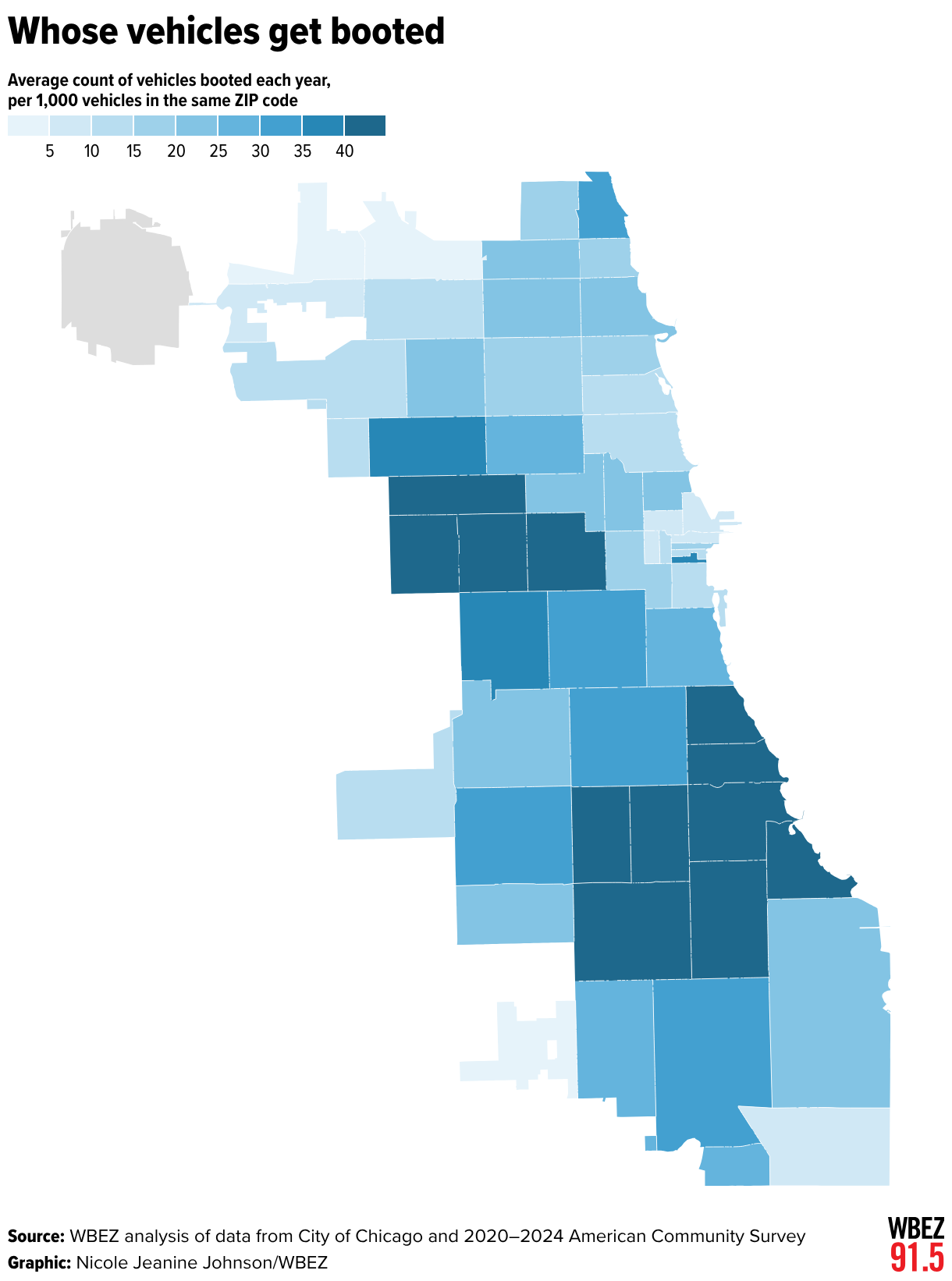
But the city’s ticketing and booting hits some especially hard, shows a WBEZ and Chicago Sun-Times analysis of the more than 283,000 vehicles that, like Ware’s, were booted by the city in the six-year span from Jan. 1, 2020, to Dec. 31, 2025, that found:
- Drivers in some parts of the South Side and the West Side got booted at rates twice the citywide rate. They include Englewood, Oakland and West Garfield Park and portions of Austin, East Garfield Park, Humboldt Park and Woodlawn.
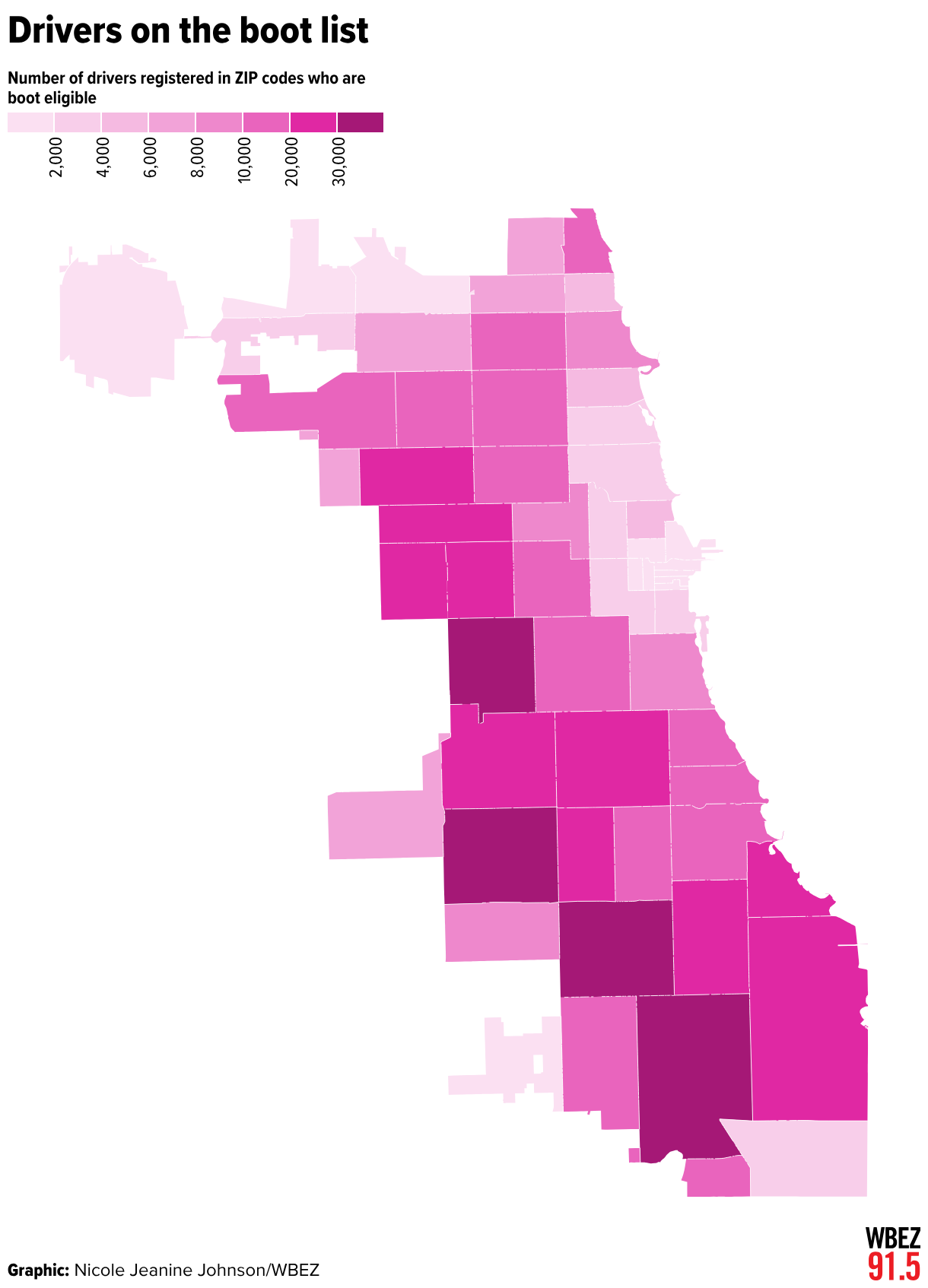
- Those same areas are among communities where the highest number of drivers are on the city’s boot list. Currently, more than 1.1 million drivers are boot-eligible.
- Every year, tickets from red-light and speed cameras were the leading violations for drivers whose vehicles got booted.
- About 1 in 4 drivers who got booted were booted more than once.
- The median amount owed by booted drivers was about $650. The most owed? More than $106,000.
- About 43,000 vehicles were booted and towed during the six-year period. As of Jan. 9, more than 12,000 vehicles had not yet been returned to drivers.
Critics of the program say the combination of automated enforcement, hefty ticket prices and mounting fees for delinquent traffic and parking tickets can easily exceed the ability of some drivers to be able to pay their debt. That lands them on the city’s boot list. And then the added fees they’ll face for the towing and impounding of their vehicles can overwhelm them financially, ensnaring them in a debt trap for months, in some cases years.
“These debts can spiral out of control really quickly and become quite invasive in a person’s life,” says Kasey Henricks, an assistant professor in the University of Illinois Chicago’s Department of Criminology, Law and Justice. “Literally taking people’s cars away is taking away their mobility in a place where their livelihood is dependent upon that.
“It completely devastates people’s lives if you have outstanding ticket debt in Chicago.”
For Ware, it was the second time he’d been booted. In the course of a year and a half, he amassed 21 tickets and owed $2,811.57. He’d been on payment plans three times and defaulted each time. He says the last time was because he lost his job during the COVID-19 pandemic. Ware, says that before he got his first boot, he didn’t realize he’d racked up so many tickets nor that he was violating driving compliance laws by not having a front license plate on his car.
“I didn’t know at all, and also there was nothing I could mount” the license plate on, he says. “There weren’t any holes on the front of my bumper.”

The city has a strict policy: If you default three times on payment plans, you can’t reinstate a new one unless you’re booted again, pay a reinstatement fee and pay up to 22% of the delinquent balance, depending on the plan you have. City officials say this is to discourage drivers who “constantly” default.
“They told me I gotta pay it in full,” Ware says, and that was something he couldn’t afford. His only option was to leave his car.
He didn’t know that, over the next three months, the city would tow his car to a pound. Weeks later, the city sold it at an auction for $262.08, records show. Because Ware’s car was unclaimed after 45 days, the city had that right.
Asked for comment about the WBEZ and Sun-Times findings, Mayor Brandon Johnson’s office says: “The Johnson administration recognizes and understands the burden mounting debt and late penalties places on working families. To that end, building on the success of the Johnson administration’s 2025 debt amnesty effort, Mayor Johnson’s budget establishes a Vehicle Debt Amnesty Program that gives residents with outstanding tickets a path to resolve their debt by paying only the original fine while waiving all late penalties, collection costs and additional fees.”
In April 2025, the city launched two debt-relief programs — the Vehicle Violation Debt Relief Program and the Commercial Driveway and Signs Violation Debt Relief Program. Those programs allowed businesses and drivers to settle their ticket debt from tickets issued before 2024. They had two months to pay what they owed in full minus the penalties and collection fees that usually are applied. But that program concluded in June 2025.
But, also in 2025, the Johnson administration added 50 new speed cameras throughout the city. The result was a surge of speed-camera tickets. In June 2025 alone — when 22 of the new cameras came online — the city issued 240,000 speed-camera tickets, the highest amount for a single month in nearly three years, the Sun-Times and
WBEZ previously have reported.
Now, the City Council Office of Financial Analysis has circulated a 2027 revenue proposal that includes options to raise the city’s towing and storage fees.
In his May 2023 inaugural address, Johnson said that, even though City Hall faces big financial pressures, closing the budget gap needed to be addressed “without breaking the backs of working people.”
But the weight of the compounding costs that drivers face when they fall behind on parking and traffic tickets is heaviest in Black, working-class communities.
“Most of the consequences for late penalties, collection fees, being placed on the boot, tow and impoundment lists are concentrated for cars … in majority Black neighborhoods and, to a lesser extent but still prominent in majority-Latinx communities, too,” Henricks says.
‘Double punishment’
Ware eventually found another job and figured his booting nightmare was in the past. But then, in February 2023, nearly a year and a half after he’d last seen his Mitsubishi, he noticed his paycheck was short by about $310.
“It was a terrible time when they started garnishing my wages,” Ware says.
City Hall had gone through the Illinois state comptroller’s Local Debt Recovery Program to collect from Ware. This program lets municipalities go after outstanding debts that otherwise would be tough to collect.
“That’s double punishment,” Ware says. “If y’all took my car, at least wipe away the slate, or give me my car back.”
His checks were garnished for four months.
“I ended up having a kid right before they started garnishing my wages, and we [were] trying to do daycare,” he says.
Asked what his reaction would be were he in Ware’s situation, city Comptroller Michael Belsky says, “I wouldn’t be happy about it.”
Belsky says the city tries to avoid situations like Ware found himself in.
“We don’t want people to be making a choice between paying their tickets and childcare and healthcare and food,” he says. But “if you do violate the law, we expect you to pay, but pay something.”
Belsky says 75% of drivers who get a ticket pay up.
“Where people run into problems is when they don’t pay,” he says. “They just get these escalating fines on top of it, and that’s when it becomes a burden.”
Drivers who get a ticket in Chicago are mailed a notice of the violation. They have 21 days to pay. If they don’t pay or if they don’t fight the ticket within 25 days after that initial 21 days, they’ll get a notice of final determination. At that point, the original fine doubles or otherwise increases up to $250.
Once drivers have at least three tickets in final determination status — or two tickets, if they’re at least a year old — the city issues a seizure notice and places their vehicle on the boot list.
Then, once a vehicle gets booted, drivers have 24 hours to pay their debt or make a deposit on a payment plan. They can request an additional 24 hours. They also are responsible for a $100 fee to remove the boot. If drivers don’t respond within that time, the city will tow and impound the car, adding a $150 tow fee for sedans to sport-utility vehicles and $250 for pickup trucks, plus a $50 daily storage fee for the time the vehicle is held at one of the city’s auto pounds.
If a vehicle hasn’t been claimed after 45 days, the driver might not be able to get it back. The city then has the right to claim the vehicle, auction it off or dispose of it.
How the booters find you
The city uses “license-plate technology to read plates that match against their seizure list,” according to a Department of Finance spokesperson.
Cameras are attached to the booter trucks and, using artificial intelligence, the city trucks scan the plates of every car on a block to check it against the department’s seizure list. The booter is responsible for verifying that the machine accurately identified the plate as a match on the list. Once confirmed, the city workers places a boot on the vehicle.
Belsky points to the city’s Clear Path Relief program, which allows drivers with incomes at or below 300% of the federal poverty level to pay off the original violation amount for tickets within three years, and then any other debt will be forgiven. That doesn’t include parking-meter debt.
“If they pay their current tickets going back three years, we waive everything in the past as long as they stay on a payment plan for a year,” Belsky says. “That also applies to booted vehicles.”
‘Barbaric and unjust’
Lower-income drivers on the South Side and the West Side have the hardest time keeping up with the tickets, fines and fees, WBEZ and the Sun-Times found, with six ZIP codes topping the list in terms of booted vehicles per 1,000 vehicles in those areas. Median household incomes in those ZIP codes range from $34,000 to $54,000 a year. Compared to the citywide rate, the boot rates were twice as high in those areas, which include Englewood, Oakland and West Garfield Park and portions of Austin, East Garfield Park, Humboldt Park and Woodlawn.
Chicago’s ticketing program is “probably one of the most regressive ticketing programs in the country,” according to Mark Wallace, executive director of the group Citizens to Abolish Red Light Cameras, which sued he city for failing to comply with its own rules about how red-light camera tickets are handled. In 2017, the city agreed to settle for $38.75 million, providing relief to drivers who received red-light camera tickets.
According to the WBEZ and Sun-Times analysis, red-light and speed camera tickets are the leading violations that land drivers on the boot list.
“I just think that the city is not very creative in trying to find ways to expand the tax base but find the easiest way to collect revenue, and those easiest ways tend to prey on lower-income Black and brown communities,” Wallace says.
Belsky says City Hall doesn’t target those communities and that the “technology is not biased.”
He says the city is fair in how it looks for boot-eligible cars.
“We have 74 booting zones, and there’s a kind of a schedule of implementation of enforcement, but it’s also data driven,” Belsky says. “If there are areas that we get a lot of complaints from aldermen or 311 or 911 [calls], we will focus resources there. But we also try to be very equitable by having these zones.”

Belsky says city officials need to ensure that the “business of the city can go on,” with things like street cleaning and making sure that cars aren’t in bus and bike lanes.
“There [aren’t] revenue goals,” Belsky says. “Our focus is to prevent accidents, promote public safety. We had [an] individual who worked for the city that was hit in a bike lane recently and killed. So that’s one too many.”
In June, Riley O’Neil, a city employee who worked on strategies to make streets safer for cyclists and pedestrians, was killed while riding his bike in a bike lane. O’Neil hit the door of a driver exiting a vehicle, which threw him into traffic and under the rear wheels of a semi-truck. The driver of the car received a citation for illegally parking his car.
Wallace calls the city’s booting program “barbaric and unjust” and says it should be a “last resort” to improve traffic safety. He says city officials need to reform the system and do a better job of notifying drivers when they’re on the boot list. He says the rules aren’t clear enough and that many drivers end up being surprised when they walk “outside of their house or walking outside of their job and getting a boot on [their] car because they didn’t pay two tickets.”
Penney McDonald says she’s among those who’ve been surprised. She grew up and learned to drive in Chicago Heights, where she says parking violations aren’t as routinely enforced.
So when McDonald moved to the South Side in 2013, she wasn’t expecting to get hit with so many tickets — mostly for parking in tow zones — that got her booted at least three times. “I never seen a ticket in my life, and I was driving a long time before I came to the city, and I never experienced that.”
Years later, she moved to Uptown and went to beauty school nearby in Rogers Park, densely populated neighborhoods where parking is hard to come by. McDonald admits that she gambled with parking in prohibited areas, hoping that a space would become available where she could park legally.
“But by the time you get to your car, you already got a ticket,” she says.
From May 2014 to June 2026, between McDonald and another driver who had access to her car, she had gotten 44 tickets, with fines totaling nearly $6,000, records show.
That’s roughly one ticket every three months. McDonald couldn’t keep up. With fines from a steady flow of tickets, plus penalties for late payments, she was constantly on the boot list.
“Call me a conspiracy theorist or whatever, but it just seems like, once you’re in their system, you’re not getting out of it, and it’s overbearing,” McDonald says.
According to city records, McDonald established at least 15 payment plans, but she says she was in a tough spot financially and defaulted on more than 11 of them. Her payment plans predate the city’s current three-strikes rule.
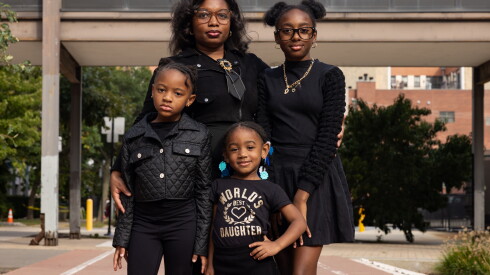
McDonald says she fell behind on her ticket debt because “I couldn’t afford it at that time.
“I do not have $60 or $75 or $150, $125, $250. I do not just have it sitting around to give for a ticket,” says McDonald, a mother of three girls, ages 5, 6, and 11. “I would rather spend that money to get my daughter some lunch, pay for some field trips. Unless you got a good PTA, that comes out of the pocket of the parents.”
One time when her car was impounded after it was booted and towed, McDonald was pregnant with her middle daughter. She says she doesn’t feel safe riding the CTA nor does she think the transit system is reliable, so she had to do everything on foot, and she felt embarrassed.
“We had to use the shopping carts to push our groceries back home,” McDonald says. “It was just ghetto and heart-wrenching at the same time. You don’t want to rack up a lot of tickets in Chicago. As a single parent, that is one of the worst situations you can put yourself in.
“People don’t understand that when you lose your vehicle, you have lost your whole lifeline,” she says. “It’s so very hard to get back to where you once were.”