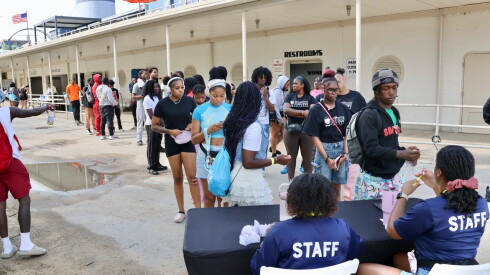
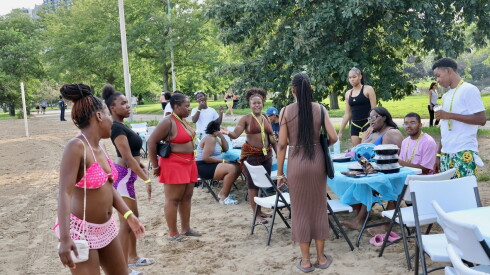
Around 5:30 p.m. Aug. 19, more than 160 Chicago teenagers were hanging out, eating food and taking photos at North Avenue Beach.
Then the volleyball players came.
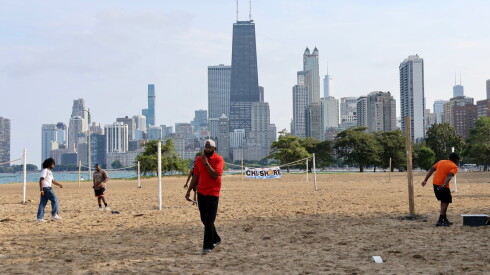
The beach party — permitted by the city — had signs around the courts. Teens were throwing footballs and playing field games. Despite teens and adults asking the players to hold their games until after the event ended at 7 p.m., the players continued setting up for their regularly scheduled games.
The conflict was resolved peacefully, but it was more than a mix-up over beach courts. Some teens said the encounter left them feeling discouraged and unwelcome in a public space they had gone through the proper channels to reserve.
For some of the teens and the adults who organized the beach hangout, it raised a larger question: Who is actually welcome in Chicago’s public spaces?
The encounter comes as Chicago grapples with how to make public spaces safer and more welcoming for young people while responding to concerns about violence, property damage and large teen gatherings.
Viral social media posts and news coverage showing large teen trends, gatherings and “takeovers” have fueled debates about parent accountability ordinances, snap curfews, escort policies and other approaches to managing youth gatherings.
City officials say they want to see more “third spaces” where young people can gather safely outside of their homes. But for teen and youth organizers, the challenge isn’t only creating those spaces — it’s making sure young people feel that they are actually welcome in them.
On Aug. 19, Project Exploration, a local youth development nonprofit organization, worked with the Mayor’s Office of Education, Youth and Human Services to throw the beach party for South Side and West Side youths.
Austin resident Carla Jones, 18, was one of 20 Project Exploration youth employees who helped organize the event.
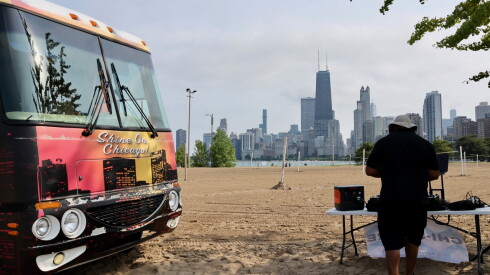
“We thought of everything teens would want to do — volleyball, we had the game trucks, the selfie booth,” Jones said.
Janeicia Williams, who helped oversee the project, said the gathering was also about something less tangible: giving young people a chance to occupy a public space without feeling like they had to justify being there.
“There aren’t a lot of times that we get to be in these spaces,” said Williams, director of community ecosystem at Project Exploration.
The mayor’s office invested more than $10,000 for food, transportation, the video game truck, a handwashing station, portable toilet, tables and chairs.
“This event was 80% planned by young people,” Williams said. “The 20% that the adults took on was just the logistics, the permitting. The only thing we did was pay for some stuff and put in some booking information.”
Upon arrival at the beach party, attendees had to register and go through a security check before enjoying lunch, music and games.
“We wanted to create a safe space for the kids so that they end the summer off with a nice event before they go back to school,” said Austin resident Porschay Graham, 19.
For some of Chicago’s Black and Brown teenagers from the South and West sides, the party was a chance to experience a part of their own city they had never explored. Some had never been Downtown, let alone to North Avenue Beach.
But the encounter with the volleyball players reinforced a message the teens said they had heard before: You can follow the rules, get the permit and bring the adults — and still be made to feel like you don’t belong.
Michael Khrin, founder of Archetype Chicago, a recreational volleyball league, typically gets a walk-up reservation for the North Avenue courts before the group’s weekly games. On Aug. 19, some of the group’s players arrived early and began setting up while the teen event was still underway.
“I saw the van and companies setting up on our courts,” Khrin said. “I was just kind of confused.”
Williams and Khrin eventually agreed that Project Exploration would end their event an hour early so that the volleyball players could begin at their regular scheduled time at 6 p.m.
“This is a once-in-a-lifetime opportunity for some of our teens,” Williams said. “It didn’t seem like they understood that. There was a certain level of entitlement.”
Jones said she felt the teens were misunderstood.
“When we’re actually trying to show that teens are not all about violence and ruckus or when we’re making events for teens to feel safe,” Jones said. “It’s kind of discouraging.”
Williams said the moment felt like a big inconvenience for some of the players.
Williams saw the encounter as part of a larger question about how Black teenagers are perceived in public spaces.
“If the roles were reversed and it was a bunch of Black kids trying to take over that part of the beach, there probably would have been more problems,” Williams said. “It probably would have been police called.”
Williams’ concern points to another tension the city is trying to navigate: how to create more places for young people to gather without treating every large gathering as a potential threat.
On June 24, City Council members held a public hearing where teens testified about “teen takeovers.” During the hearing, the Office of Community Safety and the Office of Education and Youth Policy reported “49 teen trends” in June. They also reported 25 arrests over Juneteenth weekend, June 19-21, including “at least six youth” arrests.
For the city, the challenge is balancing community safety concerns with efforts to give young people more places to go. Deputy Mayor of Education and Youth Khari Matthews Humphries said the city has two goals in addressing mass gatherings of teens: reducing violence and property damage while increasing “third spaces” and welcoming policies for Chicago’s young people.
“We would like to see more people raise their hand to say, ‘Hey, we’ll open up our space — we’ll open up our business — late for a poetry event,’” Humphries said.
Creating those opportunities can be complicated, particularly when residents and business owners have also experienced the disruption that can come with large youth gatherings.
Humphries said changing the perception about these gatherings requires adults to see young people as more than an inconvenience or source of disruption — they need to remember that they were once teens.
For Williams, supporting Chicago’s young people requires surrounding them with caring adults and activities that youth are actually interested in.
“Even when planning this (beach party) — if I’m being very quite frank — it was very uncomfortable,” Williams said. “Any large-scale group of people without parameters or certain logistics or certain controls in place can get out of hand.”
The August beach gathering ended peacefully, with teens spending the afternoon playing games, dancing to the DJ and meeting new and old friends from across Chicago.
For Williams, that was the point of the event.
“There were absolutely zero fights, there were zero weapons, there were zero altercations,” Williams said. “Young people — especially young Black people — are not a threat to the peace that we see here every day.”