Mollie Vivoda was squinting at her cellphone while also holding shopping lists at a Target in Bucktown on Wednesday.
Her three children will be starting school in a couple weeks, and her two daughters joined her for the family’s first back-to-school shopping trip. The girls, set to start third and sixth grade, were abuzz with excitement. Vivoda’s 11-year-old daughter, twin brother and 8-year-old daughter all attend a Chicago Public School in North Center.
“It’s kind of early for us [to be shopping],” Vivoda, 41, said. “This is just like our launching point. Once [I] tick off everything we got here, then I’ll probably do more comparison shopping.”
As CPS students return to class Aug. 24, parents are juggling lengthy school supply lists — at a time when inflation is making everything pricier.
Chicago K-12 parents, surveyed by Deloitte, expect to spend a whopping $794 per child on back-to-school items this year, up 7% year over year. It’s also 35% higher than the national average spend $557 per child. The survey reported children’s preferences influenced their parents to spend more and splurge on items.
But Matt Adams, principal at Deloitte, said 39% were “hyper-value seekers,” meaning they’ll shop strategically to save, like buying in bulk or using private labels.
“While consumers are planning on spending more this back-to-school season, they are also still very much seeking to stretch their dollar as far as it will go,” Adams said.
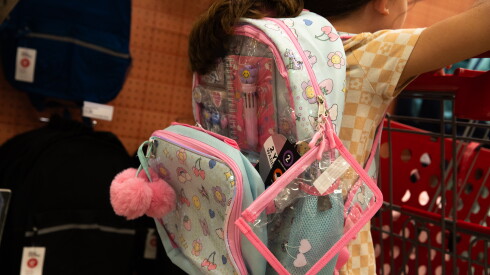
Vivoda’s 8-year-old daughter put on a pastel blue-and-pink backpack, patterned with smiley faces, butterflies and rainbows, as they shopped. A fuzzy pink cherry pom pom charm dangled off the attached lunchbox and the backpack set included matching stationery, a multicolored flower pen and binder clips.
Among the rows of standard folders, binders and notebooks were colorful displays meant to be a young girl’s dream. One large display consisted entirely of ways to decorate a reusable water bottle, with beaded charms, stickers and stick-on hooks. One sticker, like a heart-shaped waffle with the phrase, “I love you a waffle lot,” cost $3.99.
“Back-to-school shopping is a breath of fresh air,” 11-year-old Dottie Vivoda whispered, as she dumped supplies into the shopping cart.
But for some parents, this school year may be less joyful and more of a financial pain.
“We saw this huge shift towards shopping early last year, and now, it’s totally dispersed,” JLL Manager of Retail Research Keisha Virtue said. “[People are] shopping later … waiting until they have the money to shop and looking for those extra promotions and sales.”
Nationally, back-to-school spending for K-12 students is expected to reach a record $43.3 billion this year, nearly 10% higher than last year, according to the National Retail Federation. The previous record was $41.5 billion in 2023.
The NRF found consumers aren’t willing to compromise on fulfilling their kids needs, with 37% of respondents saying they’d rather cut back on other areas to save. And 20% said they would use buy now, pay later services like Afterpay or Klarna.
The highest spending categories are often clothing and shoes, as well as technology products, experts said. Data from the NRF said shoppers will spend an average of $250.29 on clothing and accessories, $293.11 on electronics and $174.01 on shoes.
Illinois residents will receive some relief on their back-to-school spending, due to provisions in the state’s 2026-27 fiscal year budget. From Friday through Aug. 16, consumers purchasing certain clothing and school-related items will pay 1.25% in state tax, a 5% reduction. Most clothing and footwear are eligible but must be less than $125. Electronics and their accessories, excluding calculators, don’t qualify as school-related items under the eligibility list.
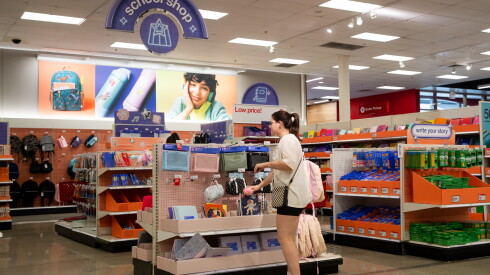
Karen Mannerino, a mom to three CPS students, aged seven to 16, used to spend less on school supplies. Her two youngest attend Wildwood Elementary and like many Chicago schools, parents can buy a prepackaged box with required school supplies.
She said this year’s box costs $125 per child. Mannerino decided to shop around for cheaper items at Target and Amazon.
“I feel like we used to be able to buy supplies for under $100, and now, it is like it just keeps going up more and more over $100,” she said. “We used to [shop] in person. Then some years, we bought the box. This year, I just felt like the box price was so much that I could probably get it cheaper if I bought it on my own.”
Belmont Cragin resident Suggey Cortez noticed prices increasing for items like headphones and backpacks. Two of her kids attend John Barry Elementary School, and her third child, an 8th grade at charter school Intrinsic, needs more costly items, like an advanced calculator.
Cortez usually spends about $200 on required school supplies for her three kids. She estimates that may increase this year to $300, or even $400.
Groundwork Collaborative and The Century Foundation in a report last month found the price of typical school supplies increased 7.7% over the past year. It noted sharp price increases from 2025 for items like lunch boxes, which jumped by 26.8%, notebooks, up 23%, and index cards, which rose 22.2%.
The analysis pointed toward tariffs as a factor for the higher prices. It said companies such as Newell Brands, owner of Paper Mate and Elmer’s glue, Logitech and ACCO Brands, parent company of Five Star and Mead notebooks, increased their prices recently because of tariffs and rising oil prices as a result of the U.S.-Israel war against Iran.
While school supply lists don’t appear to have more items than usual, the lists for Mannerino and Vivoda’s children still had more than 20 items. And many schools require parents to purchase certain items in bulk for the classroom or school, such as tissues, hand sanitizer and cleaning wipes.
Vivoda typically spends at least $300 on school supplies for her three children, with about half that total toward cleaning supplies requested by the school.
But for many Chicago K-12 parents, the most expensive part of back-to-school shopping are the fees.
Before the school year begins, Mannerino will have to pay more than $885 in fees for her three children. Most of that — $585 — is for Lane Tech College Prep High School, where her 16-year-old is a junior. There are class-specific fees, like for art and language, and fees for technology, she said. She pays between $150 to $170 annually for each of her other two children.
Cortez said she’ll be paying $150 to her son’s charter school, while her second and fourth grader’s supply list each includes a $30 “school fee.”