Chicago restaurants fighting for survival amid rising food, labor and operating costs and the inflation-linked decline in their customer base got a temporary break Wednesday at the expense of their tipped employees.
The City Council agreed to freeze the hourly pay of Chicago’s tipped workers at 76% of the minimum wage for the next two years for large restaurants and for four more years for smaller establishments with 21 or fewer employees.
The compromise was hammered out by rookie Ald. Walter R. Burnett (27th) without Mayor Brandon Johnson’s involvement. The mayor must now decide whether to issue his fourth veto or risk the political embarrassment of an override.
Johnson used his third veto to preserve one of the key items on his progressive to-do list and managed to make it stick. But with only one dissenting vote on Wednesday, the chances of a fourth veto succeeding appear slim.
The mayor is more likely to swallow hard and accept the compromise, just as both sides of the heated debate have reluctantly agreed to do.
If the remarks made Wednesday by one of the mayor’s most powerful City Council allies are any indication, a fourth mayoral veto may be coming.
The lone “no” vote was cast by Budget Chair Jason Ervin (28th), who said freezing the wages of a workforce that includes the “poorest of the poor in Chicago” is an “economic betrayal and a moral failure.”
“There’s a difference between compromise and caving in,” Ervin said.
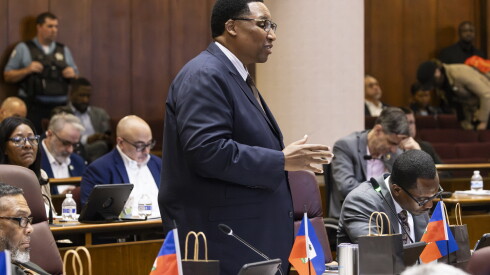
“I don’t see how people can support not letting people get to a basic minimum wage… What about their lights and their bills and their groceries?”
Far Southwest Side Ald. Matt O’Shea (19th) said a parade of restaurant owners in his border ward have told him they don’t want to leave Beverly, but city mandates have them seriously considering moves to suburbs like Oak Lawn, Evergreen Park and Blue Island.
“If the restaurants don’t exist or leave to go the suburbs, nobody’s got jobs,” O’Shea said.
The compromise did not satisfy either side of the debate, but both sides accepted it.
During the public comment period that preceded Wednesday’s City Council meeting, Illinois Restaurant Association President Sam Toia reiterated that the temporary freeze is “not the ideal outcome for our industry.”
But it’s “more workable and less harmful” to restaurants fighting to stay in business, particularly in wards that border suburbs.
“Operators need time to adjust so they can keep their doors open and their staff employed,” Toia said. “Predictability matters for workers, too. Abrupt changes can lead to reduced hours, fewer shifts, higher menu prices, more service charges and fewer opportunities for tipped employees.”
Saru Jayaraman of the One Fair Wage Coalition has also accepted the multiyear wage freeze for those she has called the “lowest-wage workforce in Chicago in the midst of the greatest cost of living increase in United States history.”
“If we are going to agree to this substitute, which we said we can live with, this has to be the end of the conversation. We should not have to continuously re-litigate something that the city has already agreed is the right thing to do, which is paying this lowest-wage workforce a full minimum wage with tips on top, like every other workforce in the city of Chicago,” Jayaraman said May 12.
Without the freeze, tipped workers now paid $12.62 an hour would receive a raise to 16% of Chicago’s minimum wage. That amount is reset every July 1 to match the cost of living. With the freeze, they would still receive a raise, but it would be capped at 76% of whatever the minimum hourly wage turns out to be.
Restaurants are mandated by law to make up the difference for servers whose hourly pay and tips do not equal the minimum wage.
Sweepstakes machine ban vote delayed
Johnson managed to avoid what might have been a second political defeat when Ald. Anthony Beale (9th) and Ald. Ray Lopez (15th) moved to postpone a vote that would have banned sweepstakes machines in Chicago.
Beale said he remains determined to maximize revenue from video gambling terminals by eliminating illegal competition from the 7,000 sweepstakes machines now operating illegally in Chicago. But he postponed a vote on the ban to beat Alds. Pat Dowell (3rd) and Nicole Lee (11th) to the punch.
“All I’m trying to do is maximize the money we can get from VGTs,” Beale said. “Allowing a black market to operate is going to undermine VGTs.”

Business Affairs and Consumer Protection Commissioner Ivan Capifali has pleaded for more time to establish a regulatory structure and “ensure seamless and lawful implementation” of the Chicago ban. The commissioner has voiced concern that the regulations that Beale proposed may be “overly broad and burdensome” and have a “disparate impact on various communities.”
Sweepstakes gambling machines look like video slot machines but have managed to operate in a gray area of the law by offering “free play” options and coupons to winners instead of cash.
EV parking spaces pilot ordinance
Also on Wednesday, Johnson introduced an ordinance that would authorize Transportation Commissioner William Cheaks Jr. to designate parking spaces “on the public way or in any public or private parking facility” for the “exclusive use of electric vehicles charging at an electric vehicle charging station.”
The “Electric Curbside Charging Pilot” would terminate June 30, 2030 unless the City Council extends that deadline. CDOT would be empowered to “install, operate and maintain” those charging stations or “enter into agreements” with private entities to create those stations. Motorists parking in those designated spaces would face $100 fines.