New York City’s buzzy progressive mayor, Zohran Mamdani, took to social media last month to announce — in multiple languages — an initiative to give thousands of free Broadway tickets to local high school students.
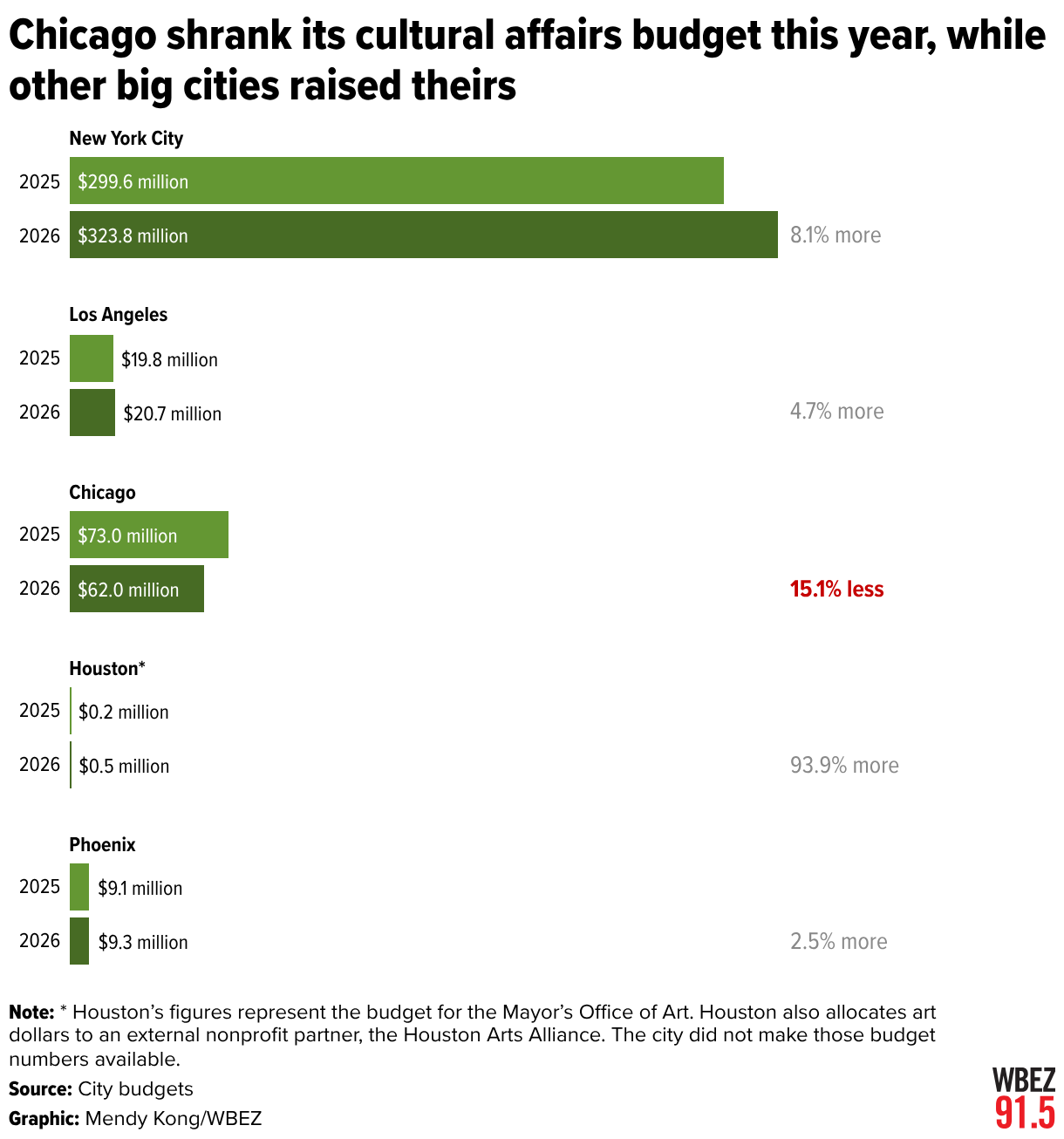
Paired with a recent, record-setting $323.8 million allocated for New York’s Department of Cultural Affairs in the city’s budget, Mamdani appears intent on building a reputation as a culture-forward mayor. His enthusiasm comes as federal arts support has withered under President Donald Trump, and as private foundations that buttress the arts shift their priorities elsewhere. That’s made local government investment more critical than ever.

New York may be the poster child at the moment for arts spending, but Chicago has historically prided itself on strong support. Now, three years into Mayor Brandon Johnson’s term, as the city heads into its fall budget season and gears up for a mayoral election, WBEZ/Sun-Times asked advocates and the mayor himself about the city’s commitment to the arts and crunched the numbers to look at how Chicago’s budget stacks up compared to other major cities.
Across the country’s five largest cities (New York, Los Angeles, Chicago, Houston and Phoenix), Chicago was the only one to cut the funding for its local arts agency during its most recent budget cycle. And while its spending dwarfs that of the larger Los Angeles, and trails only behind New York in per capita arts dollars, the pressure is mounting on city leaders to do more.
“I don’t like to compare myself to any other place because there’s just no comparison to the cultural, the art scene in Chicago,” Johnson said in an interview last week about arts under his leadership. “What I can say, though, is for me, making the investments in arts and culture, that I believe is the way to define my administration.”
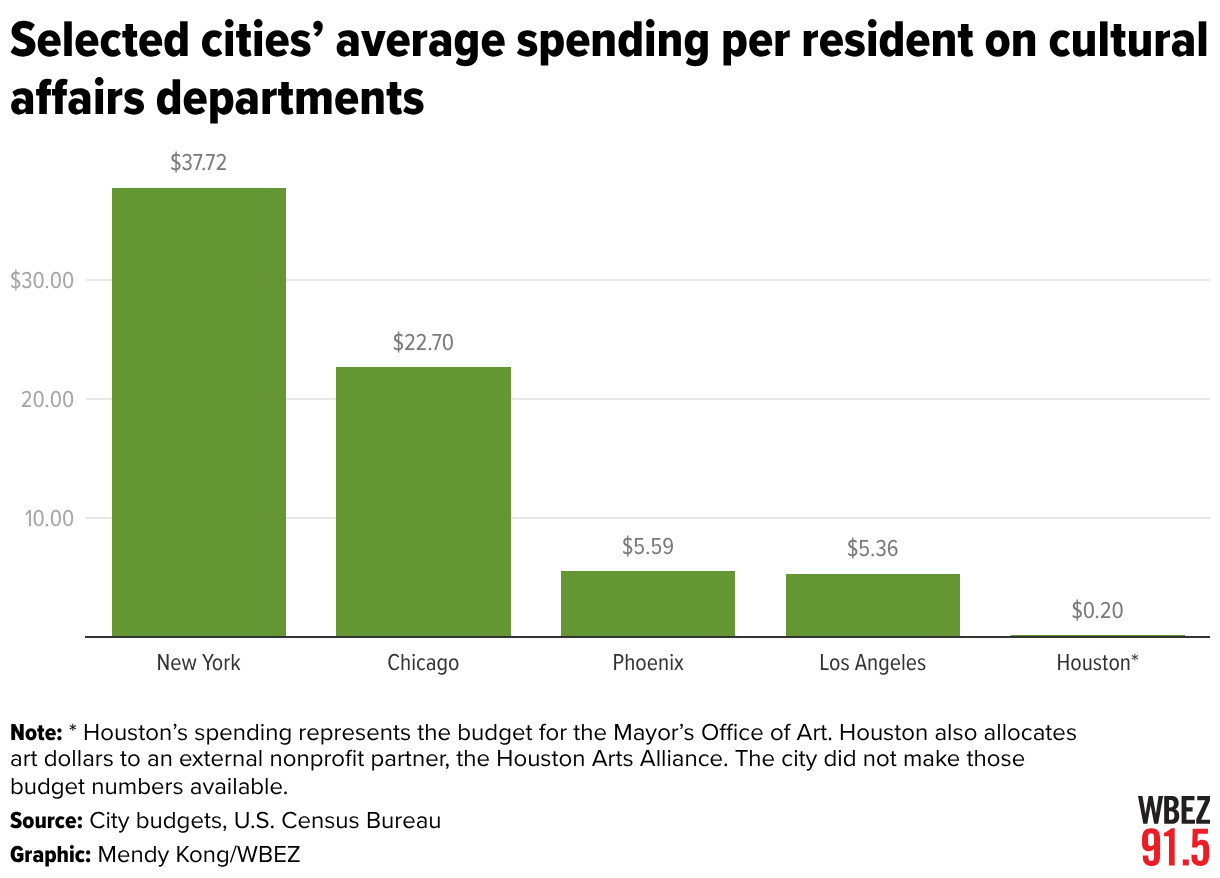
In 2026, Chicago allocated about $22.70 per capita to the city’s arts department, trailing behind only New York (which spends $37.72 per capita). But the Department of Cultural Affairs and Special Events, known as DCASE, took a 15% cut in the 2026 budget.
“I think local governments really need to get creative about funding the arts and to really look at new, interesting, dynamic ways to figure out how to increase those resources,” said Erin Harkey, Chicago’s former cultural czar who now leads the national advocacy group Americans for the Arts.
And as the city gears up for another tough budget fight this fall, with some cultural organizations gasping for air or shutting down entirely, some arts leaders and advocates worry about what comes next.
“When the arts and the cultural community contributes to the city in such meaningful and obvious ways, that should also be reflected in the budget,” said Meg Leary, a local artist who recently launched Arts First, a new collective arts fund intended to give dollars directly to artists.
The arts as an economic driver
In Chicago, a slew of recent reports make a compelling argument that the arts are good business for the city. The creative sector is actually Chicago’s third-largest industry, accounting for nearly 213,000 jobs, according to a 2026 report by Arts Alliance Illinois.
Cultural attractions such as the city’s restaurant scene and outdoor music festivals are tourism generators, cites Choose Chicago. The resuscitation of the zombie-like Loop post-COVID? The arts get much credit for that, too.
Plus, cities with stable support for the arts saw their local creative sectors emerge stronger after the blow dealt by the pandemic, according to a new national report from SMU DataArts in Dallas.
“Nobody, as an arts worker, is getting up because they’re, like, ‘I’ve got to contribute to the GDP’ or ‘I want to stimulate economic activity on this corridor,’ but these are real facts,” Harkey said. “And if something is this massive and this important to the economy, we have to pay attention to it.”
Each major city approaches its local arts agency slightly differently: Chicago’s includes the “special events” arm that programs everything from Taste of Chicago to Blues Fest; New York allocates money for city-owned spaces like the Metropolitan Museum of Art; and Houston has a designated external nonprofit partner to distribute grant dollars. In Chicago, DCASE’s funding comes primarily from the city’s special events and hotel tax, plus a mix of public and private grants.
As New York’s cultural affairs budget increased by 8.1%, local arts funding also climbed in the most recent budget cycles in Phoenix (by 2.3%) and Los Angeles (by 4.7%). In Chicago, funding trended downward in the 2026 budget.
Still, Johnson — who has not confirmed if he will seek reelection next spring — said he is committed to investing in the sector. When asked about the department’s budget cut last cycle, he pointed the finger at his political opponents in City Council.
“You don’t cut your way towards prosperity, right? You invest towards prosperity. My commitment will be consistent, and I’ll remain vigilant in my call to invest more in the arts,” Johnson said.
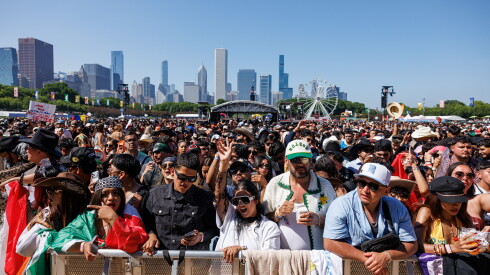
Among the biggest cultural wins of his tenure, Johnson cited the success of summer blockbusters like Lollapalooza and Sueños in Grant Park and grants given directly to artists citywide through DCASE.
While Johnson had broad support from the city’s cultural community in his first mayoral campaign, with hundreds of Chicago artists signing a statement endorsing him in 2023, a series of post-victory missteps, from replacing the cultural commissioner with a college friend to reported delays in grant payments, may have eroded that support.
The festival organizer behind the African/Caribbean Festival of Life said he was forced to cancel two summers in a row because of lack of police resources, while his pleas to City Hall went unanswered. (That festival has been moved to Sept. 25-27.)
“We don’t want to leave Chicago,” festival organizer Ephraim Martin told WBEZ/Sun-Times in May. “But on the other hand, if it feels as if we are not welcome anymore, then we may have to do that.”
Last spring, Leary, with Arts First, was among more than 200 artists who signed an open letter to Johnson, calling on the mayor to address “dysfunction” at the city’s arts department under his hand-picked commissioner.
“There is still time to do right by Chicago’s artists and creative industry who … significantly contributed to your successful election campaign,” the letter concludes.
Leary said while “artists were very hopeful” that a Johnson administration would uplift citywide arts, “I don’t know that that has happened in the way that we had maybe originally hoped.”
After embattled DCASE commissioner Clinée Hedspeth resigned her post last fall, following allegations of bullying and sexual harassment, she was replaced by longtime city staffer, Kenya Merritt, who most recently served as Johnson’s deputy mayor of business, economic and neighborhood development.
“Chicago has a strong cultural community that is not shy about sharing their recommendations, and I appreciate that,” Merritt said, who said the department has to move “in lockstep” with other cultural leaders.
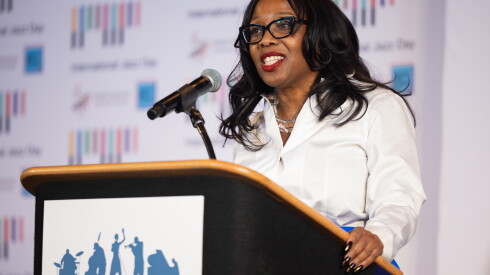
The commissioner said her priorities include more activations within the Downtown Cultural Center, where the department is housed, and focusing on “tangible policy recommendations” related to the rights of creative workers. She also sees the sector as a way to attract business to Chicago.
“When I think about the growth of our city, there is a recognition that culture plays a key role in it,” Merritt said. “You’re hearing all of these business and civic institutions now talk about the role and the value of culture.”
Funding independent artists
Even as cities increasingly recognize the importance of a creative workforce, a survey released in the spring found nearly two-thirds of arts workers in Chicago reported earning less than $40,000 annually.
One strategy used by city governments is to give grants to artists, dancers, sculptors and individual creators. This summer, the Johnson administration announced it had awarded nearly $1.4 million through the Individual Artists Program, the highly competitive initiative that awards grants of up to $6,000 directly to local creatives.
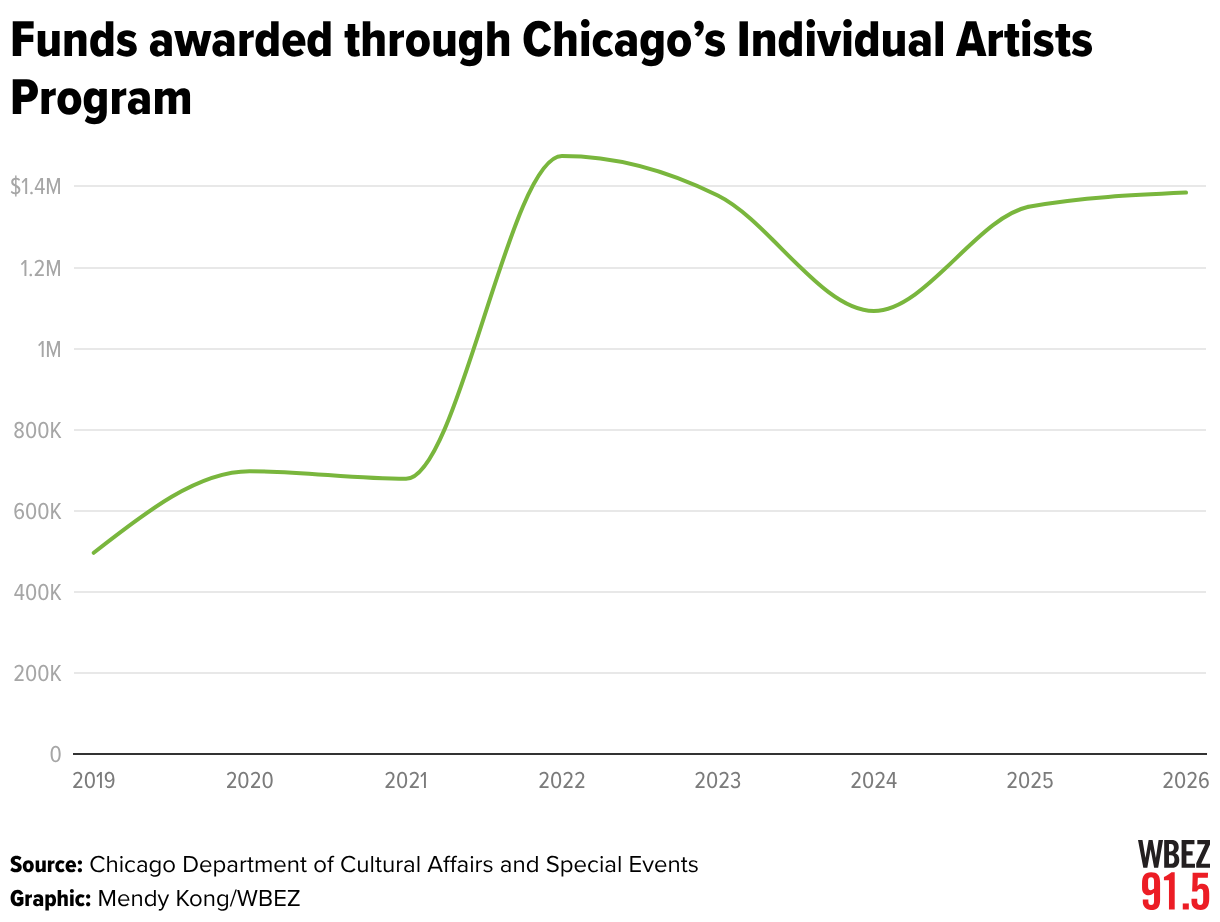
While the number of annual recipients has risen slightly to 250, up from 240 the year before the mayor took office, funding for the well-regarded program has largely plateaued since 2022. That’s when the program more than doubled in funding from $678,700 to $1,475,050 under former Mayor Lori Lightfoot.
Leading Chicago artists like Tonika Lewis Johnson — a MacArthur “genius grant” recipient, whose work includes the acclaimed Folded Map Project — say city investments were key early on. “My artistic career has essentially been influenced and flourished by the access to these new artist grants that the city provided,” she told WBEZ in 2025.
Last year, DCASE awarded a total of $10.8 million in grants to artists and arts organizations across a number of programs, according to public records. Recipients included everything from large companies like the Joffrey Ballet to the South Side storefront Perceptions Theatre. At its peak, the department awarded as much as $22 million across all its grant programs in 2023, driven by COVID relief dollars, allocated to the department by Lightfoot.
“That was hugely meaningful and right-sized the budget somewhat, at least, to be more comparable to peer cities,” said David Andersson with Bloomberg Associates, who worked on a COVID-era review of DCASE’s grantmaking programs with SMU DataArts.
Arts grants as a “stamp of approval” for cultural nonprofits
A report released this summer from the DataArts research institute at Southern Methodist University found that even small amounts of reliable local funding made a significant difference for cultural nonprofits, especially in how they fared during the COVID-19 pandemic, which upended the sector.
In part, DataArts Executive Director Jen Benoit-Bryan said, that’s because receiving city funding is seen as a stamp of approval that allows arts organizations to advocate for further funding elsewhere.
The report took stock of arts granting programs in 10 cities nationwide between 2019-24; Chicago did not participate.
“In the cities where that local support had been stable or had been growing over this five-year period through the pandemic, we see their sectors emerging as much more vibrant and healthy,” Benoit-Bryan said. “Cleveland and Phoenix are great examples of that, and in other cities where local government arts funding has been cut, like Philadelphia in particular, we see the reverse happening.”
States are also under pressure to do more. In Illinois, funding for the arts remained mostly steady under Gov. JB Pritzker’s most recent budget.
Still, Nora Daley, board chair of the Illinois Arts Council, said that budget item does not reflect the full picture of what the state spends on the sector.
“It’s a very tough budget time in Illinois, especially with all these federal cuts, so I think we have to look at new models and partnerships,” Daley said.
When it comes to sourcing further investments in the arts, Johnson pointed again to his trademark theme of progressive revenue — that is, taxing corporations and high-income individuals at a higher level.
“My preference is always that we’re investing more,” Johnson said. “We’ll continue to do whatever we can to ensure that the city of Chicago remains at the cutting edge when it comes to not just investments but shaping culture.”