Chicago faces a $882.4 million budget gap next year, Mayor Brandon Johnson announced Thursday as he teed up his next fight for “tax-the-rich” funding streams he believes are needed to offset the city’s severe financial woes.
“We will not balance this budget on the backs of working people,” Johnson said as he released his annual budget forecast. “We will continue to fight for progressive, equitable revenues that ask those who can afford to contribute more to actually do more, while protecting the essential services Chicagoans depend on.”
The budget gap is not unexpected and is smaller than anticipated, officials said. But it is still one of the largest deficits in the city’s history, forcing yet another season of contentious conversations between Johnson and the Council over how to close it.
Last year, the city had to close a $1.2 billion gap to balance its roughly $17 billion budget.
Johnson, who did not directly rule out a property tax hike Thursday, will need to find efficiencies and revenue as he contends with an emboldened Council opposition that has rejected his boldest progressive pushes so far.
Johnson said the budget gap is driven in part by $70 million more in the city’s bond payments, $90 million more in pension obligations, cost-of-living adjustments for union workers, and commodity price hikes linked to the U.S. war against Iran, including $32 million more in fuel and energy costs.
Also driving the gap is the loss of one-time revenue sources crafted by City Council members in the 2026 budget and a reduced surplus of special tax dollars known as TIF funding, Johnson said.
Currently, the city is expects to tap roughly $330 million to $340 million in surplus funds from special taxing districts. That’s far below the amount Chicago Public Schools is relying on to balance its budget. The school district receives more than 50% of declared surpluses.
Cost drivers
The forecast is a preview of Johnson’s comprehensive budget proposal expected in the fall. It does not include specific ideas for how to close the gap, or the programs and city services Johnson plans to spend money on next year.
But Johnson revealed some of the costs driving the gap.
For instance, the city is attempting to project the full cost of legal settlements, largely for police misconduct. Routinely, the city has underestimated payouts, and then ends up spending double or triple the budgeted amount.
At an estimated $400 million for 2027, that new projection is the “largest driver of our increased financial costs,” next year, said acting budget director Jonathan Ernst.
“We want to be very transparent about the costs of these settlements and judgments that are related to actions that occurred decades ago,” he said.

The city will also earmark $364 million in a supplemental payment towards its retirement funds for workers, on top of the $2.97 billion payment requirement by state law.
Similar to making an extra payment on a credit card, the supplemental pension payment is a former Mayor Lori Lightfoot-era policy that is lauded by ratings agencies.
Johnson has stuck with the policy, though he attempted to reduce the supplemental payment to $121 million amid financial woes last year but was thwarted by opposition Council members who took control of the budget process.
Overall, Johnson said Thursday, he will have made $1.1 billion in supplemental pension payments by the end of this year.
Political battle ahead
This budget season is sure to mark yet another politically divisive battle between Johnson and his City Council opposition of mostly moderate and conservative alderpeople he has labeled the “corporate caucus.”
United against the mayor’s failed 2026 corporate head tax proposal, the Council passed a series of alternative revenue fixes that have yet to produce much cash, including a proposal staunchly opposed by Johnson to sell old city debt to private collectors.
Johnson’s financial team said the 2027 budget completely nixes that projected $89 million revenue stream, after failed debt-buying deals with two different banks. The budget will assume some revenue from another Council idea — selling ad space on city bridges, said Ernst.
“It’s not as though we never said the advertising couldn’t bring in anything,” Ernst said. “It’s the timing … we knew it would take time, and the number seemed off. It seemed far, far too high. So we’re assuming some revenue, but significantly lower than what was projected for ‘26.”
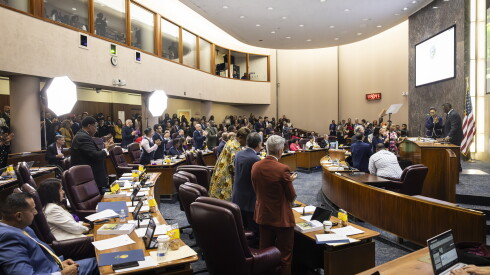
The Council coalition, which also fought for a larger supplemental pension payment, has remained organized and is unlikely to back down anytime soon. But Finance Committee chair Pat Dowell (3rd) said she’s trying to remain optimistic.
She said the coalition does not plan to introduce their own proposal to counter Johnson’s right off the bat, in favor of collaboration.
“But that’s really up to the mayor if he wants to collaborate or not,” Dowell said. “I would hope that he realizes from last year that the City Council is a co-equal branch of government.”
Johnson heads into this budget season with a brand new fiscal team after a series of high-profile departures.
But his new CFO, Ashlee Gabrysch, is a former senior director at Fitch Ratings where she served as the agency’s lead analyst for both Chicago and Illinois. She could help bridge the divide between the mayor and an emboldened opposition that had grown distrusting, and at times outright irreverent, toward Johnson’s now-gone budget leaders.
Closing the 2027 gap
Johnson, expected to announce his reelection campaign Sept. 13, is likely to embark on yet another mission to pass progressive revenue in his fourth, and potentially final, budget.
By simply pitching a new tax on wealthy Chicagoans, Johnson would be daring City Council members, many of whom are seeking another term themselves, to reject a “tax-the-rich” measure at a time when voters are demanding affordability.
It’s unclear whether Johnson will pitch a new revenue stream, another corporate head tax, or double down on the types of revenue he has already passed. Those include a tax on cloud computing that’s overperforming by $41 million this year.
Taxes on social media companies and online sports betting are also raking in cash and outperforming initial estimates by 56% and 69%, respectively. But both are facing a court challenge.
“’I’ve kept my commitment to challenging corporations and those with means to put more skin in the game. Obviously, with the forecast, it’s demonstrating that it’s working,” Johnson said. “When I present my budget in a little bit over a month, you can anticipate that that will remain my focus.”
Johnson did not explicitly rule out increasing property tax. But he and the City Council have likely missed their window to do so. The politically unpopular revenue driver is likely to be dead-on-arrival in an election year. The Council has already shown its distaste for the idea by unanimously rejecting Johnson’s proposed $300 million property tax hike in his 2025 budget.
The forecast also predicts worsening budget gaps in the years to come, growing to $943 million in 2028, and $1.02 billion in 2029.
TIF surplus
Johnson issued record TIF surpluses in his first three budgets, but that well is starting to run dry, and 2027 could be the lowest declared surplus of his tenure.
TIF funding is made up of incremental increases in property tax revenue that get set aside for local development projects, rather than going towards schools, libraries, parks or the city’s checking account. State law requires excess funds at the end of each year to be distributed among those local taxing bodies. The city gets roughly 23% of that surplus, while Chicago Public Schools receives around 55%.
This year, CPS is relying on at least $285 million in TIF funds to balance its own shaky financial picture, though that could grow by $150 million if the state doesn’t come through with more money. That would require the city to declare anywhere between a $518 million to $790 million surplus. Currently, the city is projecting up to $340 million.
Johnson has been able to issue such large TIF surpluses in part because most TIF districts were created in the 1980s and 1990s and have been reaching a peak of taxable revenue. It’s also because of a Johnson administration rule prohibiting alderpeople from indefinitely earmarking TIF funds for future projects, instead limiting them to one year.
Critics have slammed Johnson for relying on one-time TIF surpluses to balance the city’s budget. The Civic Federation, a budget watchdog, has said the city “has benefited from increasingly large TIF sweeps in recent years” but warns TIF surpluses have become a “stealth property tax” that will soon start to decline.