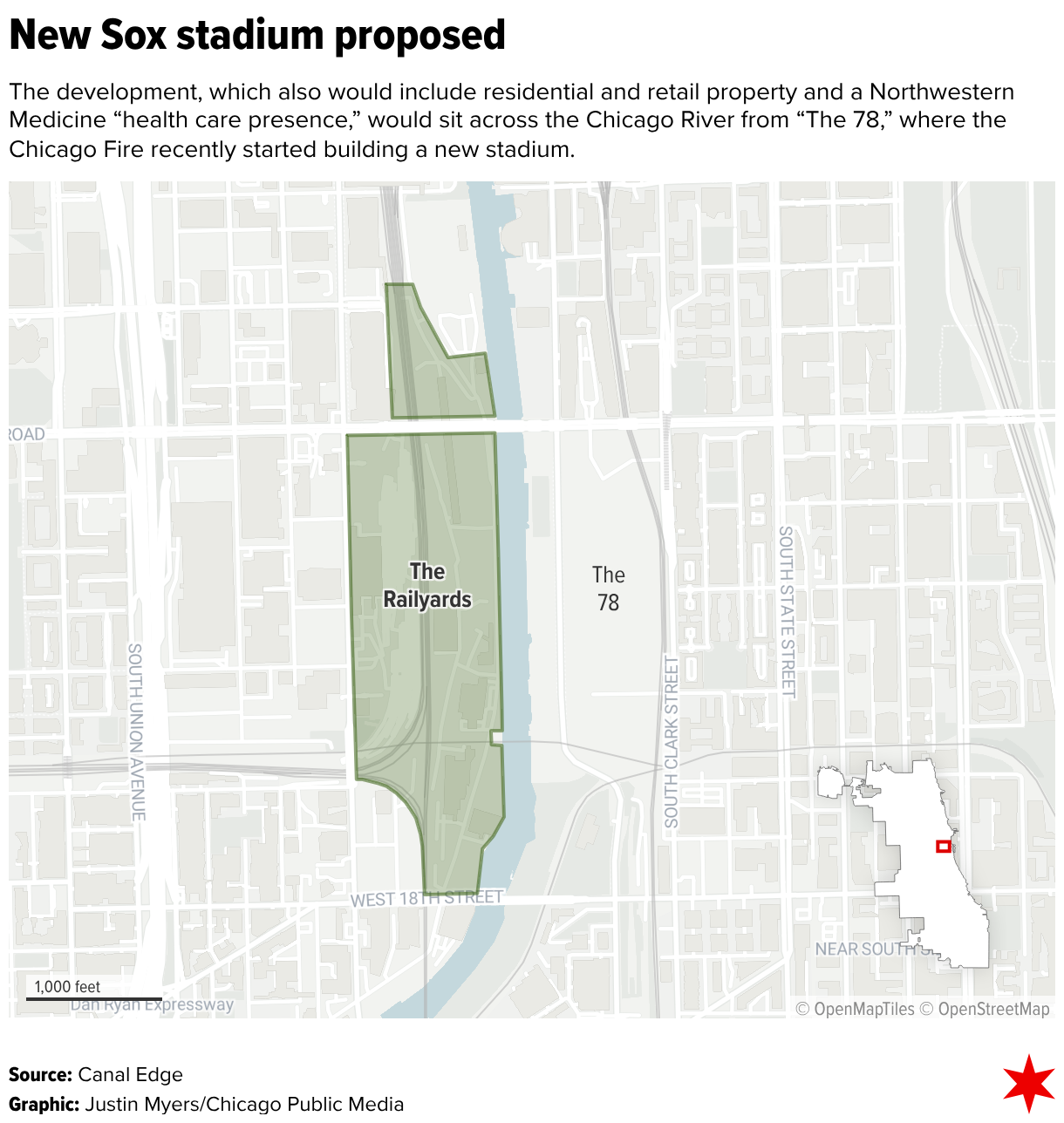
White Sox minority owner Justin Ishbia’s company, Canal Edge LLC, has proposed a mixed-use development called the Railyards as the site for a new White Sox stadium, which would be built where an Amtrak railyard now operates.
Amtrak is simultaneously shifting its maintenance operations from the relatively isolated site of the proposed stadium to a 24/7 facility that would have the same footprint as their current railyard, but in Bridgeport/Chinatown.
In recent months, a coalition has formed to address the environmental and economic impact a Sox stadium move and expanded Amtrak presence would have on Bridgeport and Chinatown.
Here’s what you need to know.
Why do the White Sox want a new stadium?
The team is under lease at the state-owned Rate Field only through 2029, with the option to extend through 2030 before a new lease is signed.
Where would the new stadium be located?
The stadium would be situated within a parcel of land alongside the Chicago River, stretching from Roosevelt Road to the north to 18th Street to the south, and bordered by the Chicago River on its east side and Canal Street to its west.
Who is behind the proposal?
Justin Ishbia. He’s a minority owner of the White Sox and co-founder of Shore Capital Partners, the Loop-based private equity firm that has boosted his net worth beyond $4 billion. Canal Edge is behind the Railyards project and is helping to finance Amtrak’s new maintenance facility in Bridgeport. He has repeatedly stated interest in a new stadium for the Sox.

Who is paying for the stadium?
Canal Edge has the land under contract. The property is across the Chicago River from where the Chicago Fire broke ground earlier this year on its $750 million stadium at The 78.
The ballpark itself would be privately financed, a source with direct knowledge of the planning told the Chicago Sun-Times. But there would be an ask for public funding for local infrastructure, including for nearby roads, bridges and potentially a new Metra station, though details haven’t been finalized.
What do the White Sox say about all this?
The team, which previously said it was solely focused on the concept of a stadium alongside the Chicago Fire’s stadium at The 78, said last weekend it will evaluate the outcomes of the Railyards site’s environmental and transit studies to decide whether to consider it as a viable option for their next home.
The White Sox are owned by Jerry Reinsdorf, who remains in control of the team’s stadium decisions until he decides to sell the team. He has the option to sell to Ishbia as soon as 2029.
What else is planned beyond a stadium?
The mixed-use proposal also would include a Northwestern Medicine “healthcare presence” as well as transit-oriented residential, commercial and retail development. But the concept is in its early stages. A monthslong study on the feasibility of transportation and environmental evaluations is just beginning, the company said in a statement.
How is Amtrak involved?
As Ishbia looks to take over Amtrak land in the South Loop, Amtrak has secured land in Bridgeport and is now looking to start work on building a 24/7 maintenance facility there as soon as this fall with the financing help of one of Ishbia’s companies. Operations could start as soon as 2027, Amtrak previously said.
Amtrak received more than $600 million and a “categorical exclusion” from the federal government for the project, which allows it to move forward without a full environmental assessment or an environmental impact statement “unless there are extraordinary circumstances.” There was, however, an environmental review process that included a noise/vibration/air quality review.
While the company said it will still conduct “standard due-diligence investigations,” residents worry the new facility could tank property values, particularly because of the potential for Rate Field being shuttered and the sound, smells or health hazards emanating from the train maintenance facility.
What do elected officials have to say?
Eleventh Ward Ald. Nicole Lee, whose ward encompasses Bridgeport and Rate Field, said the Sox’s move out and Amtrak’s move in would be “devastating” for the area and called it a “betrayal.”
Ald. Jason Ervin (28th), whose ward would encompass the new stadium site, said he would have an open mind but would focus on “what’s in the best interests” of his ward and the city.
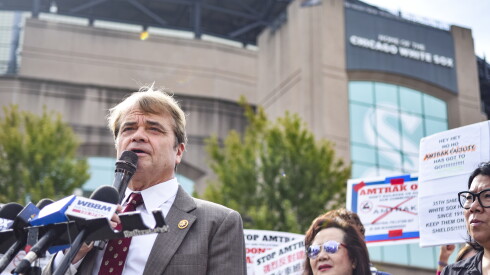
The project also is shaping up to be an issue the race for Chicago mayor. Three mayoral hopefuls, Illinois Comptroller Susana Mendoza, Cook County Treasurer Maria Pappas and U.S. Rep. Mike Quigley, all stood alongside Lee this week to decry the plan.