A 7-ton glass security desk designed by the late renowned architect Frank Gehry for the Inland Steel Building is now up for auction online, with its consignor looking to get between $100,000 and $200,000 for the work.
The blocky, 16-piece setup — dubbed “Icehenge” — has been a fixture in the building’s lobby since 2012. Gehry, a longtime fan of the superlative 19-story midcentury tower at 30 W. Monroe St., had a small ownership stake in the skyscraper from 2005 to 2007 and created the station specifically for the ground-floor space.
The Chicago office of Freeman’s Auctioners confirmed it will be handling the bidding. The online auction ends July 15.
A modernist landmark, the Inland Steel Building is owned by New York Life Insurance Co. The company acquired the skyscraper’s deed from the building’s previous owners, Capital Properties, in lieu of foreclosure in 2025.
Freeman’s didn’t respond to additional questions, including a query about why the desk was being sold.
But the auction house’s listing for Icehenge — as effusively written as the text from a J. Peterman catalog — details the desk’s history and inspiration.
“The idea for the desk was sparked by a rogue piece of glass Gehry encountered while developing another project,” the listing says. “The possibility of stacking thick glass slabs at shifting angles, allowing light, texture, and material imperfections to become the focal point, proved irresistible. … Against the restraint of the modernist lobby, the work feels intentionally provocative — Gehry at his finest.”
Widely read Chicago flâneur and architecture-watcher Lynn Becker brought attention to the auction last week on social media.
The work was fabricated by John Lewis Glass Studio in Oakland, California.
Gehry, an internationally famous architect and pop culture figure, died in 2025. He’s best-known around these parts as the architect who designed the Pritzker Pavilion and the silvery BP Pedestrian Bridge, both in Millennium Park.
The kinetic-looking lobby desk and the buttoned-down postwar cool of the SOM-designed Inland Steel Building mark one of the city’s most striking architectural pairings — although you have to go inside the glass-walled lobby to fully appreciate the effect, because a white drapery prevents Gehry’s work from being seen from the street.
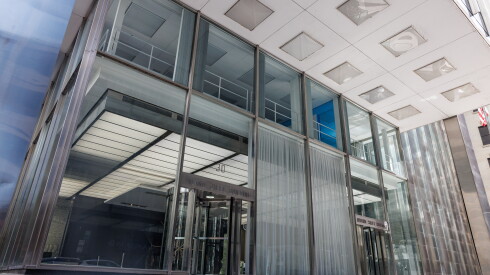
But it’s more than worth a look. The emerald glass desk matches the color of the Inland Steel’s exterior glazing and squares up nicely with its visually prominent lobbymate, Radiant One, Richard Lippold’s Space Age goldenrod and wire sculpture that is original to the 1958 building.
The nearly 15,000-pound station includes two slabs that make up the main desktop, plus desk supports, “decorative forms” and a pair of mirrored cabinets, according to Freeman’s.
“Although conceived specifically for its site, Gehry reportedly entertained the possibility of reconfiguring the 16 elements over time, allowing the work to evolve over time and in new settings,” according to the auction listing. “Different lighting conditions, architectural surroundings, or simplified functional contexts could dramatically transform its presence while preserving the power of its composition.”
The winning bidder is responsible for packing up all that power and hauling it away within seven days of the auction’s end.
The stainless steel-clad Inland Steel Building, which looks as contemporary today as it did 70 years ago, is one of the most important skyscrapers of the postwar era.

SOM architects Bruce Graham and Walter Netsch gave the Inland Steel open floor plans by designing it with columns located on the structure’s perimeter and then putting elevators, the plumbing stack and other mechanical needs in a tower wedded to the structure’s eastern side.
The building and its lobby — including the Lippold sculpture — have been under city landmark protection since 1998. The designation allowed the stand-alone Gehry desk to be added and doesn’t prohibit its removal.
Chicago Architecture Center CEO Eleanor Esser Gorski said she worked on the Inland Steel landmark designation when she was a Chicago Department of Planning and Development official.
“We were sure to protect the [Lippold] that was in there,” she said. “And then this [desk] came up … after the building was landmarked. There were questions: ‘Is this appropriate?’ But in the end, it is a movable piece of furniture, which is why it was allowed to be installed in this area.”
Gorski said she hopes a museum ends up with Icehenge.
“I think it needs to be displayed in a way that echoes how Gehry wanted it to be displayed,” she said.
Becker, who is critical of the design changes happening lately at the Art Institute of Chicago, said the art museum should buy Icehenge.
“As a reception desk to bring back some life and sense of fun to the pompous empty wasteland they’ve made the Michigan Avenue entrance lobby,” he said.