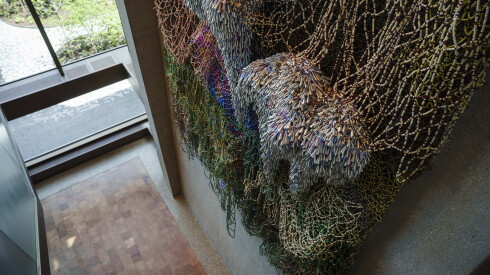
Barack and Michelle Obama are well-documented art lovers. So it’s little surprise that the new Obama Presidential Center features several contemporary artists in the prime of their careers, from Mark Bradford and Rashid Johnson to Chicagoans Theaster Gates and Nick Cave, who partnered with Indigenous artist Marie Watt for a bead-heavy work on display in the ticketed museum.
But what’s surprising is where most of this art has ended up. Only a fraction of the more than two dozen commissions sit behind the ticketed museum entrance: The vast majority of the sculptures, murals and mosaics pop up in locations around the 19.3-acre campus that are open to the public.
The selections were handpicked by the Obamas themselves from a short list prepared by the renowned curator Virginia Shore, said Obama Presidential Center Museum Director Louise Bernard.
“Art was central to the mission,” Bernard told WBEZ in an interview. “Virginia would bring forward a selection of artists she thought would work well in particular spaces — given the scale of the space, the need for a particular kind of materiality, the adjacency of other works. We would bring those selections to President and Mrs. Obama with recommendations, and [they] would make the final selection.”

The decision to commission many works for locations outside of the ticketed museum was a deliberate effort to encourage people to gather, Bernard said.
“There was a desire working with the architecture of Tod Williams and Billie Tsien to really activate and elevate the spaces and to use art to draw people in,” Bernard said, “especially to many of the places that you see where people will sit and convene and gather and hang out.”
Bold color, life-size bronzes and stunning murals are tucked away throughout the campus and make a fun seek-and-find for art lovers who want a scavenger hunt.

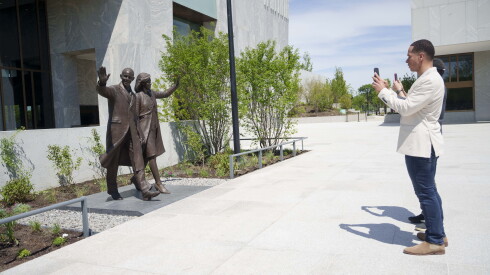
Start with the most visible, and immediate, work to greet visitors. Waving at visitors outside the museum is a 1,200-pound sculpture in bronze by Brooklyn-based StudioEIS. The group based the imagery of the waving couple on Inauguration Day photos from 2009, founder and director Ivan Schwartz told the Chicago Sun-Times.
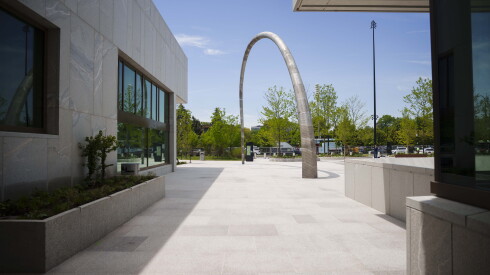
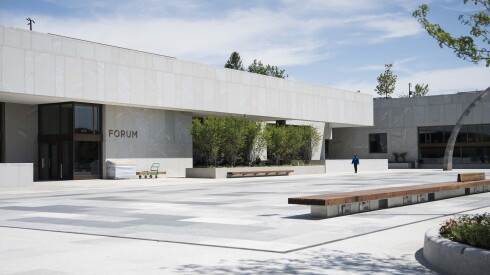
Situated in an outdoor lobby between the museum and the welcoming Forum, the bronze stands directly across from Martin Puryear’s Bending the Arc. The stainless steel arch pays tribute to the late civil rights leader John Lewis and reflects the artist’s belief that the moral arc does not bend naturally to justice without the sweat and effort of everyday people to carry it forward.
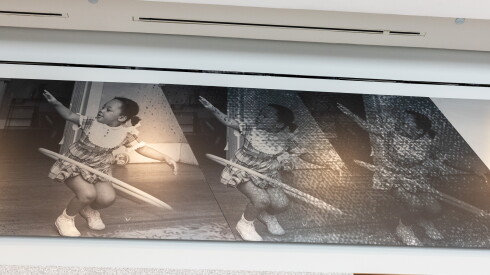
From there, visitors can enter the Forum, the beating heart of the complex and home of the restaurant Tafari’s Kitchen, museum shop and the Hadiya Pendleton Atrium. Look up in the atrium and you’ll see a striking black-and-white photo collage running 175 feet atop the room: “To See What They Could See” is the work of Theaster Gates, a West Side native whose work is now the subject of major exhibitions in New York and Japan. (His first Chicago solo show was just last year.) Gates reprinted photography from the Johnson Publishing Co. archives onto aluminum friezes, creating a historic mural of everyday Black residents — homemakers, students, activists — participating in rallies, marches and peaceful gatherings.
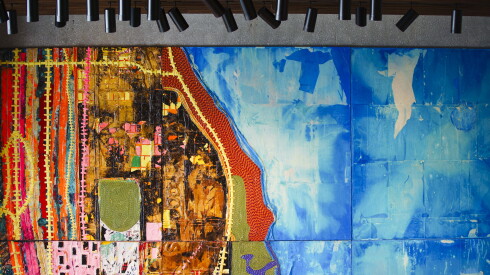
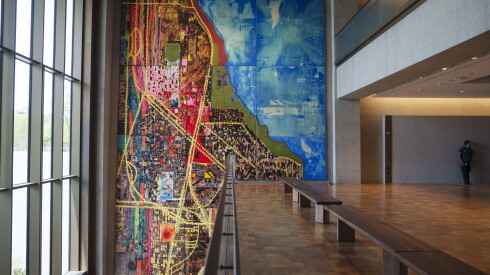
Walk downstairs in the Forum, near the cafe and store, and you’re positioned to see one of the largest scale works in the center. Mark Bradford’s “City of Big Shoulders” stretches three floors with its artist interpretation of the South Side colored in pinks, yellows and reds. The vibrant blue of the lake angles dramatically across the canvas and is easily viewed without a museum ticket.
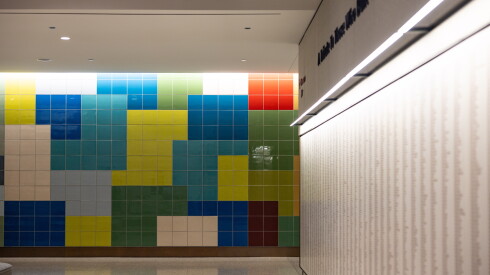
Not to be missed, too, are several works in the lower level of the Forum outside of the auspices of the ticketed museum. Artist Spencer Finch often builds installations using light fixtures, but here he has designed a tile wall featuring colors hand-selected by President Obama based on formative memories of Honolulu, Jakarta, Chicago and Nairobi.
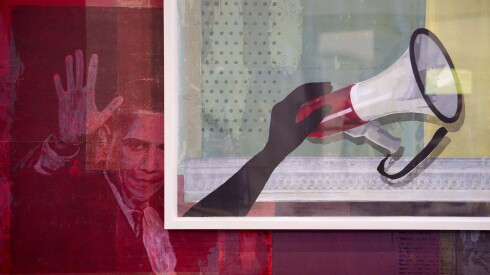
At the end of the hallway, Tyanna J. Buie’s “Be the Change!” provides the backdrop for a quiet seating area. Buie, a printmaking professor at the Rhode Island School of Design, has said she screenprinted and hand-inked her piece to evoke memories of participating in Chicago’s annual Bud Billiken Parade as a young adult.
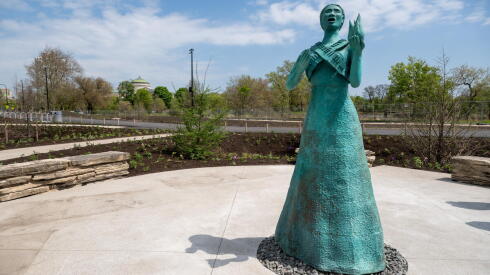
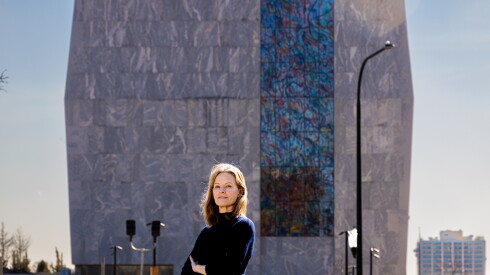

Exit the Forum, head north and take a loop around the Women’s Garden to see Alison Saar’s Torch Song. The garden is one of the final pieces of the campus to be finalized; the cast bronze sculpture manages to evoke both the city’s blues tradition and the Statue of Liberty with her flame. The garden also offers a view of one of the museum building’s central features: “Uprising of the Sun,” a vertical stained glass work from Julie Mehretu that stretches up the northern end of the museum building.
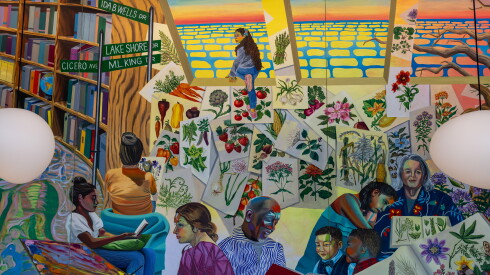
Loop back to a building not to be missed: the Chicago Public Library outpost on the campus. Inside, a large Aliza Nisenbaum mural “Reading Circles/Weaving Dreams/Seeding Futures” shows people reading, gathering and making art, with some notable figures hidden in the panels.

Outside the library’s courtyard sits the final sculpture by a Chicago art luminary who was the first artist commissioned for the Obama complex. Book Bird by Richard Hunt takes off in flight from the pages of a book, showing the late artist’s gift for evoking movement even when fixed in heavy metal. The fact that his mother was one of the city’s first Black female public librarians makes the selection feel especially poignant.
Just when you think you’ve seen everything, walk through the Eleanor Roosevelt Fruit & Vegetable Garden and into the teaching kitchen. There you’re staring face-to-face with a reprise of Rashid Johnson’s “Broken Men,” a mosaic series of broken ceramics that nods to chaos, contemplation and even feels reminiscent of the artist’s teenage years in Chicago as a graffiti artist.

The selection of Johnson is prescient: The Chicago native’s work was recently featured in his first major Guggenheim exhibition. He’ll soon get his flowers in Chicago when that show travels to the Museum of Contemporary Art. On a campus of legends in the making, he rightfully takes his place.