Unless you have some business at the Chase bank at Green Bay Road and Central Street in Evanston, it’s easy to pass through the busy intersection without ever really noticing the one-story building.
But the cool little brick-and-glass bank branch is worth a look — while it’s still there.
JPMorgan Chase & Co wants to demolish the 47-year-old building and erect a new, smaller branch on the site.
Evanston’s Historic Preservation Commission thinks the structure is valuable enough to at least consider landmarking.
The panel took up the issue at its meeting Tuesday but decided to postpone a vote for 60 days at the request of Chase, which objects to the building receiving landmark status.
Evanston resident James McKee, an architecture buff, had submitted a request to the town’s planning officials suggesting they seek landmark status for the bank. His ask helped put the building before the preservation commission.
“I thought it was worthy of nominating for landmark status since Chase is planning to demolish it,” McKee said. “You know, if we don’t landmark it, they’ve got a plan in place … to close it, demolish it, build a new branch. It would be a real shame to lose.”
In a town chock-full of great architecture, would the demolition of a humble bank branch count as a loss? Indeed it would.
The pavilion-like brick-and-glass building was designed by the late David Haid, a very fine architect who lived in Evanston and studied under Mies van der Rohe at the Illinois Institute of Technology. And he worked in Mies’s Chicago office before forming his own architecture firm.
Much of Haid’s work bears a design kinship to Mies: minimalist, glassy, boxy and well-turned.
His best designs include Walter H. Dyett High School for the Arts, composed of two low-slung jet black beauties — an academic building and a natatorium — at 555 E. 51st St. in Washington Park and the architect’s own Evanston residence.
“Haid is now widely regarded as a prominent master of steel-and-glass structural expression in his own right,” Cade Sterling, preservation planner with Evanston’s Office of Historic Preservation, said in a report to the commission. “His body of work actively extended from his Miesian foundation — representing one of the purest, most refined expressions of the Second Chicago School [of architecture] during the critical transitional era of Late Modernism.”
But Haid’s most recognized work is the black steel-and-glass residential auto pavilion in Highland Park, where Cameron Frye’s dad kept that ill-fated red Ferrari in the 1986 movie “Ferris Bueller’s Day Off.” The architect supervised the repair of the pavilion’s glass after the scene.
Haid died in 1993 at age 64.
Built in 1979 as the First National Bank and Trust of Evanston, Haid’s Chase bank is a subtle and clever structure.
At its Central Street main entrance, the blonde brick building seems to part like a curtain to make way for a full-story glass entry. But at the Green Bay Road side, the brick pulls a vanishing act and the bank greets Green Bay with just a pure steel-and-glass wall.
And inside, the original single-room, column-free banking hall is largely intact. The ceiling is a remarkable exposed structural grid with lighted panels.
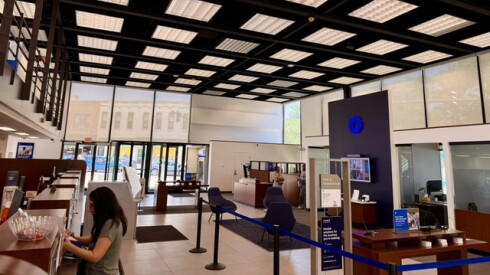
“It’s hard to make a simple building really beautiful, and I think [Haid] succeeds at that,” said architectural historian Susan S. Benjamin who co-authored the book “Modern in the Middle: Chicago Houses 1929-75” with Michelangelo Sabatino.
“This is special,” she said of the bank. “This is really special.”
In a written objection to the preservation commission JPMorgan Chase & Co. Vice President Jonathan Krissoff said the building is “utilitarian” and not worthy of landmark status.
Haid “never pushed the boundaries or advanced the profession in the way that other of Mies’ students, employees or other modernist did, such as truly renowned architects Bertrand Goldberg, Harry Weese, Helmut Jahn, Phillip Johnson, Myron Goldsmith or Bruce Graham to name just a few,” Krissoff wrote.
Krissoff and Chase should rethink their response.
JPMorgan Chase says it needs a smaller branch in the site. Fair enough.
But think of the blinding amount of resources that company holds. It has enough money to consider virtually any solution under the sun that could preserve and restore the building, while creating whatever new space the bank wants.
To simply send in demolition equipment to rip into the building and lay waste to that lovely banking hall is distasteful and an affront to good architecture.
They’ve got some time to reconsider. The commission will revisit the landmark recommendation on Nov. 18.