In the 25 years since the 9/11 terror attacks, there’s been considerable examination of how they could have been prevented.
What if our intelligence agencies had communicated with each other better? What if our foreign policy in the Middle East had been different?
What if warning signs were taken more seriously? What if the U.S. had succeeded in capturing or killing al-Qaeda leader Osama bin Laden in the 1990s?
Not to be overlooked: just how porous the front line security was at U.S. airports — along with weak security oversight by the federal government that allowed the airlines to handle screening with low-cost contractors and few prohibitions on what’s in purses, pockets and carry-ons.
After all, certain knives and blades were legally allowed on commercial aircraft at the time — and al-Qaeda terrorists took full advantage of that loophole by using box cutters to overtake the crew and passengers on flights they hijacked.
But had decision makers taken heed from a once-confidential security report by an Elmhurst consultant in the mid-1990s, as well as many other voices of concern and reform prior to 9/11, some experts wonder whether things could have ended differently.
The report — compiled by the Conley Group at the behest of officials at O’Hare Airport, which was and is overseen by City Hall — slammed aviation security practices before 9/11.
Obtained by the Chicago Sun-Times in 2002 and publicized then in a news story, the report advocated in the years leading up to the attacks for the public sector to assume screening for fliers and luggage, with O’Hare a proposed site to test the concept and expand from there.
At the time, airlines handled their screening duties by hiring private companies known for high employee turnover, lax training and cheap wages to staff the checkpoints. Critics said the aim was less about safety but rather to screen as swiftly and inexpensively as possible to enhance passenger convenience, and profits.
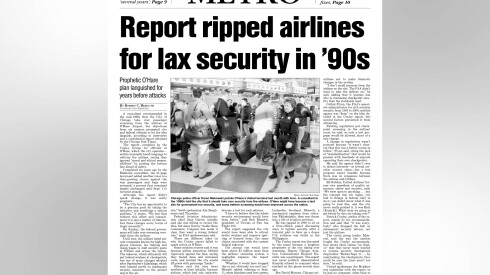
Mistakes, such as letting banned items through checkpoints, were relatively common, records show.
Not that there were many restrictions on carry-on items imposed back then by the Federal Aviation Administration, the public agency that regulates U.S. airports, airlines and airspace.
An airline industry trade group recommended that screeners confiscate pepper spray if detected, but the FAA did not technically bar it from commercial flights, according to published accounts. And some of the 9/11 hijackers apparently used a form of chemical agent during the attacks.
The FAA did ban blades over four inches, but that allowed smaller knives, razors and box cutters to be carried on, as hijackers did on 9/11 — though two aviation trade groups had advised that even smaller blades not be let through checkpoints, according to published accounts.
The Conley report suggested that by giving security duties to the Chicago Department of Aviation, the arm of City Hall that runs O’Hare and Midway airports, they’d be able to attract better workers and improve spotting dangerous items.
And if it worked out there, the concept could be exported to other airports, officials said at the time.
“I have to believe that the whole security environment would have been better” had the report’s conclusions been embraced earlier, Bob Monetti said in 2002. An aviation safety and security advocate, Monetti lost his son in the Pan Am 103 bombing over Lockerbie, Scotland, in 1988.
“Whether it would have stopped” 9/11 “or not, obviously you can’t say,” Monetti said. “But the likelihood would have been people would be better trained, equipped and motivated.”
The FAA was aware of the report but it’s not clear why they didn’t allow such a test program at O’Hare. However, some worried it could lead to a lack of security “standardization” around the country, while others pointed to the influence of the airlines, who presumably would have had to plunk down more money to pay for any changes.
The Conley report said the O’Hare project would’ve likely cost about $3 million more annually.
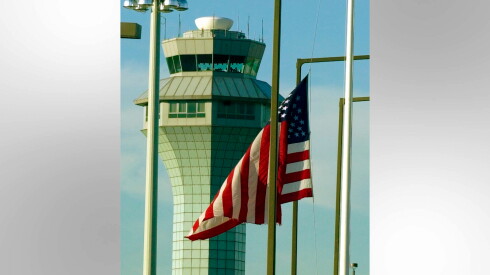
David Mosena, a former Chicago aviation commissioner, told the Sun-Times in 2002: “The FAA’s call was to leave it the way it was and not have different units of government or states or cities or even the feds be security screeners for airports, so it didn’t go anywhere. I think they were under some pressure from the airlines not to make dramatic changes in the system.”
It’s unclear if and how the Conley report focused on expanding prohibited carry-on items, but others in the aviation industry did raise concerns before 9/11 about non-prohibited objects that could be used for weapons.
Numerous studies also flagged flaws with the pre-9/11 security system at U.S. airports, including the U.S. General Accounting Office which noted days after 9/11: “As we reported in June 2000, tests of screeners revealed significant weaknesses as measured in their ability to detect threat objects located on passengers or contained in their carry-on luggage.”
“In 1987, screeners missed 20 percent of the potentially dangerous objects used by FAA in its tests. At that time, FAA characterized this level of performance as unsatisfactory. More recent results have shown that as testing gets more realistic — that is, as tests more closely approximate how a terrorist might attempt to penetrate a checkpoint — screeners’ performance declines significantly.”
The GAO also wrote that “of 102 other countries with international airports, 100 have placed screening responsibility with the airports or the government; only 2 other countries — Canada and Bermuda — place screening responsibility with air carriers” besides the U.S.
Former FAA administrator Jane Garvey recently recalled that there was a pending rule under review around the time the administrations changed, with President George W. Bush taking office in January 2001 as Bill Clinton left, that would’ve had the government assume airport security more directly.
“It’s often something I thought about, it was so close to the finish line,” Garvey said.
But she also wondered whether, had 9/11 not happened, “would the public at the time have accepted some of those rules that we now take for granted?”
“We had such a view of our own security and sense of freedom, I’m not quite sure.”
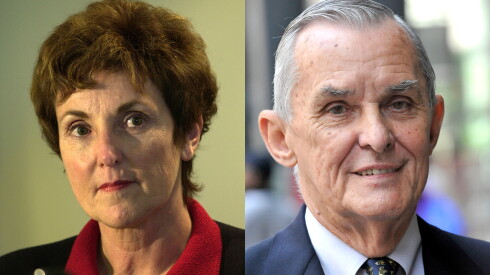
Former U.S. Rep. William Lipinski (D-Ill.) was on the U.S. House’s aviation subcommittee and, with Midway in his district, one of Chicago’s aviation experts and advocates.
Long retired, Lipinski said recently that his panel held a hearing perhaps two years before 9/11 at which “many of the flaws that were unfortunately exploited on 9/11” were “pointed out.”
It was part of a larger effort to try to transfer security “responsibility from the airlines to the federal government,” he said.
While he and others “really saw the dangers” with the security system as it existed, the plans didn’t take flight.
After 9/11, the federal government did take over screening and security duties through the newly created Transportation Security Administration, or TSA, and vastly restricted what was allowed on airplanes, while enacting other measures including fortified cockpit doors and better explosive detection and passenger vetting.
The Conley report was eerily prophetic, stating: “The City has an opportunity to do a genuine good by taking the initiative and rectifying a serious problem. We feel that without this effort and commitment it is just a matter of time before these changes occur, borne of tragic necessity.”