Nearly 20 years ago, then-Mayor Richard M. Daley struck a deal that allowed him to avoid raising property taxes, but has come back to haunt him and Chicago ever since.
On Tuesday, the City Council took a vote that made that lopsided agreement a little less onerous for Chicago taxpayers.
The Council gave final approval to New York investment firm Stonepeak Partners’ $2.53 billion bid to acquire Chicago parking meters after Council leaders brokered a compromise to sweeten the sour deal for the city. The Council approved the deal by a 46-3 vote, with Alds. Byron Sigcho-Lopez, Jason Ervin and William Hall voting against it.
It calls for the city to receive a $75 million transfer fee at closing, 5% of net income going forward and 2% of the sale price if and when the meters are sold again before the deal ends in 2084.
The compromise, brokered without Mayor Brandon Johnson’s input but with a strong assist from retiring Corporation Counsel Mary Richardson-Lowry, also reduces costly compensation the city is required to pay for every space taken out of service.
Seven times a year, the city will be authorized to hold special events that take meters out of service for up to 10 hours without compensating Stonepeak. That’s up from the current threshold of six hours. Those so-called “true-up payments” cost the city nearly $174 million through 2025.
Stonepeak also announced that its subsidiary, Air Transport Services Group, reached an agreement to sell Omni Air International, an airline that has provided long-haul deportation flights for the Department of Homeland Security during President Donald Trump’s deportation campaign. And it has agreed to explore creating entire nonmetered city blocks as “potential electric vehicle charging stations with charging revenues shared with the city.”
Tuesday’s vote ends months of controversy that only exacerbated the tension and distrust between Johnson and the Council.
When private investors from as far away as Abu Dhabi wanted out after recouping their initial $1.15 billion investment twofold with 57 years to go on the deal, Johnson entered the competition without consulting the Council.
The mayor submitted four bids to take back the meters, topping out with a $3.2 billion bid that turned out to be hundreds of millions of dollars higher than the competition.
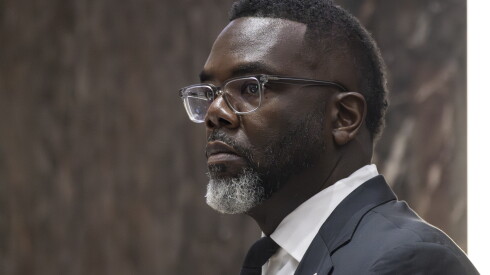
But Johnson abandoned the offer after determining the risk of undoing the parking meter deal was not worth the reward, either financially or politically.
It would have required the city to pledge to siphon other major sources of revenue the city depends on “if parking habits shifted, alternative modes of transportation become more common” or if parking and commuting habits changed.
The City Council was kept in the dark and learned of Johnson’s multiple bids only after the city dropped out. Stonepeak then emerged as the winner with a $2.53 billion bid that was nearly $700 million below Johnson’s last and final offer.
The deal still needed Council approval. That gave Council leaders led by Finance Chair Pat Dowell (3rd) and former Finance Chair Scott Waguespack (32nd), an opening to make the deal a little better.
“We delivered to all of Chicago a better deal than we delivered in 2008,” Dowell said. “Nobody said this was the deal of the century… [But] this deal is 10 times better than the deal in 2008.”

This time, it was Johnson who was kept in the dark. Richardson-Lowry helped, but kept the negotiations in confidence and maintained a firewall between the Council and the mayor’s office. Johnson was briefed only after the deal was done.
The Council’s five-member negotiating team initially pegged the benefits at $376.2 million over the life of he deal. Downtown Ald. Bill Conway (34th), an investment banker, has called that number inflated — after Stonepeak deducts interest expenses and adds the potential for depreciation.
But almost anything would be better than the shortsighted deal Daley struck in 2008.
The $75 million up-front transfer fee will be used to chip away at the city’s $36 billion pile of unfunded pension liabilities.
Waguespack was one of only five alderpersons to vote against the original parking meter deal. He went into the latest negotiation believing the deal was “ironclad” and came out with changes he never thought were possible.
“When you go to buy a car, do you get the price that you want? No. The dealer says one thing. You say another and, at some point, you reach the middle point. And that’s what happened here,” said Waguespack. “Yes, we were given a bad deal in 2008. We tried to break it open and this is what we got: Five percent over the next 58 years.”
Ervin, alderperson of the 28th Ward favored his own eleventh-hour plan to to create a public infrastructure trust to take back the parking meters. He likened Tuesday’s roll call to the lightning-fast vote that sanctioned Daley’s decision to lease Chicago parking meters for 75 years — and forfeit decades of recurring parking meter revenues — tying the city’s hands for decades.
“Every time we tried to close a street,” Chicago Parking Meters LLC said, “ ‘Screw you. Pay me.’ And here we are again getting screwed,” Ervin said. “I still stand on the premise that we should take our streets back.”
In casting one of the three no votes Tuesday, Ervin said that the “irony is that some of the same things” that were said during that 2008 debate are being said now. Then and now, Ervin said, the city’s precarious financial condition was used as a reason to approve the deal.
“We chose to cower down and sell out for $75 million,” Ervin said. “History will judge us poorly.”
Hall, who voted against the deal, said African Americans have been left out of the $17 million in professional services contracts tied to Stonepeak’s acquisition of Chicago parking meters. “This is not the city we all were dreaming of,” Hall said. If the city is 27% Black, African American contractors should be “27% in the deal.”
Chicago Parking Meters LLC, a consortium that includes Morgan Stanley, Allianz Capital Partners and the Sovereign Wealth Fund of Abu Dhabi, had threatened to take legal action against the city if the sale to Stonepeak was not approved.
That was apparently enough to convince City Council members who wanted nothing to do with the parking meter deal to cast a vote they hope won’t come back to haunt the city like it did with Daley, who compounded the problem by spending the $1.15 billion in proceeds while pension funds sunk deeper into a hole.