Nearly a decade has gone by since the former Ebony/Jet Building was sold to a residential developer, and the most original, intact and supremely funky 1970s corporate interiors in the U.S. was lost.
Designed by Black Chicago architect John Moutoussamy and opening in 1972, the 11-story Johnson Publishing Company headquarters still retains its regal, modernist presence at 820 S. Michigan Ave.
However, the tower’s insides — still abuzz and brimming with its original colors, patterns, textiles, materials and furnishings after 40 years — were wrecked and removed in 2017 to make way for 150 apartments.
Historic and one-of-a-kind spaces, gone forever. Another repeat of a Chicago story that’s almost as old as the city itself.
But now, the Ebony/Jet interiors live again, courtesy of a new monograph published this month, “820 Ebony/Jet: Visions of the Johnson Publishing Company, an American Icon,” by photographer Barbara Karant.
The book is a both a goodbye kiss and a loving remembrance to the historic Johnson Publishing offices, photographed between 2012 and 2015 — the years between the company’s sale of the tower to Columbia College Chicago and developer 3L Real Estate’s eventual purchase of the building from the liberal arts school.
The work features Karant’s sharp, evocative images, plus well-written essays from those who either once worked in the building or studied its history. And including top-notch Ebony/Jet archival photos taken shortly after the building was opened and staffed is a very nice touch.
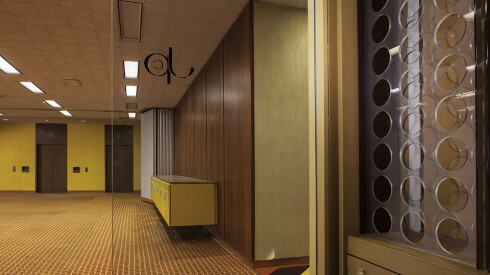
As a result, the reader experiences the building as Karant saw it: voided spaces that somehow still carry the spirit of those who worked there.
“I never felt the space was empty, despite the fact that it was empty,” said Karant, describing the times she photographed the building. “I always felt that there was a lingering feeling of the company and what they did there and their creativity and energy within the space.”
Founded by Black businessman John H. Johnson, Johnson Publishing was near its apex when it opened offices on South Michigan. The new building provided enough room for a growing corporate empire.
Its leading publication, the glossy monthly magazine Ebony, was entering its 26th year, and its weekly news digest, Jet, was a staple on nearly every coffee table and nightstand in Black America.
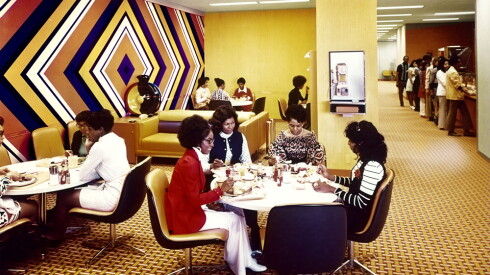
Johnson’s wife, Eunice, founded and directed Ebony’s Fashion Fair couture shows and created a cosmetics line for Black women. The company would venture into television production, radio and even encyclopedia publishing with its four-volume Ebony Pictorial History of Black America.
“We were entering a new age in many ways,” Aaron Bryant, an “820 Ebony/Jet” essayist and co-curator of the Johnson Publishing Company Archives at the National Museum of African American History and Culture in Washington D.C. told me earlier this week.
“So when you look at Johnson Publishing and the building, I think it really represents that. Johnson’s publishing achievement, not just in America, but even globally to a certain degree,” Bryant said. “Then, of course, John Moutoussamy being the first black [partner] for a major [architecture] firm in Chicago.”
Karant’s book tells us that Johnson hired Moutoussamy for the building’s exterior and turned to their friends and Palm Springs, California, neighbors Arthur Elrod and William Raiser for the electrifying interiors.

And those 1972 interiors and virtually all of the original furnishing remained in the building — preserved, remade or restored — for 40 years until Johnson Publishing moved out in 2012.
“After Johnson Publishing Company moved out, I took a tour of the building,” Karant, an adjunct photography professor at Columbia College, said. “I saw the space and by the time I was done touring it, I could barely construct a sentence because I was so completely enthralled.”
I know the feeling. After I saw the interiors in 2013, I wrote the “offices embodied an Afrocentric modernism that was well-turned, avant-garde, and quite hip.”
One space had leopard print carpet, Mozambique wood furnishings. Every floor in the building was different. And it was all unforgettable.

“The spaces, the carpets and the walls,” former Johnson Publishing Company Art Director Raymond Anthony Thomas, who has fond memories of the building’s design, told me this week. “We had ostrich skin and all kinds of crazy stuff.”
“You know, it should have become a museum,” Thomas said. “Or a space where people can come and really know what that legacy was about.”
Karant’s photography shows us peacock feather-patterned wallpaper — and it’s fantastic — along with a wealth of other interior details such as eye-popping carpets and wallpaper, along with swankier-than-swank custom-made furniture and built-ins.
She also documents the Ebony Test Kitchen — an unforgettable tornado of orange, purple and avocado green — that was saved from demolition by Landmarks Illinois and the advocacy of a certain architecture critic who sounded the alarm.

The kitchen is in the possession of the National Museum of African American History and Culture, which is conserving the room and has plans to someday put the space on display.
Meanwhile, Chicago artist Theaster Gates owns some items from the building, including the workout machines from John Johnson’s penthouse office, the publisher’s desk and library, and he has displayed them at his Arts Bank, 6760 S. Stony Island Ave.
The Ebony/Jet Building was landmarked in 2017. The status protects the exterior and rooftop sign from demolition.
But the designation happened after building was gutted, which is a rotten shame. Fortunately, “820 Ebony/Jet” makes sure the interiors are documented and not forgotten.
“Everything about this space represented entrepreneurship, sophistication, creativity,” Karant said. “It was very important to document the space.”