
Fears are rising that a ‘mega-quake’ could strike Japan after the country was rattled by a powerful earthquake yesterday.
The quake had a magnitude of 7.7 and struck in waters off northeastern Japan, with the shaking felt hundreds of miles away in Tokyo.
Tsunami alerts pinged on phones across the coastline amid waves as high as 10 feet in Iwate prefecture, akin to a county, and the island of Hokkaido.
Videos posted on social media showed hanging pots and pans rattling in the kitchen and lampshades and power lines swaying.
More tremors have been reported today.
Sign up for all of the latest stories
Start your day informed with Metro’s News Updates newsletter or get Breaking News alerts the moment it happens.
Weather officials say the chance of a mega-quake in the next week has risen from just 0.1% to 1%.
That may seem small, but it represents a meaningful jump over typical odds – it’s 10 times higher.
What is a mega-quake?
The strength of earthquakes is measured on a scale of magnitude. The higher the number on the scale, the more powerful the quake.
Mega-quakes are far larger and more destructive earthquakes defined as those with a magnitude of more than eight.
The largest was in 1960, when a magnitude 9.5 earthquake flattened a 1,000-mile-long stretch of Chile.
To view this video please enable JavaScript, and consider upgrading to a web
browser that
supports HTML5
video
Richard Walker, a professor of tectonics at the University of Oxford, tells Metro that mega-quakes rumble deep beneath ocean trenches.
‘Although these really large earthquakes are rare, they can be very damaging as they produce strong shaking and because they have the potential to produce tsunami waves that can inundate coastal regions, including places far away from the earthquake itself,’ he adds.
Scientists can’t predict when, or whether, one will strike, but they always review historical data when an earthquake stronger than a seven strikes.
Japanese weather officials say these increased odds are partly based on a string of quakes that struck in March 2011.
Just two days later, a 9.1 magnitude earthquake devastated the northeast coast, triggering a tsunami that killed more than 19,000 people.
‘This is why there is a warning of elevated risk of a very large earthquake occurring following Monday’s magnitude 7.5 offshore Japan,’ explains Walker.
‘Though a “megaquake” occurring in the very near future is unlikely in absolute terms, careful messaging and education on how to prepare and react – including the present advisory notice – are important parts of the mix in terms of how to limit the impacts should one occur.’
Why does Japan have so many earthquakes?

Deep under your feet is something called a tectonic plate, a massive slab of rock that floats on molten rock.
Sometimes, one slips under another, causing a burst of energy called an earthquake. The boundaries where these can happen are called fault lines.
Japan is in the Pacific ‘Ring of Fire’, a horseshoe-shaped chain of shaky faults encircling the Pacific Ocean.
This makes it one of the world’s most earthquake-prone countries, seeing about three a day, according to the University of Tokyo.
While a mega-quake warning system was only introduced in the aftermath of the March 11 tremor, Japan has a sophisticated early alert system.
Seismometers cover the country’s land and oceans, and if the needle of one wobbles to a seismic intensity of three or more, the weather services issues a Seismic Intensity Information report within 90 seconds.
Many Japanese-made phones – even flip-phones – have in-built emergency alert and disaster message board apps.

Much of this comes from decades of government investment following an earthquake in the Mino and Owari provinces at the end of the 19th century.
The 1923 Great Kanto Earthquake, which killed more than 140,000 people, intensified this, with officials making resilient homes and tall sea walls.
How to prepare for an earthquake – and what to do when one happens
The Earthquake Country Alliance, an earthquake coordination organisation, recommends that people secure items in their home, such as bookcases, that could easily topple over.
The same goes for fragile items like TVs or heavy pieces like a hot water heater.
Official guidance in Japan recommends people keep their footwear by their bed and be ready to evacuate at any time, even during the night.
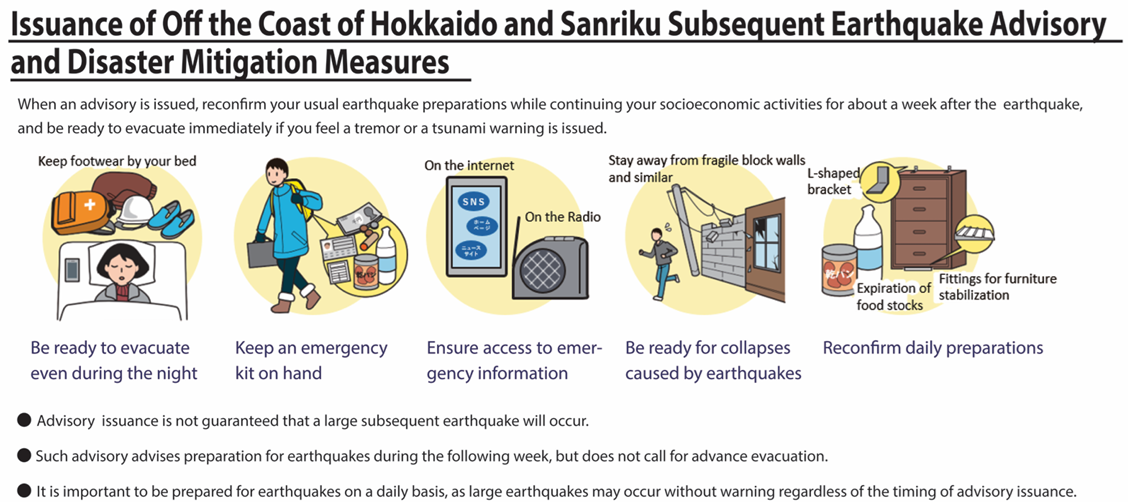
Keep an emergency kit of basic supplies – ID, money, water and medication- and listen to official broadcasts on the radio and internet for updates.
‘Stay away from fragile block walls,’ it adds. ‘Be ready for collapses caused by earthquakes.’
Could a mega-quake happen in the UK?
The UK sits on the Eurasian tectonic plate, far away from the shift fault lines.
In other words, we don’t see quakes all that much. Those that do rattle us are clustered around the Midlands Microcraton.
This is a roughly 590-million-year-old triangle-shaped rock that stretches from the Peak District to Swansea and London.
We generally see a quake every few days or so, according to the British Geological Survey, yet only 30 of the 300 a year are felt by people.
Major ones are very rare, such as when parts of southwest England and Wales were rocked by the strongest earthquake in a decade in 2023.
But this would be a comparatively mild trembler by Japan’s standards, clocking in just 4.2 on the Richter scale.
‘The UK is far, far, away from the nearest deep ocean trench, with prominent global examples being those in the Caribbean, offshore western South America and Alaska, and along the eastern margin of Asia (including Japan),’ adds Walker.
Get in touch with our news team by emailing us at webnews@metro.co.uk.
For more stories like this, check our news page.