Forty percent of Chicago’s operating budget is gobbled up by pension and debt payments — which is why opposition aldepersons want to make it tougher for Mayor Brandon Johnson or his successor to add to that mountain of debt.
But they’ll have to wait a while longer.
Mayoral allies temporarily derailed an ordinance at Wednesday’s City Council meeting that would require future borrowing to be approved by a three-fifths vote. That’s 30 votes instead of the current benchmark of 26.
Retiring Ald. Marty Quinn (13th) is championing the reform, in what amounts to the latest show of force by the City Council majority that rejected Johnson’s corporate head tax.
But Budget Committee Chair Jason Ervin (28th), the mayor’s most powerful political ally, used a parliamentary maneuver to delay the final vote for at least one meeting. If 26 votes is “enough to pass any and every” other piece of legislation, Ervin said it makes no sense to “allow a minority of members to effectively hold everybody hostage.”
“Why now? We need to look at the optics of how this will be perceived — especially in minority communities, as to what’s being done to whom, by whom,” Ervin told his colleagues at last week’s Finance Committee meeting.
Senior mayoral adviser Jason Lee has similarly argued that allowing a minority to block “bond ordinances for critical infrastructure for whatever reason” would only “lead to gridlock and potentially harmful delays on critical investments that the city needs to make to preserve” roads, bridges and other aging infrastructure.
Civic Federation President Joe Ferguson said earlier this month that raising the bar for issuing new city debt “isn’t a political thing. This is math.”
According to the Civic Federation, the city’s outstanding net debt rose by 32.8%, from $22 billion to $29.2 billion, between 2014 and 2023 — an amount driven by increased O’Hare Airport debt that was retired by airline revenue.
Last year, the Council almost blocked an $830 million general obligation bond issue that included a back-loaded repayment schedule that raised the overall price tag to $2 billion. Johnson’s 26-23 victory was secured only after the mayor had to cast the third tie-breaking vote of his tenure.
Johnson’s data centers moratorium bid
Johnson followed through on his promise to propose a one-year moratorium on new or expanded data centers until permanent regulations are established to mitigate their impact on the power grid, the water supply and the environment.
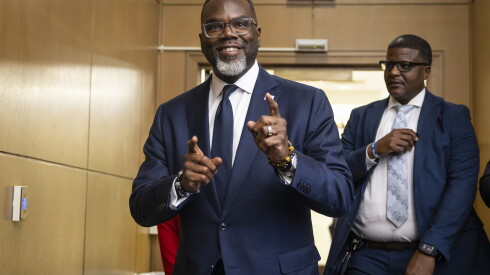
But Zoning Committee Chair Gilbert Villegas (36th) accused the mayor of going too far in riding the wave of public opposition to data centers, which have become a whipping post across the country. The measure was referred to the Rules Committee in an attempt to slow it down.
Villegas said a moratorium should be confined to what he called “hyper-scalers.” That refers to new and expanded data centers with more than 500,000 square feet of space — not the 1,000-square-foot and “20% of total enclosed floor space” cut-off that Johnson proposed.
“The city needs revenue and we have an opportunity to do it responsibly. I’m not saying we put data centers everywhere. But there’s vacant buildings right now. Class C buildings that are not going to get new tenants and they have power. So why don’t we capitalize on that?” Villegas said.
“We don’t need these large farms… taking up acres of land when we can do vertical, urban edge computing, repurpose empty commercial buildings, collect property tax revenue and collect personal property lease tax revenue in an industry where we’re perfectly situated given the fiber and density in our city.”
Villegas said Northwestern Memorial Hospital and Chicago’s most prestigious universities all have data centers.
“Are you going to ban those? You need data centers,” he said. “This is political because it’s popular. And unfortunately, the mayor is in a tight race and he sees this as an opportunity to pick up support.”
The Data Center Coalition, the leading membership association for the data center industry, said the proposed one-year moratorium “sends another signal that Chicago is closed for business — both for data centers and for other significant economic development projects.
“It will cause Chicago to relinquish significant long-term economic investment, jobs and tax revenue to neighboring areas and states,” the coalition’s statement said.
Johnson countered that his only motivation is to “protect the health, safety and quality of life” for Chicago residents. “We welcome innovation, investment and the jobs and opportunities that come with it, but growth must be done responsibly,” the mayor said in a statement about the moratorium.
Foundry Park TIF approved
Council members also authorized a $201 million tax increment financing subsidy that would pave the way for JDL Development to start construction of the first phase of a $3 billion replacement for the failed Lincoln Yards mega-project on the North Side.
The Foundry Park subsidy passed with support from Ald. Brian Hopkins (2nd), who dropped his opposition after city officials pledged that infrastructure improvements promised to area residents as part of the Lincoln Yards project would ultimately be delivered. Hopkins said the $3 billion development will be built over the course of ten years and, “We have time to fix this.”
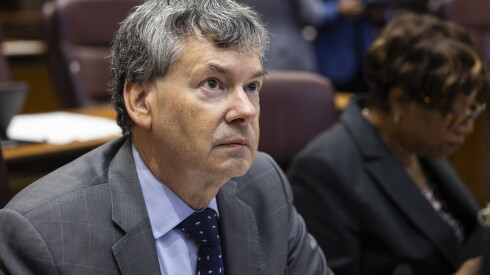
The Council gave final zoning approval to a new 1.2 million square foot hospital on Northwestern Memorial Hospital’s Streeterville campus, a new warehouse campus on the Southwest Side site now occupied by Ford City Mall, a new Amazon “last-mile” warehouse in Gage Park and a new five-story building in Lincoln Park that will allow Francis W. Parker School to expand enrollment by 125 students.
Other Council action
A nearly $14 million settlement was approved to compensate two defendants framed for murders by corrupt Chicago police Det. Reynaldo Guevara, along with a $6 million payout to the family of a man killed in another police chase gone wrong.
Ald. Ray Lopez (15th) voted against the Guevara settlements, citing a deposition that former Cook County State’s Attorney Kim Foxx gave in a lawsuit filed by another one of Guevara’s alleged torture victims. In it, Foxx said she believed that both of the defendants in line for Wednesday’s settlements were guilty even though she granted them certificates of innocence.
Ald. Anthony Beale (9th), the City Council’s most senior member, proposed a reduced starting salary of $120,000 for newly elected alderpersons. Right now, 29 alderpersons get salaries of $155,688 a year, while those who opted out of cost-of-living raises are paid $142,776 a year.
And Bridgeport Ald. Nicole Lee proposed City Council hearings on Amtrak’s plan to build a maintenance facility in her ward, near Rate Field where the White Sox play. Lee has been determined to prevent the Sox from leaving Rate Field for the South Loop under a plan proposed by Sox minority owner Justin Ishbia. That plan also entails the construction of the Amtrak maintenance site in Bridgeport.