Sometimes in theater, timing is everything. I’ve seen that work in a playwright’s favor, such as a play about a Queen (“Coronation” by Refracted Theatre), premiering in the weeks after Trump’s 2024 election.
In other cases, writing plays on slippery and ever-changing contemporary themes can put pressure on the writer to do more to respond to the moment.
That’s what happened the last time Zayd Ayers Dohrn premiered a play. “Revolution(s)” opened at Goodman Theatre in the height of Operation Midway Blitz, and, despite the title, it failed to say anything revolutionary.
Dohrn, who commendably likes to write about current events, has a new play called “The Humanities,” premiering at Victory Gardens, that takes place in the aftermath of a problematic speaker being invited to the fictional Lincoln University.
The problematic speaker, Luka (Daniil Krimer), is underwritten. We know he is a former student of a professor named Martin (Steve Pickering) and has been influenced by the professor’s lectures. Martin gives one such lecture during the play about ideology and how groups have influence over individuals.
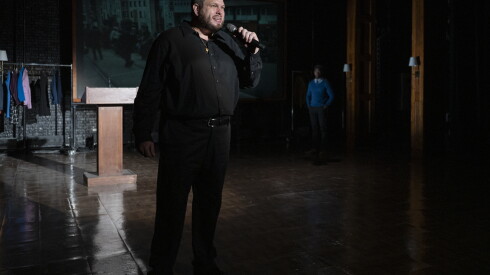
So much of the story builds towards Luka’s on-campus speech, yet the production doesn’t fully flesh out who he is, explicitly state his ideology or clearly explain why he became a provocateur in the first place. All of this seems to be skirted in favor of dissecting the blowback of the invitation itself. Quite frankly, that’s not as interesting.
The majority of the action revolves around how the campus faculty and students react to the invited speaker. The University ends up doing damage control, as the speech lands days before its $2.5B capital campaign. The students meanwhile gear up for a mass protest that leads to violence and arrests.
The production arrives in Chicago just days after the one-year anniversary of the death of college campus provocateur Charlie Kirk, whose “Prove Me Wrong Debates” at universities around the country made him a celebrity and a victim. Kirk was fatally shot while speaking at an outdoor event at Utah Valley University. It also premieres weeks after Milo Yiannopoulos, a former Breitbart News editor also known for speaking on college campuses, was deported.
And yet again, in the looming shadow of real world events, Dohrn’s work misses the mark. The production meanders its way to the big speech where the former student-turned-provocateur Luka argues he’s “not a white supremacist,” but a “western supremacist” who believes in democracy. The actual speech is much too tepid to cause protests even in this fictional world and is a misrepresentation of students who feel they must protest campus speakers in the actual world, especially around such topics as genocide, immigration and human rights.
In the dialogue, we hear accusations that colleges indoctrinate students, that they contribute to culture wars, and that campuses are no longer public squares for the debate of differing ideals. It’s a fair stance to take. But crafting a play around the blowback a university faces for inviting a speaker is much easier, and far less risky, than parsing why students feel the speaker is problematic and examining the complexities of conflicting ideas on stage.
There are productions that thread this needle well. Theater Wit recently staged Itamar Moses’ “The Ally.” In that play, a problematic speaker at a fictional university makes a lengthy argument on behalf of the State of Israel — which takes guts to stage in an American theater in a progressive city in 2026. His argument gets countered by a Palestinian student, born and raised in Gaza in a production that does more to take risks and give space to uncomfortable and polarizing opinions.
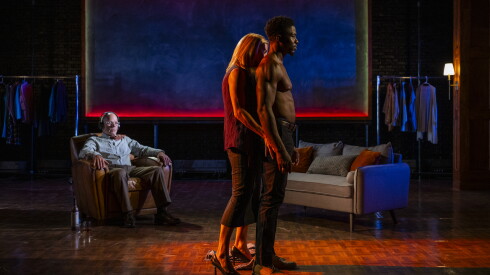
There are, however, bright spots in the production. The acting was stellar, led by Chicago theater vet Steve Pickering. He’s the aging college professor who sparks the action of the play when he invites a former student to speak on campus. Pickering displays an outstanding ability to incorporate character ticks, and subtle nuances in delivering lines with flair or different pitches of voice — things that may go unnoticed individually, but as a whole, build a character that is believable and lived-in. Bringing him back from retirement was a great choice.
Ernest Bently is masterful as Jonas, a young hotshot Ivy Leaguer whom Martin has hired as an assistant professor in his department. Jonas is ambitious, astute, and keenly aware of how the university is positioning him because of his race — going so far as agreeing to moderate the talk with Luka in exchange for a faster track to tenure.
One of the most interesting threads in the play is the love triangle between Jonas, Martin and Martin’s wife, Margot (Naomi Evans), an art professor. In an early scene, Margot propositions Jonas to join the couple for a sexual encounter — rather, Margot and Jonas will participate, with Martin watching. With all the shifting dynamics of race, power, and age (Martin and Margot being much older than Jonas), this throuple is a compelling part of the narrative. Here, director Edward Torres shines. The scenes with these actors, throughout the production, were some of the most riveting in the show.
“The Humanities” has terrific acting, interesting subplots and provides plenty of chuckles. But unfortunately for Dohrn, it’s an issue of production mistiming (to be fair, he wrote this in 2019). Crafting a story around campus culture wars without mentioning any significant topics of debate, while so many in the audience are collectively experiencing these things in our real lives, makes what ends up on stage feel hollow.