The education of Chicago Public Schools’ class of 2026 was shaped by many events that have already made the history books.
The COVID-19 pandemic. The murder of George Floyd. A mass deportation campaign. The rise of artificial intelligence. Their post-high school life could be just as eventful.
WBEZ and the Chicago Sun-Times spoke with three teens who graduated from CPS this month about some of the pivotal moments in their schooling and the lessons they’re taking with them as they leave home for college.
Destiny Singleton, Ogden International School

You wouldn’t know it from listening to her distinguished voice at Chicago School Board meetings or her polished high school graduation speech, but Destiny Singleton says she was quite shy when she began high school.
Then a school project that involved directing a scene from Shakespeare’s “Macbeth” helped her see her own leadership potential.
“That led me to get out of my comfort zone, and talk to people, and kind of be the boss, which I like to be,” Destiny says.
Destiny, this year’s honorary student school board member, graduated from Ogden International School this month and will attend Stanford University in the fall. She’s planning to study psychology and political science.
She’s had her sights set on big goals for a while now. Before her junior year, she wrote down a list of goals, like getting good grades, going to a good college and becoming more vocal. But as she studied her list, she knew there was work to do.
So she started to voice her opinion more and sought out friends who allowed her to comfortably be herself.
“They push me to say things, they push me to question things, they push me to speak up and be me, and be okay with being me,” Destiny says.
As she worked toward her goals, Destiny was drawn to teachers who were raw and real — she says she learned as much from their personalities as she did from their lessons. Mya Dudley, who teaches science at Ogden, was an especially influential role model to Destiny as one of her only Black female teachers throughout her schooling.
“She was just so authentically herself and so authentically Black, and that was so important to me,” Destiny says. It made her feel like: “Okay, I can be that.”
At 18, Destiny is a part of a generation whose formative years were defined by the COVID-19 pandemic and rapidly advancing technology. The 2019 Chicago Teachers Union strike was her first exposure to a protest, and the first half of her senior year took place against the backdrop of mass immigration arrests across the city.
“It kind of stole some innocence in a way,” she says. “That was pretty heartbreaking for me, and I also think it just showed me a lot about what’s happening in the country, and who I want to be, and how I want to make an impact on the city.”
Back in October, Destiny spoke at a school board meeting about how Operation Midway Blitz was traumatizing students and affecting their daily lives.
“We feel the weight of ICE in our city, in our country, and students have been posting minute-by-minute [updates] on ICE agent locations,” Destiny told board members through tears. “We shouldn’t need to protect ourselves in this way, and we are terrified.”

Destiny’s involvement in CPS is something of a family legacy. Her grandmother, Harriet Cobbs, worked in the district for more than 20 years as a teacher’s assistant and later ran a daycare in North Lawndale.
Destiny’s mother, Candice Cobbs, sees glimpses of her own mother, who died when Destiny was 3, in her daughter. Like her grandmother, Destiny has a way with words and a dedication to public service and education, Cobbs says.
Like many parents, Cobbs can’t help but be scared of her daughter being so far away. But she also knows “if I confine her to only Chicago, she won’t be able to reach her heights.”
“I see where the light was always destined for her,” she says.
Destiny says growing up in Chicago and attending CPS taught her to lead with empathy and how to work with all different types of people. In her classmates, she saw kindness and dedication, she says, as well as the need for more access to opportunities and resources.
“I think that CPS students are some of the most talented, bright, compassionate, amazing people in the world,” she says. “We just need to invest in them more, and we need to believe in them more. … They’re going to go far out, and they’re going to change the world, and they’re going to come back and say that Chicago and CPS is the reason why I felt that I could do that.”
—Mary Norkol
Rigoberto De La Torre Fonseca, Solorio Academy

Some kids like to play video games in their free time. Others binge television shows. When he has nothing else to do, Rigoberto De La Torre Fonseca enjoys solving math problems.
Since he was in preschool, his mother encouraged him to keep learning outside of class. Around third grade, his teachers introduced him to Khan Academy, and he used the site’s free online courses to move beyond basic multiplication and division. By 10th grade, he was teaching himself advanced calculus.
But his learning hasn’t been just for fun. His parents weren’t afforded the opportunity to further their education in their Native Mexico. Seeing them toil for long hours at work to give him that chance pushed him to excel.
“It would be a waste on my part to leave all that energy, all that sacrifice, let it go in vain,” Rigoberto says. “I had no choice but to try and do better so that as I got older I could have access to more than they had, and hopefully one day provide more opportunities to my own family.”
That focus helped the recent graduate of Solorio Academy in Gage Park earn a perfect 36 on the ACT exam — the first in the school’s history. This fall he’ll attend the Massachusetts Institute of Technology, where he’s considering a few fields, but is interested in mechanical engineering.
Rigoberto is part of another milestone, too: He is among the 252 seniors who graduated from CPS this year with an associate degree, joining the growing number of students earning a semester or more of college credits while still in high school.
Rigoberto got his degree in engineering science through Daley College, one of the City Colleges of Chicago, which partners with CPS to offer free college classes to high schoolers. It took a lot of commitment. He spent summers taking college classes, and juggled college-level courses at Solorio and Daley during the school year. He could often be found in Solorio’s STEM lab, chipping away at an online lesson.
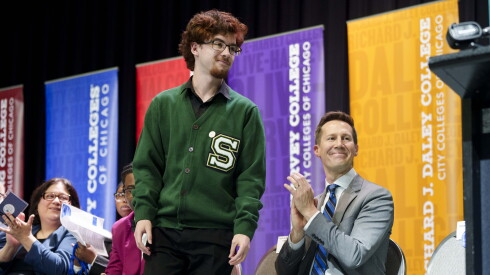
Though Rigoberto says “almost none” of his college credits will transfer to MIT, he says they were still worth pursuing, partly because it taught him not to stretch himself too thin. His junior year schedule was too ambitious, he says, and to keep up with the workload he slept only six hours a night.
“I’m better at managing my own limits and knowing when I can’t take on any more work,” Rigoberto says. Plus that work helped to prepare him. “If I hadn’t gotten the associates and taken the classes, I might not have gotten into MIT,” he says.
But his decision to attend a school hundreds of miles away from home, even one as well-regarded as MIT, didn’t come easy.
Last fall’s ramped-up immigration enforcement, which hit heavily Hispanic neighborhoods like Gage Park especially hard, weighed on his mind. Leaving his family for college at a tense time for the Latino community didn’t feel right.
“It felt like if there was some kind of situation while I was in college, I would need to be there for them, that I’d need to step in whatever way was necessary,” Rigoberto says. “And I just wasn’t going to be able to do that if I was on the other side of the country.”
But after speaking with his parents and weighing those concerns, Rigoberto decided he couldn’t pass up the opportunity to attend MIT.
And though the share of students at MIT who identify as Hispanic has decreased recently in the wake of the Supreme Court ruling that banned the consideration of race in college admissions, Rigoberto isn’t worried about finding community. He noticed many Hispanic student groups when he visited in the spring, and he’s made it a priority to learn about them once he gets to campus.
“I have a community here,” Rigoberto says. “But I think it would be nice to try a fresh start with all the other opportunities that a school as large and resourceful as MIT can offer.”
—Emmanuel Camarillo
Zachary McCarney, Excel Academy of Englewood

Zachary McCarney’s plan for after high school is similar to a lot of other graduates. He’s going to Illinois State University where he’ll major in computer science and play basketball.
But on his high school graduation day, his wide smile exuded the type of unabashed joy that one rarely sees coming from a 19-year-old.
“This day is very special to me because I remember it was a time where I really didn’t know where I would be in life,” he said. “I’m just so proud of myself.”
Zachary was the 2026 valedictorian from Excel Academy of Englewood, one of a few dozen Chicago Public Schools that takes in students who have dropped out or been expelled from traditional high schools. The enrollment at these alternative schools fluctuates, but the official fall count was around 6,000 students.
Some question the quality of education at some of these schools, where a lot of the learning is online and students can get credit for classes in weeks, rather than a whole school year.
But that doesn’t take away from this moment for these young people, many of whom didn’t think they would make it to graduation.
Students come to these alternative schools with all types of circumstances. Some just need a few last credits to get a diploma. At Excel’s ceremony in late May, one graduate was a mother of three.
Another young man, who’d been expelled from his traditional high school, was wearing a sash imprinted with pictures of friends who had been killed. He said he was surprised to be at a church for his graduation, rather than a funeral.
Before Zachary came to Excel, he bounced around a lot. He left his high school in rural Alabama. His mom sent him to live with his dad in a Chicago suburb. When that didn’t work out, he went to his aunt’s on the South Side of the city.
For almost two years, he wasn’t in school and was working at McDonald’s. With all the back and forth, he felt lost.
“It was a dark time for me,” he said. “I just felt hurt.”
But then his grandma, who also lives in Chicago, told him that she didn’t want him working and not going to school. He says he was elated at the idea of going back.
At first, she took him to Kennedy-King College, one of the City Colleges of Chicago, to enroll in a GED program. But the community college staff suggested he go to Excel’s Englewood campus instead.
Housed in an old elementary school, Excel Englewood helped Zachary find a small, safe place where he says the staff cared about the students.
“They gave me that push, they gave me that extra edge, and so it was a big shift for me,” he says.

Zachary credits his grandmother, Wanda Patterson, for insisting he go to school and supporting him. But Patterson turns to her grandson, saying it was all his doing.
“I couldn’t coddle him because I am his grandmother,” she says. “He went through ups and downs and came out of it as a man.”
She is looking forward to him going to college and says she’s already thinking about how she’s going to “scrape up money” so he has some cash to spend.
“I’m gonna be sad to see him go, but I’m happy that he’s leaving the South Side of Chicago,” she said, noting that the city can be a dangerous place for young Black men. “I tell him: ‘Don’t look back, don’t come back here unless you’re visiting.’”
Not many students from Chicago’s Excel Academies go to college. The most recent data shows about a quarter of their 2025 graduates enrolled in a post-secondary school. Historical data shows that few of them — just over a third of the 2024 college enrollees — stay at school for more than a year.
But Zachary said he is not nervous about going to ISU, even though he’s never visited the campus. He has scholarships and financial aid to cover tuition and housing. And if there’s one thing that his high school experience has taught him, it’s that he can persevere.
In his valedictorian speech, Zachary told his fellow graduates that he knows all of them, like him, had setbacks and sometimes wanted to give up.
“What makes this class special is that we kept going,” he said.
To that, the family and friends packed in a church sanctuary for the graduation exploded in applause.
—Sarah Karp