On a recent day, Jonathan Schlesinger took a walk through Washington Park on Chicago’s South Side. He works for the Illinois Department of Natural Resources, and he was scoping out the lagoon for a fishing event. A couple of bridges cross the water to a roughly 9-acre piece of land called Bynum Island. When Schlesinger walked across one, a tall metal fence stopped him. He wondered why the island was gated off and if this “lost world” would ever be open to the public.
Bynum Island has been closed to the public for years, but back in the 1970s, it buzzed with children enjoying a Space Age playground. Several decades before that, the island served as a holding pen for sheep that grazed in Washington Park.
Today, people still sneak onto the island, sometimes to bird-watch, other times for less innocent activities. But for anyone setting foot on this patch of land, there are signs of its robust history and maybe a glimmer of what’s in store for its future.

From pastoral past to padlocked gates
In 1871, renowned landscape architects Frederick Law Olmsted and Calvert Vaux drew up plans for Washington Park. It didn’t include an island — it was a peninsula sticking out into the water. The architects envisioned it as a paddock where deer would live.
In their plan, Olmsted and Vaux explained that the deer would be “confined by an under-water fence, as it is not safe for deer to range where there are children.” This spit of land did not actually end up serving as a deer paddock, said Julia Bachrach, who worked for 29 years as the Chicago Park District’s historian. But the park did have deer and sheep during its early history.
Olmsted and Vaux wanted the park to be pastoral — a restful place where city residents would feel calm as they watched animals grazing, Bachrach explained.
Bigger than downtown’s Grant Park, Washington Park covers more than 300 acres, stretching from 51st Street to 60th Street, from Cottage Grove Avenue to King Drive. But in the original 1871 plan, it was part of an even more expansive green space, extending across what was then Chicago’s southern outskirts. Over time, Olmsted and Vaux’s plan evolved into three parks: Jackson Park, the Midway Plaisance and Washington Park.
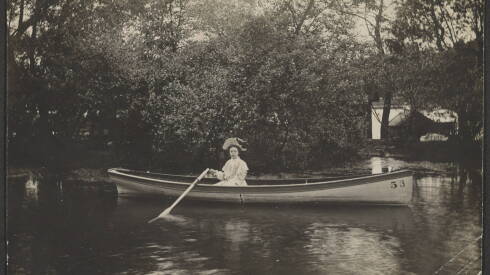
At the turn of the 20th century, boating and ice skating were popular in Washington Park’s lagoon. This body of water — originally known as the mere, an old word meaning a small lake — formed a crescent shape around the peninsula. But that shape wasn’t ideal for an outing in a rowboat.
“People were getting frustrated because they couldn’t make a full loop,” Bachrach said. “And so, in 1904, the South Park Commission decided to excavate that area where the peninsula was connected, so that it would be an island.”
In the following decades, nearby neighborhoods became predominantly African American. The Chicago Park District — formed in 1934 by the merger of smaller park commissions — set out to address the Black community’s needs, according to a history written by Bachrach. Three swimming pools and a field house were added at Washington Park, which became an important recreational hub.
Cecilia Butler, who’s been the president of the Washington Park Advisory Council for more than 30 years, attended the park’s day camp as a girl in the 1950s, which she remembers as “the best summers of my life.”
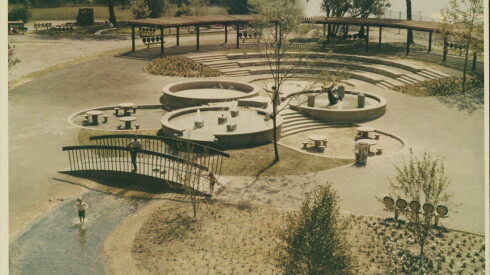
Bynum Island Adventure Playland on June 30, 1970.
Calumet Studio Photographers/Chicago Park District Records: Special Collections, Chicago Public Library, Photographs
Butler said she walked to the island as a girl. But the island didn’t become a major attraction until 1970, when the Marshall F. Bynum Adventure Playland opened. It was named after the first African American who served on the Chicago Park Board. Bynum, who died in 1969, was also an undertaker who led protests against the racial segregation of Chicago cemeteries (a story told in a 2025 Curious City episode).
Supported by federal funding, the $750,000 playground aimed to spark creativity in children. Designed to accommodate up to 2,500 children at a time, it featured a moonscape, a mountain maze, a fishing station and an observation tower. When it opened, it was overseen by a staff of 21 recreation specialists.
“They had these life-size Lincoln Logs. We would use those to build forts and all sorts of things,” said Arnold Randall, executive director of the Gaylord and Dorothy Donnelley Foundation, who played in the Bynum Adventure Playland as a boy in the 1970s. “There was sort of like a spaceship. Lots of climbing things that were really beyond what you would see at other playgrounds. … It’s almost the same excitement you’d get from going to an amusement park.”
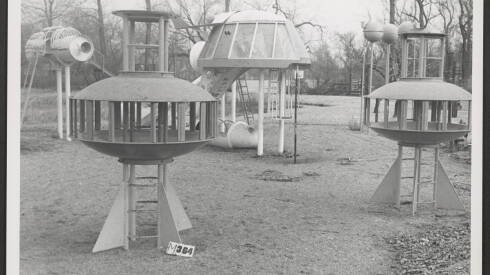
But by the 1980s, the playground had fallen into disrepair. Randall, who at one time worked for the Chicago Park District, says the district did a great job of building the Adventure Playland but didn’t put in the resources needed to maintain it. In 1990, the playground was removed, leaving only an outdoor stone amphitheater.
“It seemed like a big loss for the neighborhood,” said Randall, who has lived in Woodlawn for most of his life. “That wasn’t the only thing that was going into disrepair in my neighborhood. This was just another reflection of that disinvestment in my community.”
A 2002 framework plan laid out the Park District’s goals for Bynum Island, including creating natural habitats and landscaping. A year later, a $1.9 million project made “significant improvements” to the lagoon and surrounding land, along with some “modest improvements” on the island, according to a Park District document.
In that same document — a nomination form that earned Washington Park a place on the National Register of Historic Places in 2004 — Bachrach wrote about changing attitudes toward Bynum Island: “Over the years, awareness of the importance of Olmsted’s vision for the park has increased, and park district administrators now believe that a large playground is not appropriate on the island.”
At that time, the island was still being used for recreation, but on a more limited basis. In the early 2000s, it was occasionally opened up for an adventure fitness program using an obstacle course. And on special nights, families were allowed to camp on the island overnight.
Lost world, opening soon?
Signs warning parkgoers “Do not enter fenced areas” are posted near Bynum Island. But people do visit the abandoned space.

As it happens, this reporter has visited that lost world: More than a year before I was assigned to answer Schlesinger’s Curious City question, I slipped through a gap in Bynum Island’s fence on a spring day, seeking out a worm-eating warbler, a bird species rarely seen in Chicago. On the island, I came across the amphitheater’s stone circle and pieces of the obstacle course, identified by old signs as a squeeze box, a tunnel, an incomplete bridge and something called a “wobbly woozy.”
I’m not the only birder who has ventured into this forbidden zone. Cody Paulsen, the first birder who’d spotted the worm-eating warbler, said the island attracts many migratory species. “What I like the most about birding is that it’s taken me a lot of places, both within the city and elsewhere, that I never would have gone before,” he said. “I think there’s a lot of places in Chicago, especially on the South Side, that are underrepresented or undersurveyed. This is definitely one of them.”

When I visited the park recently, a Chicago Park District security employee warned that I could be arrested if I sneaked past the gates.
The Park District did not directly answer our questions about why the gates have remained closed, but Butler offered this explanation: “It’s in bad condition. Everything has overgrown.” Security is needed to prevent criminal activities on the island, she said, and people have worried about the possibility of homeless people camping there.
Could Bynum Island open up for the public to visit again? It’s been a topic of conversation at the park district for years, and people say they want it.
“I would love to see the island available and open, even if the park district only could do the most minor improvements,” Bachrach said. As she pointed out, many people take walks on another island that’s not too far away, in Jackson Park. “We know how much everyone loves the Wooded Island,” she said, “and it should be the same kind of thing in Washington Park.”

Paulsen said he’d like to see the island open as a natural area. Randall suggested using it for nature-based play. But Butler said she’d enjoy seeing Bynum Island become an active playground again, similar to what it was in the 1970s. And she has other ideas: “To have a roller-skating situation on Bynum Island would be great. I mean, really, when you think of Bynum Island, the sky is almost the limit.”
The Chicago Park District has been working on a new framework plan for improvements in Washington Park. At a December 2024 community meeting, one local resident suggested using Bynum Island as a nature sanctuary, the Hyde Park Herald reported.
The framework plan will be announced “in the very near future,” Irene Tostado, the Park District’s deputy director of communications, said via email. “The plan will include the Bynum Island.”
That doesn’t mean the island will reopen anytime soon. But for folks like Schlesinger, who imagine stepping into this lost world, the day may come when they won’t need to risk hopping a fence.
Robert Loerzel is a freelance journalist, historian and avid nature photographer. His website is robertloerzel.com, and his social media feeds on Bluesky and Instagram frequently feature his photos and videos of Chicago’s wildlife.
More about our question-asker
Jonathan Schlesinger is the Chicago urban fishing program coordinator for the Illinois Department of Natural Resources.
“I’ve done many fishing events at Washington Park through the years, but I’d never explored the lagoon as a whole,” he said. “So I decided to go for a walk and found some really amazing things.” That was when he noticed Bynum Island.
“The forbidding nature of the island only inspires one to what might actually be happening on the island,” he said. “Is Bynum Island home to some dinosaur de-extinction facility? Or maybe it’s the getaway spot for the man who lives inside the Bean.” Our reporting hasn’t uncovered any information to back up either of those speculations.
This is not the first time Curious City has answered a question from Schlesinger, who lives in the north suburbs. He also prompted a 2024 story,“What’s the oldest family-owned business in Chicago?”