Not leaving your home for days or weeks. Always being on the lookout to protect yourself and your loved ones. It can lead to a constant state of fear, stress, even hopelessness.
Over the last year, immigrants in many communities in Chicago and the suburbs have experienced such a rollercoaster of emotions as federal immigration agents have detained people without legal immigration status and others who also were swept up in arrests as part of President Donald Trump’s mass-deportation campaign.
They’re not the only ones to have been left reeling. People trying to help them have felt this, too — community leaders, social workers and people who provide mental health services for immigrants and their families.
“Secondary trauma was so pervasive,” says Mauricio Cifuentes, director of programs for the Family Service and Mental Health Center of Cicero.
Many of these helpers are immigrants themselves, with stories of their own families’ journeys to the United States. These are the stories of three of them. They speak of how Operation Midway Blitz has affected them and what they do to cope.
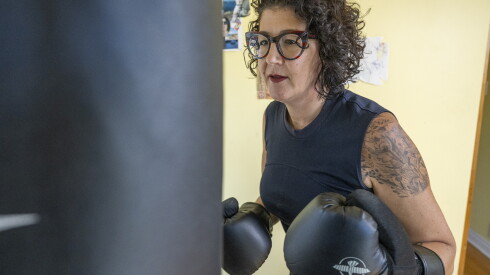
Boxing as a lifeline
At the height of Midway Blitz in the fall of 2025, Cindy Eigler would open her phone and see hundreds of messages on rapid response threads reporting ICE sightings and activity around the north suburbs.
“It was taking up all of my brain space,” says Eigler, who lives in Evanston. “I wasn’t sleeping, and I was really grumpy with my kids and snapping at them at things that I shouldn’t be and then just feeling really helpless.”
She’s kept a whistle by her front door and in her car since she regularly responded to sightings of federal Immigration and Customs Enforcement agents, often at Home Depot stores and other locations migrants might gather. It was part of her volunteer work with a rapid response team trying to stay on top of sightings of immigration agents. She also assisted with the aftermath of immigration enforcement, helping families whose relatives were detained to get aid to pay for rent and food.
“That was really heavy but super-important,” Eigler says.
She felt overwhelmed.
Her entire world — 24 hours a day — was taken over by Operation Midway Blitz. It was her volunteer work and her day job.
Eigler is executive director of the not-for-profit Coalition for Immigrant Mental Health. A key part of her job is preventing mental health crises by creating mostly virtual healing spaces for immigrants, refugees and frontline staff workers of organizations that work with them to help process what they’ve seen and experienced. She says she’s trying to help people understand what trauma is, how it affects their health and how to manage it.
Eigler used to work with survivors of police torture. So she says she’s heard horrible stories before. But Midway Blitz felt different. It hit close to home.
Eigler’s parents came to the United States from Venezuela while her mother was pregnant with her. Her father’s family were refugees who escaped the Holocaust, and her mother’s family traces their roots to Egypt and Palestine.
Growing up, Eigler’s family didn’t talk about pain, rage or sadness.
“The trauma that they’ve experienced and not always having that feeling of belonging or being ostracized or discriminated against, that shows up in how they are and how they move in the world,” she says.
She says her mother has lived in the United States for nearly 50 years and yet “she still gets told all the time to go back to where she comes from.”
Eigler says she used to try to hold in her feelings. But, for the past decade, she has found an outlet to try to release them: boxing.
“What I was taught from a young age was: You just put your head down and you just take it, and you just try to help other people and not say what you need,” she says. “Boxing was the first time where I was, like, ‘Oh, I get to really have a desire or a need or a power. ’”
Eigler knew the constant updates in her rapid response thread set off hypervigilant feelings for her. It took about three months to realize it was too much. She stepped back from the rapid response movement and says, as a result, she soon felt more present as a parent and at the coalition.
Eigler has now started a program to embed mental health support inside community organizations to offer that help at places where people already feel safe, among those they trust.
The coalition develops programming with partner organizations and designs it to respond to a community’s particular needs, from training on secondary traumatic stress to art or yoga. There are healing circles and listening spaces with the goal of providing a place where people can feel free to process what they are carrying and feel heard in community.
A year since Midway Blitz began, Eigler says she is still consumed by and passionate about her work. Immigrants still fear what could happen to them and their families. She says she thinks a lot about how to make sure their mental health is a priority. She says trauma can unfold for generations.
“You have good days, and you have days that feel harder and when you feel more pessimistic and more cynical about what is happening,” Eigler says. “It helps me a lot to be at an organization where I can be in motion with other people and be trying to support in the ways that we can and be in action.”
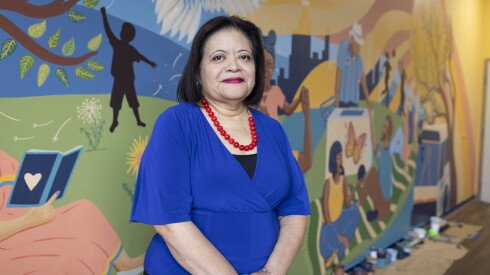
Hoping to ‘regain our bearings’
Angela Sedeño was on her way to the bank last October when she learned tear gas had been deployed outside Rico Fresh Market in Logan Square in front of the LoSAH Center of Hope, the bilingual mental health clinic where she is executive director.
She saw people running for shelter. She rushed to check on her neighbors. She still can’t shake the memory of seeing two of her youngest staff members come inside with watering, bloodshot eyes from the gas and how she felt she couldn’t protect them.
“It was just things that we didn’t prepare for, that we couldn’t have seen coming,” Sedeño says. “We have all of these emergency and crisis plans for all sorts of other things, like mental health crises, but certainly not those types of tactics being used in the street.”
The LoSAH center is a community-funded clinic that serves Logan Square, Avondale and Hermosa with affordable mental health services in English and Spanish, including therapy, support groups and collective healing practices like sound baths and drum circles.
Sedeño’s role encompasses everything from forming community partnerships and overseeing clinical services to providing community interventions and trying to stay on top of the community’s mental health needs.
The responsibility of serving the center’s clients and also her staff can be a lot even in ordinary times. But the uncertainty and violence of Midway Blitz took a steep toll on her employees, half of them bicultural and bilingual themselves, as they sat in with clients experiencing panic, fear and despair while navigating their own feelings of rage and helplessness.
Sedeño says she tries to make sure that her staff members take breaks and aren’t overburdened. She says she uses a practice called reflective supervision to create spaces for people to share and process their feelings with the help of trained supervisors.
“Everything we would do for a client, we’re also doing for our staff,” says Sedeño, a first-generation Mexican American.
“Growing up brown in the United States meant that, at different points of my life as a child, there was discrimination for skin color, for language,” Sedeño says. “And so, seeing all of this happening so blatantly, it’s heartbreaking. It’s heartbreaking to hear the stories and to see the faces that look like you being targeted.”
To care for herself, she leans on a therapist, her family, her faith and the LoSAH center’s many community partners.
With the new school year starting and the uncertainty that can bring, Sedeño and her staff are bracing to support families as their fears, anxieties and traumas resurface.
“I would hope that at some point we regain our bearings and people have an opportunity to rest and recover because that hasn’t happened yet,” Sedeño says.
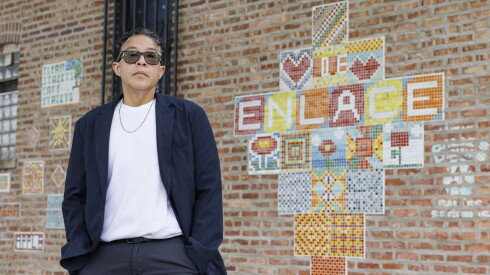
Bringing calm, hope back
Little Village, the predominantly Mexican American Southwest Side neighborhood, was at the center of immigration enforcement operations last fall. Whirring helicopters and whistles warning that immigration agents were near became the norm.
Vero Ortiz, senior director of community wellness for the not-for-profit organization Enlace Chicago in Little Village, remembers it this way: “There were days that you wouldn’t see anybody on the streets. There was just so much fear. And now we’re living in the underbelly of that fear.”
While fewer agents roam the streets and enforcement has become more targeted, Ortiz says the psychological impact persists.
Ortiz lives in the suburbs and has worked for Enlace for two years but identifies as someone “adopted by Little Village.” As a first-generation Mexican American, Ortiz speaks to having a strong cultural connection to the neighborhood, which is why having to fight a system Ortiz says is trying to erase the vibrant community has prompted grief, anger and stress.
“I cried this morning,” Ortiz says. “I saw a post of a little girl standing between an ICE agent and her mom, right? It’s still happening.”
Ortiz’s powerful emotions, however, have not hindered their work. Rather, they fuel it, with a drive to offer more preventative options to help residents be empowered and ready for the next crisis.
Ortiz has been working to meet the surge in need for mental health services. They secured city funding this year for an additional community-based therapist and a school-based therapist as well as for a new family support specialist who could help, for instance, people who might still be afraid to leave their homes.
“We can sometimes work at 100 miles an hour even though, as leaders, we’re not asking our staff to do it,” says Ortiz, who has worked in child welfare and gang intervention. “I think they do it because they love what they do. So it’s also my responsibility to be, like, ‘Hey, I’m going to need you to not burn yourself out’ because I need my staff to be well in order for us to serve the community.”
Contributing: Feixu Chen
Mary Ellen Ritter and Navya Shukla produced this story as part of the Medill Investigative Lab-Chicago at Northwestern University.
This story was produced as part of the Mental Health Parity Collaborative, a group of newsrooms and universities covering mental health care access and inequities in the United States.